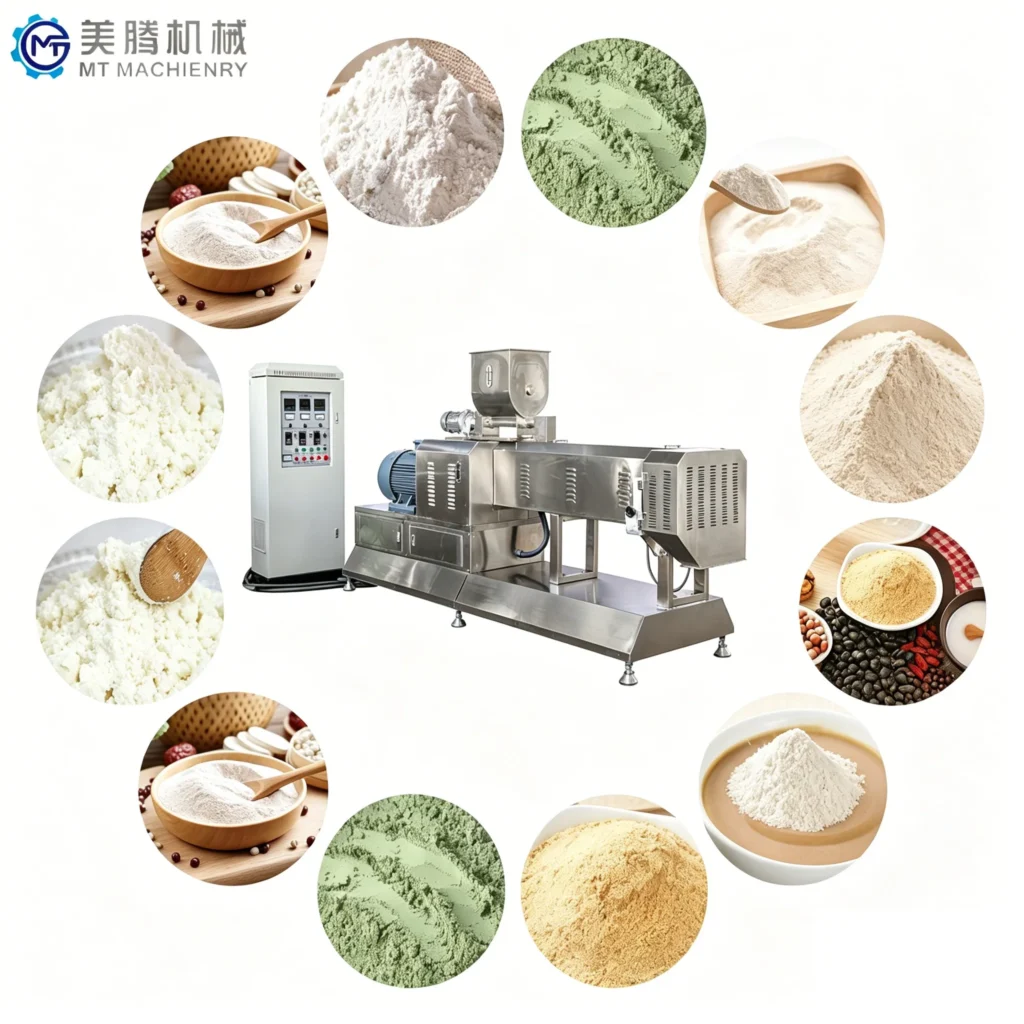
Screw Configuration Matched to Formulation — screw elements and die geometry are specified to your raw material blend before production begins, not copied from a generic build.
Technical Specifications
| Parameter | Value |
|---|---|
| Product Type | Nutritional Powder and Baby Rice Flour Processing Line |
| Model | MT65 / MT70 / MT75 / MT85 |
| Screw Type | Twin Screw |
| Installed Power | 84 kW (MT65) / 160 kW (MT70) / 190 kW (MT75) / 210 kW (MT85) |
| Power Consumption | 59 kW (MT65) / 120 kW (MT70) / 140 kW (MT75) / 150 kW (MT85) |
| Output Capacity | 120–150 kg/h (MT65) / 150–200 kg/h (MT70) / 200–250 kg/h (MT75) / 300–400 kg/h (MT85) (basis not stated in source — confirm raw material formulation and moisture content) |
| Voltage & Frequency | 380V 50Hz, Three Phase Standard |
| Overall Dimensions (L×W×H) | 20000×1500×2200 mm (MT65) / 21000×1500×2200 mm (MT70) / 23000×1500×3200 mm (MT75) / 25000×1500×3500 mm (MT85) |
| Control System | PLC (verify against manufacturer catalog) |
| Contact Material | Stainless Steel 304 |
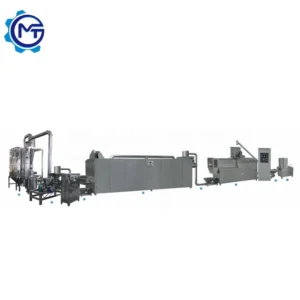
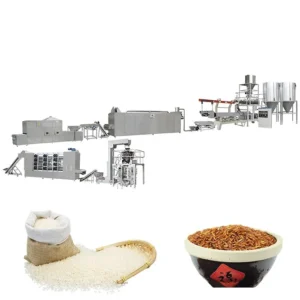
| Line Stations | Mixing → Screw Conveying → Extruding → Air Conveying → Drying → Air Conveyor → Pulse Grinder |
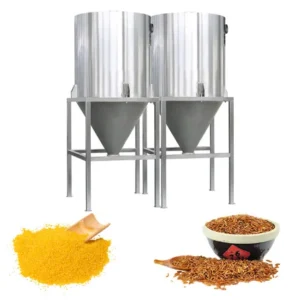
| Mixer Capacity | 20–30 kg/time / 70–80 kg/time / 170–180 kg/time |
| Mixer Power | 4 kW / 7.5 kW / 15 kW |
| Pulse Crusher Capacity | ~200 kg/h (verify against manufacturer catalog) |
| Pulse Crusher Power | 11 kW |
| Pulse Crusher Weight | 1500 kg |
| Pulse Crusher Dimensions | 3000×900×2200 mm |
| Drying Oven Fuel Options | Fuel / Gas / Electricity |
| Drying Oven Drive | Double Pitch Roller Chain Drive |
| Warranty | One year free warranty |
| Standards | CE, ISO |
Application Suitability
| Application | Material or Output |
|---|---|
| Baby rice flour production | Milled rice and grain blends for infant nutritional powder |
| Fortified and artificial rice processing | Grain flour with added vitamins, trace minerals, and protein isolates |
| Modified starch processing | Corn, cassava, or potato starch requiring twin-screw gelatinisation |
| Functional food powder | Multi-grain blends with fibre, amino acids, or therapeutic additives |
| Infant formula base material | Pre-gelatinised grain substrates for downstream blending |
Why "Rated Capacity" Means Nothing Without Your Formulation
Every output figure on a nutritional powder processing line full equipment range sheet changes the moment your raw material blend changes.
I learned this the hard way early in my career sourcing equipment for nutrition plants across Southeast Asia. One facility ran a rice extrusion line perfectly on standard milled rice during the factory test. When the buyer switched to their own brown rice formula with added trace minerals, gelatinisation rates dropped, expansion went out of spec, and an entire batch was scrapped before anyone identified the root cause. The extruder was not at fault — the screw configuration had simply never been matched to the actual formulation [NEED_CITE: raw material variability in twin-screw extrusion performance].
This is why capacity numbers without raw material context are meaningless. A nutritional powder processing line full equipment range that claims a fixed throughput assumes a specific moisture content, particle size, and starch-to-protein ratio that almost certainly does not match yours.
Every Station Sized as One System
The nutritional powder processing line full equipment range is configured so that mixer batch output, extruder throughput, dryer residence time, and pulse grinder capacity are balanced from the start. When an extruder pushes product faster than the downstream dryer can handle, moisture remains trapped in the pellet core. The grinder then produces inconsistent particle size because the material is still internally soft. Sizing every station together prevents this cascade of mismatched throughput.
Dryer Configuration Determines Final Powder Quality
The drying oven offers selectable fuel sources including fuel, gas, or electricity, with adjustable temperature profiles and retention time. For baby rice flour, the drying curve must be gentle enough to prevent case hardening — where the pellet surface seals while internal moisture remains locked inside. This trapped moisture later causes clumping in the finished powder and inconsistent rehydration behaviour, which is unacceptable for infant nutrition applications [NEED_CITE: moisture migration in extruded cereal products].
What the Specs Actually Mean for Your Output
The twin-screw design across all four models provides the shear control necessary for complete starch gelatinisation at the relatively high moisture levels typical of nutritional powder formulations. Single-screw extruders struggle with sticky, high-moisture doughs because material adheres to the barrel wall and causes surging. The twin configuration creates a self-wiping action that keeps the barrel interior clean and maintains consistent residence time.
Stainless steel 304 contact materials throughout the food zones meet the hygiene standards required for infant and functional food production. Any corrosion or pitting in food-contact surfaces creates bacterial harbours that no amount of CIP cleaning can fully resolve.
The PLC control system, once verified against the manufacturer catalog, provides the repeatability needed for nutritional powder batches. When vitamin and mineral premixes are involved, even small temperature deviations across production runs alter the degradation rate of heat-sensitive micronutrients [NEED_CITE: thermal degradation of vitamins during extrusion].
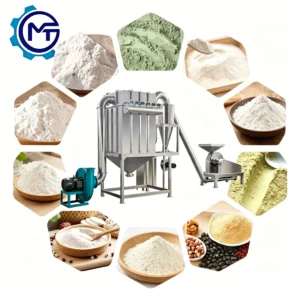
The pulse grinder at the end of the line reduces dried extrudate to fine powder. Its 11 kW motor and dedicated 3000×900×2200 mm footprint indicate a unit designed for continuous operation rather than intermittent batch grinding, which matters when the upstream extruder runs continuously.
The Cost of Ignoring Station Balance
Buyers who source the extruder from one vendor and the dryer from another often discover too late that the dryer cannot keep pace. The extruder keeps running, product piles up on the cooling conveyor, and moisture content at the grinder inlet fluctuates wildly. The resulting powder varies in particle density and rehydration speed between batches — a problem that shows up only after the product reaches the consumer [NEED_CITE: consequences of unbalanced extrusion line throughput].
Why Procurement Happens Here
Complete line stations from mixing through extrusion to drying and grinding come from one supplier, so throughput is matched at every transfer point rather than guessed at across separate purchase orders.
Screw configuration and die design are specified to your raw material formulation before the machine enters production, reducing the risk of gelatinisation or expansion failures during commissioning.
An in-house testing workshop allows trial runs on your actual raw material blend before shipment, so formulation problems surface in Jinan rather than on your factory floor.
Twin-screw expertise covers the specific demands of nutritional powder — high moisture, multi-ingredient blends, and heat-sensitive additives — rather than borrowed from snack or pet food applications.
Documentation & Verification
- Line layout drawing showing station spacing and throughput balance for your selected model
- Screw and die configuration record matched to your grain blend and target gelatinisation degree
- Trial run report generated on your raw material in the testing workshop before dispatch
- Electrical schematic confirming voltage, frequency, and control language for your market
- Factory test record documenting continuous run performance at agreed parameters
- Operation and maintenance manual with wear parts list for screw elements and dies
Installation, Commissioning & Support
- Overall line length up to 25,000 mm requires straight-run floor space with level concrete substrate
- Three-phase 380V 50Hz supply with dedicated circuit breaker sized to installed power up to 210 kW
- Stations ship in modular sections for on-site assembly and belt alignment verification
- First-run commissioning includes screw speed, barrel temperature, and dryer profile tuning on your formulation
- Operator training covers PLC interface navigation, screw element replacement, and daily cleaning procedures
- Wear parts stock includes twin-screw elements, die plates, and dryer chain links for the first replacement cycle
What We Need Before Quoting
Before preparing a line configuration, share your raw material formulation including grain type, moisture content, and any vitamin or mineral premix ratios. Confirm your target daily output and available workshop floor dimensions, including ceiling height for the taller MT75 and MT85 models. Specify your local voltage and frequency standards along with the preferred control interface language.
Frequently Asked Questions
Q: How is output capacity verified and what raw material assumptions apply?
A: Output figures are referenced to specific formulations. Since nutritional powder blends vary widely in starch content, moisture, and particle size, the rated capacity on the specification sheet must be confirmed against your actual raw material through a trial run in the testing workshop before any production commitment is made.
Q: How is the dryer and grinder sized to match the extruder throughput?
A: Each station is calculated together during line configuration. The dryer retention time and temperature profile are set so that pellet moisture at the grinder inlet falls within the range needed for consistent particle size reduction, preventing soft-core material from causing uneven powder output.
Q: What screw and die configuration is specified for nutritional powder versus artificial rice?
A: Nutritional powder requires higher shear and complete gelatinisation because the extrudate will be ground into fine flour. Artificial rice needs controlled expansion and a specific die shape to hold grain-like form. Screw element arrangement and die geometry are specified separately for each application.
Q: Is a trial run on my raw material available before shipment?
A: Yes. The in-house testing workshop runs your actual formulation through the configured line before dispatch. This identifies any gelatinisation, expansion, or drying issues early, so adjustments to screw configuration or temperature profiles are completed before the equipment reaches your facility.