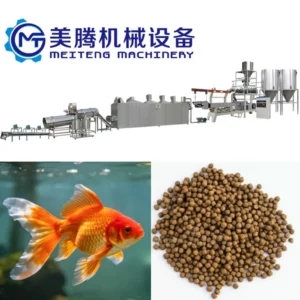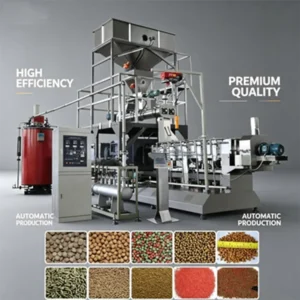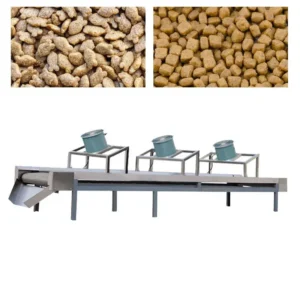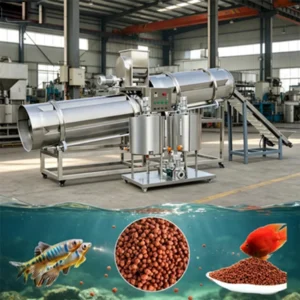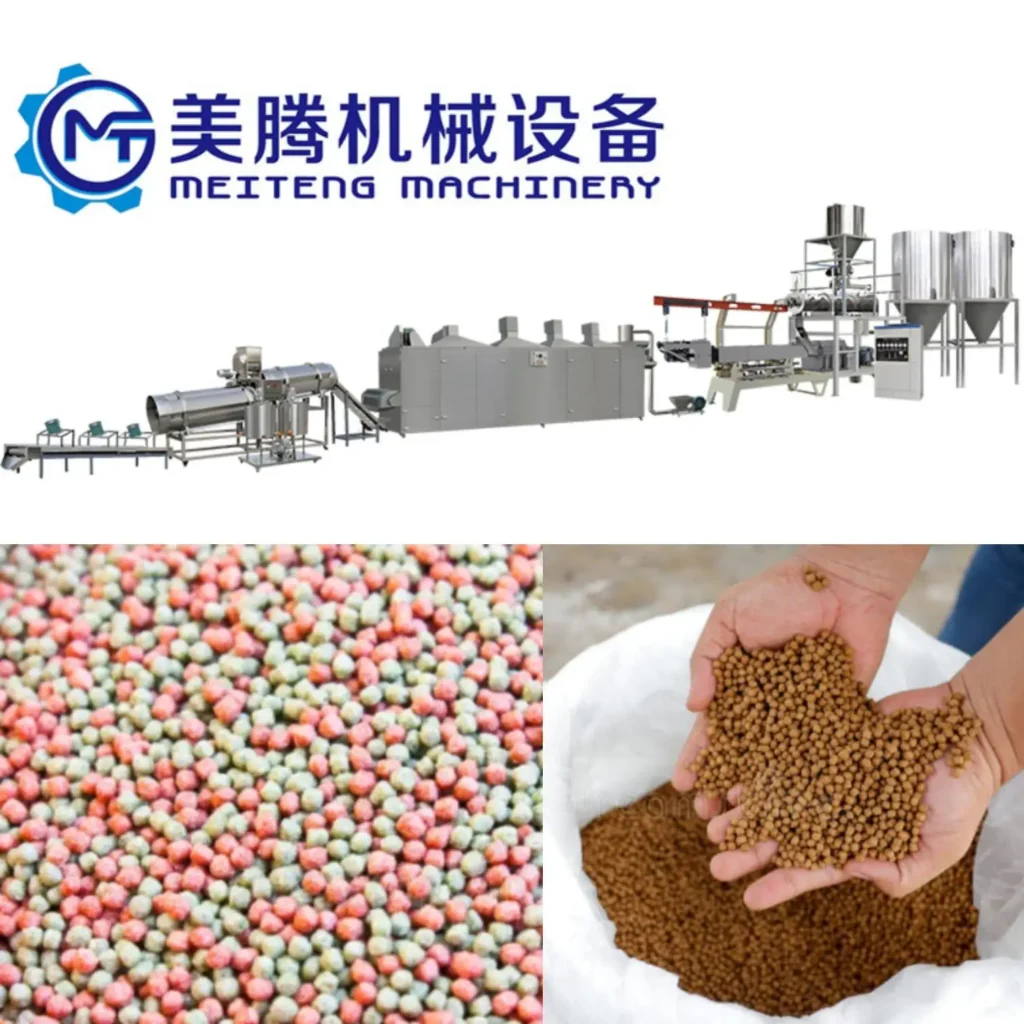
Throughput Matched Across Stations — Every batching, extrusion, drying, and packing unit is sized against the same formulation target so the line holds its rate from infeed to bagging.
Technical Specifications
| Parameter | Value |
|---|---|
| Product Type | Fish Feed Production Line |
| Output Capacity | Up to 3 t/h (basis not stated in source — confirm raw material formulation, moisture content, pellet diameter and density target) |
| Extruder Type | Twin-screw extruder |
| Construction Material | 304 stainless steel on all food-contact parts |
| Control System | Available with PLC and MCC control (per manufacturer standard — verify against quotation) |
| Screw Configuration | Matched to buyer’s raw material and target pellet specification (L:D ratio and die design to be confirmed) |
| Line Stations | Batching, mixing, extrusion, drying, coating, cooling, packing (verify station list against actual quotation) |
| Target Pellet Buoyancy | Floating and sinking capability (confirm buoyancy specification per formulation) |
| Certification | CE (manufacturer standard since 2014), ISO certified |
Application Suitability
| Application | Material or Output |
|---|---|
| Trout and salmon aquaculture feed | High-protein marine and plant-based meal blends, oil-coated floating or slow-sinking pellets |
| Catfish grow-out feed | Grain and protein concentrate formulations, floating pellet formats across multiple diameters |
| Multi-species hatchery and nursery diets | Fine-grind ingredient blends requiring tight particle sizing and high gelatinisation |
| Specialty aquafeed with functional additives | Vitamin, mineral, and probiotic inclusion with post-extrusion vacuum coating |
What "Up to 3 t/h" Actually Means on Your Formulation
Capacity is a function of your recipe, not the motor plate.
I have watched aquafeed producers sign off on a fish feed production line full equipment range based on a headline number, then discover at commissioning that their high-fat trout diet runs at a fraction of the quoted rate because the screw profile was built for a starch-heavy test formula. The extruder may push material through, but if the downstream dryer bed cannot handle the moisture load at that throughput, pellets exit tacky and degrade in storage. Coating drums sized for a lower volume leave oil distribution uneven, and the packing station backs up while the extruder keeps producing. [NEED_CITE: moisture removal rates in belt dryers versus pellet moisture load]
The only way to validate a capacity claim is to run your actual raw material blend through the complete station sequence and measure output at each stage under your target pellet diameter and density.
How Screw Profile Dictates Pellet Density
The twin-screw extruder at the heart of this fish feed production line full equipment range is configured around the buyer’s specific formulation rather than a generic build. Screw element spacing, kneading block angle, and die orifice geometry together determine the shear energy and residence time the material receives inside the barrel. For a floating trout pellet, the profile must generate enough starch gelatinisation and steam expansion at the die face to trap air cells; for a sinking catfish pellet, compression is increased and expansion restricted so the pellet sinks predictably. Switching between species on the same line means changing screw elements and dies — a process that takes measurable downtime if the configuration is not planned in advance.
Matching Dryer Area and Coating Volume to Extruder Output
A fish feed production line full equipment range only holds its rated pace when every downstream station is calculated against the extruder’s real throughput on the buyer’s recipe. The dryer must remove enough moisture within the available belt length and air temperature profile so that pellets reach safe storage moisture before packing. If the extruder delivers material faster than the dryer can process it, operators are forced to slow the entire line. Similarly, the coating drum must hold enough volume for the oil or fat application cycle to complete uniformly before discharge. [NEED_CITE: post-extrusion drying requirements for aquafeed pellet stability]
What the Stainless Steel Contact Surfaces Mean in Practice
All food-contact components along this fish feed production line full equipment range are built from 304 stainless steel. In an aquafeed environment where raw materials include fish meal, marine oils, and high-moisture slurries, corrosion resistance directly affects sanitation intervals and component lifespan. Screw barrels, die plates, dryer trays, and coating drum interiors all face continuous exposure to salts and lipids that degrade carbon steel rapidly. The PLC and MCC control architecture allows recipe parameters — barrel zone temperatures, screw speed, feeder rate — to be stored and recalled, reducing batch-to-batch variation when switching between trout, salmon, and catfish formulations.
The Cost of Skipping a Pre-Shipment Trial Run
Producers who accept delivery without witnessing their own formulation run through the line often spend weeks after installation adjusting screw combinations, die sizes, and dryer settings to achieve target pellet density. That delay compounds: the hatchery waiting for feed, the harvest cycle shifting, and the buyer’s own customers losing confidence. I have seen operations where floating feed sank in the pond because the die geometry was copied from a generic build that never ran the buyer’s high-oil recipe. Every day of post-installation troubleshooting is a day of lost production revenue. [NEED_CITE: aquaculture feed buoyancy requirements by species and growth stage]
Why Single-Source Line Supply Reduces Commissioning Risk
Each station in this line — from batching through packing — is supplied by one manufacturer, which means throughput calculations, utility connections, and control integration are resolved before the equipment leaves the factory. When a producer assembles a line from separate vendors, the extruder supplier blames the dryer vendor for bottlenecking, and the dryer vendor blames the extruder for delivering material outside its design moisture range. Here, one engineering team is accountable for the entire sequence. The screw and die configuration is specified to the buyer’s formulation, not a generic template. An in-house testing workshop allows trial runs on the buyer’s actual raw material before shipment, with a written report documenting throughput, pellet density, and moisture at each station. CE conformity and ISO certification are maintained across the complete line, simplifying import documentation and local regulatory approval.
Documentation & Verification
- Line layout and capacity calculation showing throughput at each station from batching to packing
- Screw and die configuration record matched to your raw material blend and pellet specification
- Trial run report from in-house testing workshop using your formulation before dispatch
- Electrical schematic with voltage, frequency, and control language confirmed to your site conditions
- CE declaration of conformity and ISO certificate covering the full line scope
- Operation and maintenance manual with wear parts list specific to your screw and die arrangement
Installation, Commissioning & Support
- Foundation planning based on the twin-screw extruder weight and dryer footprint for level installation
- Dedicated power circuits sized for the PLC-controlled extruder motor and dryer heating zones
- Station-by-station alignment verification from batching through packing during on-site assembly
- First-run parameter setting on your formulation with screw speed, barrel temperatures, and dryer belt rate documented
- Operator training covering die changeover procedure between floating and sinking pellet formats
- Wear parts supply schedule for screws, dies, and dryer belts with recommended replacement intervals
Before You Request a Quote
Send your raw material formulation including protein sources, starch percentage, fat level, and any functional additives. Specify the target species, pellet diameter range, and whether you need floating, sinking, or both. Provide your facility voltage, frequency, and preferred control language so electrical design starts correctly. If you have existing upstream milling or downstream bagging equipment, share those details so interface points are resolved early.
Frequently Asked Questions
Q: How is the output capacity verified against my specific formulation?
A: The manufacturer runs your actual raw material blend through the in-house testing workshop, measuring throughput at each station — extruder, dryer, coater — and issues a trial run report documenting real output, pellet density, and moisture content rather than relying on a generic capacity figure.
Q: How are the dryer and coating drum sized to avoid bottlenecks?
A: Dryer bed area and coating drum volume are calculated against the extruder’s actual output on your formulation, accounting for the moisture that must be removed and the oil application cycle time required, so no single station forces the entire line to slow down.
Q: What determines whether the line produces floating or sinking pellets?
A: Screw element arrangement, kneading block angles, and die orifice geometry are configured to control expansion at the die face. Floating pellets require higher starch gelatinisation and trapped air cells, while sinking pellets need greater compression and restricted expansion.
Q: Is every station supplied by the same manufacturer?
A: Yes. Batching, mixing, extrusion, drying, coating, cooling, and packing are all sourced from one supplier, meaning throughput matching, control integration, and single-source accountability are built in rather than negotiated across multiple vendors.
Q: Can I see my formulation run before the line ships?
A: The manufacturer conducts a trial run using your raw material in their testing workshop and provides a written report covering output rate, pellet density, buoyancy, and moisture at each station, allowing you to approve the configuration before production begins.