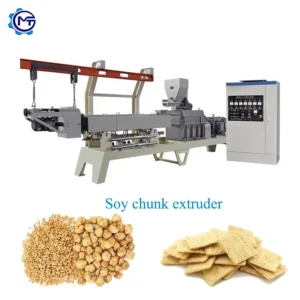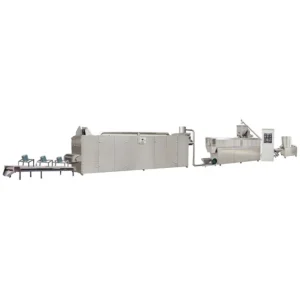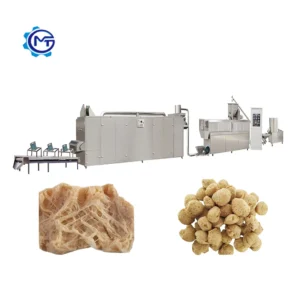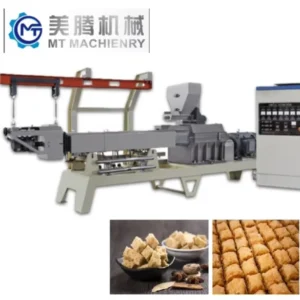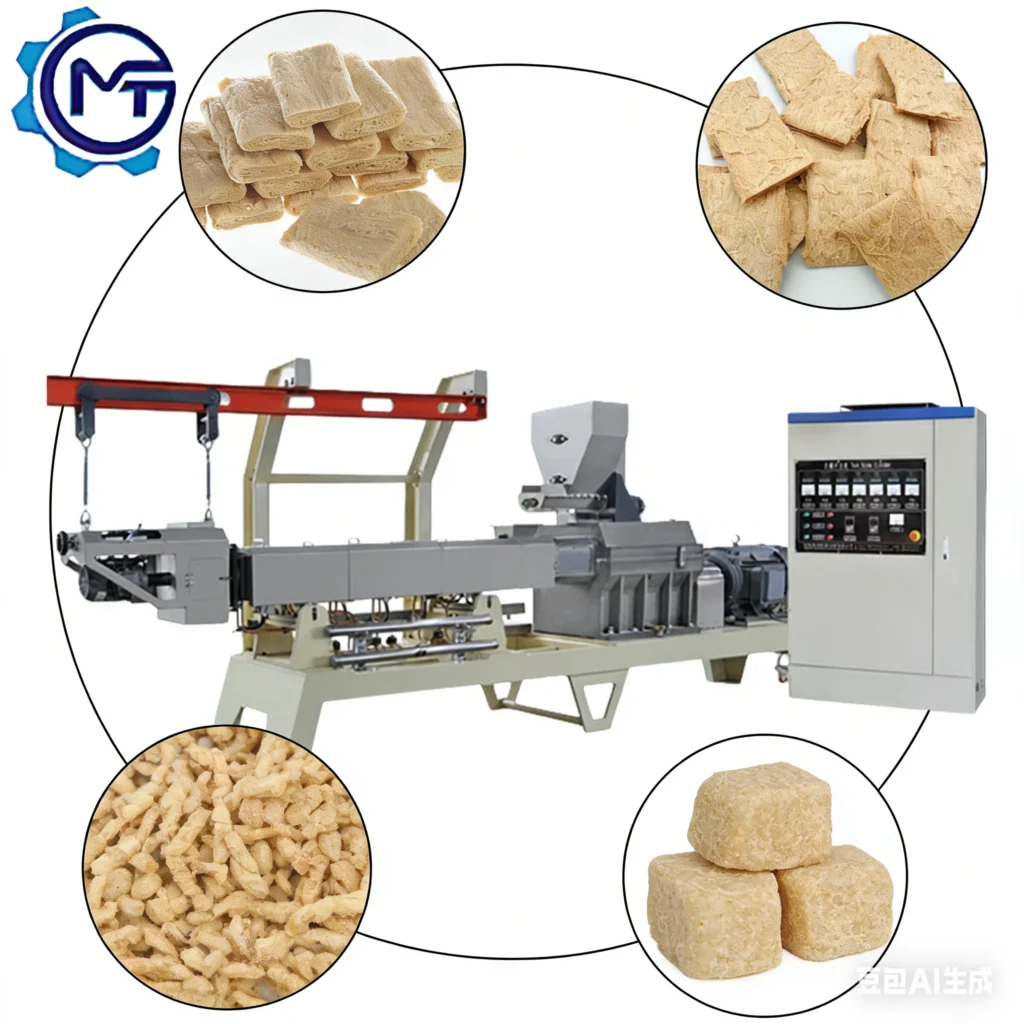
Line-Wide Throughput Matching — Every station from the mixer to the cooling conveyor is sized against the extruder’s actual output on your protein formulation, so no single machine bottlenecks the next.
Technical Specifications
| Parameter | Value |
|---|---|
| Product Type | Twin Screw Extruder for Textured Vegetable Protein (Plant-Based Meat) |
| Available Models | MT65 / MT70 / MT75 / MT85 |
| Installed Power | 84 kW (MT65) / 160 kW (MT70) / 190 kW (MT75) / 210 kW (MT85) |
| Power Consumption | 59 kW (MT65) / 120 kW (MT70) / 140 kW (MT75) / 140 kW (MT85) |
| Output Capacity | 100–150 kg/h (MT65) / 150–200 kg/h (MT70, MT75) / 250–300 kg/h (MT85) (basis not stated in source — confirm raw material formulation, moisture content and target product format) |
| Overall Dimensions (L×W×H) | 40000×1200×2200 mm (MT65) / 41000×1500×2200 mm (MT70) / 43000×1500×3200 mm (MT75) / 45000×1500×3500 mm (MT85) |
| Screw Type | Twin screw |
| Screw Length | 1050 mm / 1520 mm (model-dependent) |
| Main Motor Power | 22 kW / 30 kW / 45 kW (model-dependent) |
| Feeding Motor Power | 0.75 kW |
| Rotary Cutting Motor Power | 0.75 kW |
| Heating Power | 10 kW / 14 kW (model-dependent) |
| Mixer Capacity | 20–30 kg / 70–80 kg / 170–180 kg (model-dependent) |
| Mixer Power | 4 kW / 7.5 kW / 15 kW (model-dependent) |
| Mixer Contact Material | Stainless steel 304 |
| Dryer Type | Multi-layer, round-trip drying with double pitch roller chain drive |
| Dryer Heating Options | Fuel / gas / electricity (buyer selectable) |
| Line Stations | Mixer → Screw Conveyor → Twin Screw Extruder → Air Conveyor → Multi-layer Dryer → Cooling Machine |
| Certification | CE, ISO |
| Lead Time | 15–35 working days after deposit (verify against current production schedule) |
Application Suitability
| Application | Material or Output |
|---|---|
| Textured vegetable protein (TVP/TSP) chunks | Defatted soya flour, low-temperature soya flakes |
| Soya nuggets and protein bites | Soya flour blends with starch and fibre additives |
| High-moisture vegetarian meat analogues | Soybean protein concentrate, wheat gluten blends |
| Plant-based protein blocks | Soybean dregs, peanut dregs |
| Reconfigured snack and cereal formats | Adjusted screw and die configuration for expanded snack pellets or breakfast cereal |
What "150 kg/h" Leaves Out When Sourcing a Twin Screw Extruder for Plant Based Meat Processing Line Manufacturer
Nominal capacity means nothing until it is validated against your actual raw material formulation and moisture content.
I once commissioned a High Moisture Vegetarian Meat Extrusion Machine at a facility in Latin America where the buyer ordered based on a brochure figure. Their local defatted soya flour absorbed water at a noticeably different rate than the material used during factory testing. The screw speed, feed ratio, and barrel temperature profile all had to be recalculated on site, and the line ran well below the quoted throughput for the first week. That gap between a data-sheet number and real production is where projects stall. When evaluating a twin screw extruder for plant based meat processing line manufacturer options, the question is never just what the extruder can produce in isolation — it is whether the mixer upstream can keep it fed and the dryer downstream can keep up [NEED_CITE: raw material moisture variability in soy protein extrusion].
How Each Station Connects to the Next
A twin screw extruder for plant based meat processing line manufacturer builds its catalogue around the extruder, but the extruder only holds rate when every supporting station matches. The mixer must hydrate the protein blend uniformly before it enters the feed hopper. The screw conveyor must deliver a consistent volume without surging. After extrusion, the air conveyor transfers the cut product into the multi-layer dryer, where residence time and temperature determine whether the TVP chunks dry evenly or case-harden on the outside while staying wet inside. Each station in this range is specified so that its throughput band overlaps the extruder’s actual output window rather than a theoretical maximum.
Dryer Sizing and Heating Configuration
The multi-layer dryer uses a round-trip belt path with a double pitch roller chain drive, giving the product multiple passes through heated zones. Buyers can select fuel, gas, or electric heating to match the utility infrastructure at their facility. In regions where industrial gas is reliable and inexpensive, gas-fired dryers keep operating costs predictable. Where electricity is the default, the heating elements are staged across zones so operators can profile the temperature curve — higher heat in the first zone to set the structure, lower heat in the final zone to bring moisture to target without over-drying [NEED_CITE: industrial dryer heating source selection for food processing plants]. The dryer’s belt width and length are matched to the extruder model so that product bed depth stays within a range that allows consistent airflow.
Reading the Specs That Actually Matter
Screw length varies between 1050 mm and 1520 mm across the model range, and this dimension directly affects residence time inside the barrel. A longer screw gives the protein-starch blend more time under shear and heat, which improves gelatinisation and fibre alignment — critical when producing high-moisture meat analogues that need a layered, muscle-like texture. Main motor power steps from 22 kW on the MT65 up to 45 kW on the larger models, and this determines how much mechanical energy the screws can impart to high-viscosity doughs. The mixer’s stainless steel 304 contact surfaces prevent iron contamination that can discolour light soya flour blends. Heating power of 10 kW or 14 kW across the barrel zones supplements mechanical shear; on high-moisture formulations where less friction heat is generated, electrical barrel heating carries a larger share of the thermal load.
The Hidden Cost of a Mismatched Line
When a buyer sources the extruder from one supplier and the dryer from another, nobody owns the throughput gap between them. The extruder pushes product faster than the dryer can handle, so wet chunks pile up on the cooling belt, stick together, and spoil. Or the mixer cannot hydrate material fast enough, and the extruder starves, running at partial load while consuming full motor power. These mismatches do not show up on a quotation — they appear during commissioning, when the line is already on the floor and the installation crew is booked for another job [NEED_CITE: throughput mismatch consequences in multi-vendor food processing lines]. Specifying every station from one equipment range shifts the responsibility for line balance to a single source.
Why Procure the Full Range From Here
Every station in this catalogue — mixer, screw conveyor, twin screw extruder, air conveyor, multi-layer dryer, cooling machine — is documented with its own specification sheet, so buyers can verify throughput alignment before placing an order. Screw and die configurations are selected based on the buyer’s raw material sample and target product texture, not copied from a generic build. An in-house testing workshop runs trial extrusion on the buyer’s actual defatted soya flour or protein concentrate before the line ships, producing a trial run report that confirms achievable output and product appearance. Voltage, frequency, and control language are confirmed during the specification stage to avoid commissioning delays in markets with non-standard electrical grids. Food-grade contact materials run through every station, not just the extruder barrel.
Documentation & Verification
- Line layout drawing showing station-by-station throughput calculation for your target TVP format
- Screw and die configuration record matched to your soya flour formulation and moisture target
- Machine specification sheet confirming voltage, frequency, and control language for your facility
- Trial run report from the in-house testing workshop on your raw material sample before dispatch
- Electrical schematic and wear parts list covering screws, dies, and dryer chain components
Installation, Commissioning & Support
- Foundation planning based on the MT85 line footprint of up to 45000×1500×3500 mm requiring level concrete flooring
- Dedicated electrical circuit sized for up to 210 kW installed power with confirmed local voltage and frequency
- Equipment arrives in modular sections for staged assembly — extruder barrel, dryer segments, and cooling belt installed sequentially
- First-run commissioning includes barrel temperature profiling and screw speed adjustment on your raw material
- Operator training covers feed rate control, dryer zone temperature setting, and cutting speed synchronisation
- Wear parts inventory including replacement screw elements, die plates, and dryer chain links supplied with initial shipment
What to Include With Your Enquiry
To receive a line configuration that reflects your actual production conditions, share your raw material type and supplier data sheet, your target product format (chunks, nuggets, or high-moisture blocks), and your daily output requirement. Specify your facility’s available voltage and frequency, preferred dryer heating source, and the control language your operators need. If you have existing upstream or downstream equipment that the new line must integrate with, include those machine specifications as well.
Frequently Asked Questions
Q: How is extruder output capacity verified on my specific soya flour or protein concentrate formulation?
A: Before shipment, the testing workshop runs your raw material through the selected extruder model under controlled moisture and temperature conditions. The trial run report documents actual throughput, product texture, and moisture content at the die exit, giving you a verified baseline rather than a nominal figure.
Q: Which supporting stations are required to avoid bottlenecking at my target throughput?
A: The mixer capacity, dryer belt area, and cooling conveyor length are each calculated against the extruder’s verified output on your formulation. The line layout document shows the rated capacity of every station so you can confirm no single unit limits the line below your production target.
Q: What screw and die configurations are available for switching between TVP chunks, soya nuggets, and high-moisture meat analogues?
A: Screw elements can be rearranged to adjust shear intensity and residence time, while interchangeable die plates control product cross-section and expansion ratio. The configuration record supplied with your line documents the setup for each product format you plan to run.
Q: Can the dryer be specified for gas, electric, or fuel heating to match my factory’s utility infrastructure?
A: Yes. The multi-layer dryer is available with gas, electric, or fuel-fired heating. The selection is confirmed during the specification stage so that the heating system matches the utility supply already available at your facility, avoiding costly retrofits after installation.
Q: What documentation is provided for each station in the line?
A: Each station ships with its own specification sheet, electrical schematic, and wear parts list. The full line package also includes a layout drawing, trial run report, CE declaration of conformity, and an operation and maintenance manual covering all stations together.