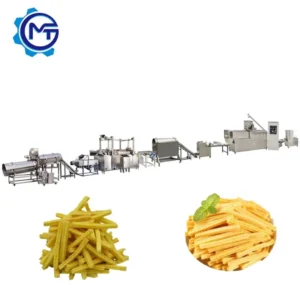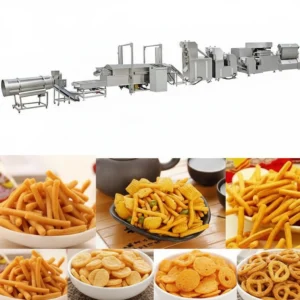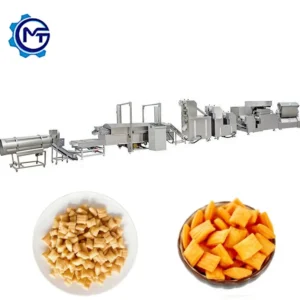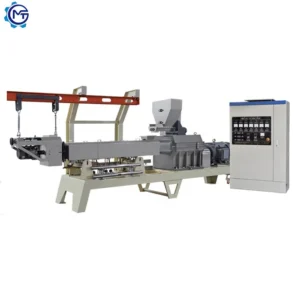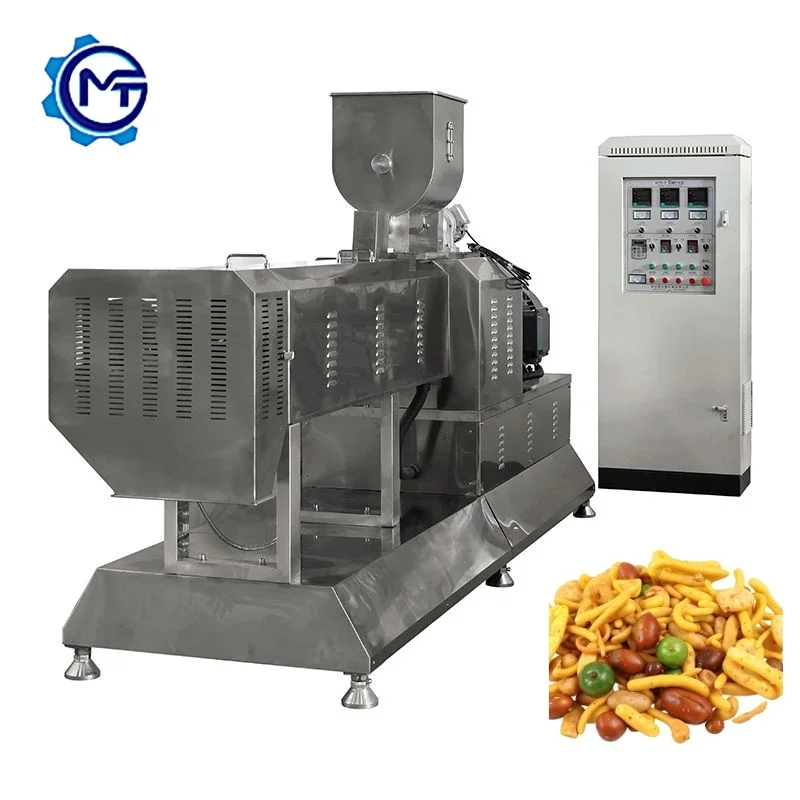
Complete Equipment Range — This continuous deep fryer is engineered to match upstream extruder throughput and downstream coating or cooling stations within a unified snack production line.
Technical Specifications
| Parameter | Value |
|---|---|
| Product Type | Continuous Deep Frying Machine for Snack Production Line |
| Rated Power | 2.6 kW (control/conveying system); Heating Tube Power: 60 kW |
| Voltage & Frequency | 380V / 50Hz |
| Control System | PLC controlled |
| Overall Dimensions (L×W×H) | 6700 × 2200 × 1200 mm |
| Net Weight | 2000 kg |
| Oil Capacity | 320 L |
| Output Capacity | 100–1000 kg/h (basis not stated in source — confirm product type, moisture, frying time) |
| Heating Method | Electric heating / Gas heating (dual option) |
| Belt System | Upper and lower double-layer mesh belt with frequency conversion stepless speed regulation |
| Oil Filtration | Continuous oil circulation filtration system |
| Slag Discharge | Bottom slag discharge system |
| Lifting System | Automatic lifting system for upper hood and mesh belt |
| Construction Material | Food-grade 304 stainless steel |
| Warranty | 1 Year |
Application Suitability
| Application | Material or Output |
|---|---|
| Deep frying traditional snacks | Nimko, chickpea flour-based extrudates, lentil-based formed pellets |
| Fried chip and crisp production | Potato slices, tapioca starch sheets, corn-based dough chips |
| Extruded snack finishing | Direct-expanded corn snacks, rice-based puffed pellets post-extrusion |
| Integrated snack line station | Downstream from twin-screw or single-screw extruders, upstream of flavouring drums |
Why Frying Capacity Often Bottlenecks the Entire Snack Line
A fryer that cannot hold pace with your extruder turns upstream investment into idle steel.
I once saw a snack producer in Southeast Asia run their twin-screw extruder at full output only to watch product pile up before the fryer because the mesh belt speed could not keep up. The extruder was rated correctly, but the frying station had been sourced separately without throughput verification. Products cooled unevenly, oil absorption became inconsistent, and the entire batch had to be re-fried or scrapped [NEED_CITE: throughput matching between extrusion and frying stations]. When sourcing an industrial deep fryer for sale, the first question should never be about price — it should be about how the fryer’s belt speed and oil volume align with your specific upstream output.
Mesh Belt Design and Frying Time Control
The double-layer mesh belt on this continuous frying machine sandwiches the product between upper and lower belts, preventing lighter snacks from floating to the oil surface. Frequency conversion stepless speed regulation allows operators to adjust residence time in the oil bath precisely. For a product like nimko, which requires a specific frying duration to achieve the target crunch without excessive oil uptake, this control is essential. The belt width and length together determine how much product can move through the oil at any given moment, directly governing line throughput.
Oil Filtration and Product Consistency
A continuous oil circulation filtration system runs alongside the frying process, removing fine particulates before they carbonise and degrade oil quality. In my experience working with snack lines in Shandong, producers who skip filtration find their oil acid value climbing within a single shift, forcing mid-run oil changes that halt production. This unit’s filtration loop extends edible oil service life and maintains consistent colour and flavour across long production runs. The 320 L oil capacity provides a volume buffer that stabilises temperature when cold product enters the bath [NEED_CITE: oil degradation rates in continuous deep frying operations].
Heating Options and Energy Infrastructure
This fryer offers both electric heating and gas heating configurations. The 60 kW heating tube array under electric mode demands a dedicated circuit with appropriate breaker sizing at 380V / 50Hz. For facilities where electrical infrastructure is limited or electricity costs are high, the gas heating option shifts thermal input to a burner system. The choice between the two is rarely about the machine itself — it depends on local utility rates, available gas supply pressure, and whether the factory already has a central boiler or thermal oil system. Specifying the wrong heating method before shipment leads to costly on-site modifications.
Key Parameters That Shape Daily Operation
The 6700 mm overall length reflects the fryer’s oil bath length plus entry and exit conveyance zones. A longer bath means longer maximum residence time, which matters for denser products requiring extended frying. The 2000 kg net weight indicates substantial steel mass and oil volume, requiring a level concrete floor with adequate load-bearing capacity. Food-grade 304 stainless steel construction throughout the contact zones meets hygiene requirements for food production environments and withstands the corrosive effects of hot oil and cleaning chemicals. The automatic lifting system for the upper hood and mesh belt allows operators to access the oil bath interior for cleaning between product changeovers without manual disassembly.
The Cost of Mismatched Line Stations
When a continuous frying machine is specified in isolation — without confirming how it connects to the extruder, dryer, or flavouring drum upstream and downstream — the consequences compound. An undersized fryer forces the extruder to run below capacity, wasting its rated output. An oversized fryer burns oil unnecessarily when product flow is thin. I have seen lines where the fryer belt speed was correct but the discharge conveyor could not transfer product fast enough, causing jams at the exit chute [NEED_CITE: material handling bottlenecks in snack processing lines]. These problems surface only during commissioning, when changes are expensive and slow.
Why Source the Fryer Within a Full Equipment Catalogue
This continuous frying machine sits within a broader catalogue covering every station from mixing and batching through extrusion, drying, flavouring, coating, cooling, and packing. Sourcing the fryer from the same supplier that provides upstream and downstream equipment means throughput is calculated across all stations rather than assumed. The 60 kW heating system and 320 L oil capacity can be cross-referenced against extruder output specifications before production begins. PLC control language and electrical schematics are confirmed for the target market during the design phase, avoiding on-site rewiring. Trial runs using the buyer’s actual raw material take place in the testing workshop before the line ships, catching compatibility issues early.
Documentation & Verification
- Line layout showing this fryer positioned between extrusion and flavouring stations
- Machine specification sheet confirming heating method, belt dimensions, and oil capacity
- Electrical schematic with 380V / 50Hz circuit requirements and PLC I/O mapping
- Trial run report on buyer’s actual snack product with oil temperature and time data
- Factory test record documenting mesh belt speed calibration and filtration flow rate
- CE declaration of conformity and ISO certificate for export market compliance
Installation, Commissioning & Support
- Level concrete floor required to support 2000 kg static load plus oil and product weight
- Dedicated 380V / 50Hz circuit with breaker sized for 60 kW heating tube draw plus 2.6 kW conveyance
- Unit ships fully assembled; hood and mesh belt lifting system allows immediate access for inspection
- PLC interface language and alarm messages configured to operator preference before dispatch
- First-run commissioning includes oil temperature profiling across the 6700 mm bath length
- Wear parts list covers mesh belt segments, heating tubes, and oil filter elements with replacement intervals
What to Share Before Requesting a Quotation
To configure this continuous frying machine correctly within your line, provide the specific product type, target output per hour, and raw material composition. Share your local voltage, frequency, and preferred PLC interface language. If you already have upstream extruders or downstream coating drums in place, send their capacity data so the fryer can be matched to prevent bottlenecks.
Frequently Asked Questions
Q: How is the 100–1000 kg/h output capacity verified for my specific product?
A: The stated range depends on product size, moisture content, and required frying time. We conduct a trial run using your actual raw material in our testing workshop, documenting oil temperature, belt speed, and final product quality. The verified capacity from that test becomes the basis for line configuration rather than a generic catalogue figure.
Q: Can the voltage, frequency, and PLC language be customised before shipment?
A: Yes. Electrical components and PLC programming are configured during production based on your confirmed specifications. We verify the target market’s voltage and frequency standards, set the PLC interface to your preferred language, and document everything in the electrical schematic provided before the machine ships.
Q: How does this fryer integrate with upstream extruders and downstream stations?
A: Throughput is calculated across all stations during the line layout phase. We cross-reference the fryer’s belt speed and oil capacity against your extruder output and your flavouring drum or dryer intake rate to confirm no station bottlenecks another. The layout document shows material flow between every machine.
Q: What wear parts should I stock, and how often do they need replacement?
A: The primary wear items are mesh belt segments, heating tubes, and oil filtration elements. We provide a complete wear parts list with recommended inspection intervals based on your production hours. Stocking critical spares on-site prevents unplanned downtime when a component reaches end of service life.
Q: What documentation comes with the machine for customs and compliance?
A: You receive a CE declaration of conformity, ISO certificate, machine specification sheet, electrical schematic, trial run report, factory test record, operation and maintenance manual, and packing photographs. We also provide customs documentation support tailored to your destination country’s import requirements.