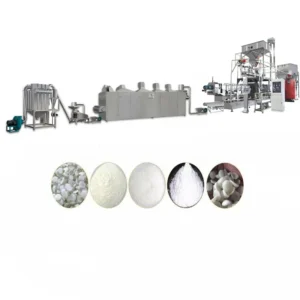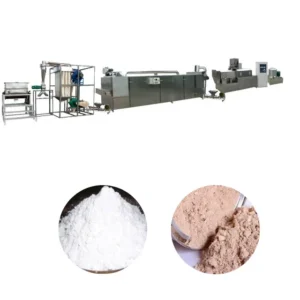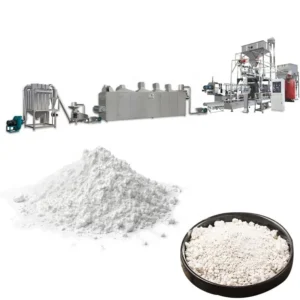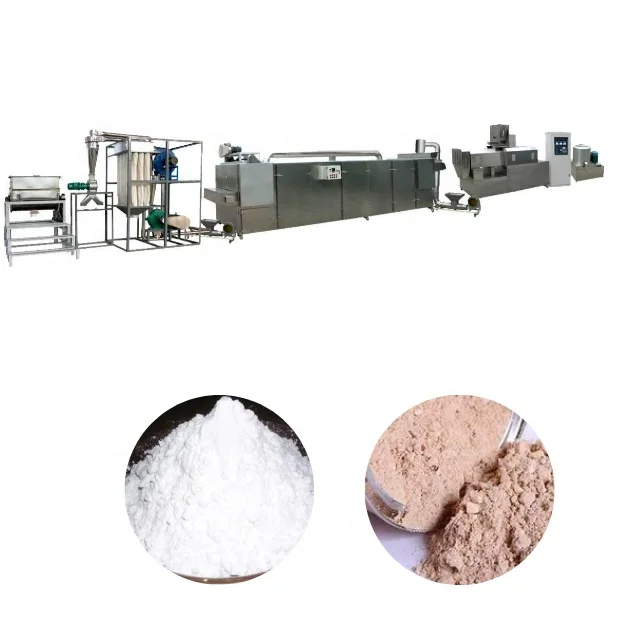
Integrated Line Engineering — twin-screw extrusion stations matched to cooling and grinding throughput so no single node bottlenecks your modified starch output.
Technical Specifications
| Parameter | Value |
|---|---|
| Product Type | Modified Starch Processing Line |
| Extruder Type | Twin Screw |
| Total Installed Power | 45-200 kW |
| Throughput Range | 100-1500 kg/h (basis not stated in source — confirm raw material / moisture content) |
| Line Weight | 1000-5000 kg |
| Electrical Supply | 220-440V, tri-phase |
| Contact Material | Food-grade stainless steel (304) |
| Core Line Stations | Twin screw extruder, cooling conveyor, pulse grinder |
| Control Architecture | Automatic operation |
| Assembly State | Complete production line |
| Certification | CE |
Application Suitability
| Application | Material or Output |
|---|---|
| Food-grade modified starch for thickening and formulation | Corn starch, wheat flour, rice flour |
| Industrial starch for oil drilling mud additives | Modified corn and tapioca starch |
| Starch binders for paper making and corrugated board | Wheat flour, soybean flour blends |
| Fortified and specialty nutritional starch products | Nutrition grain flours, composite blends |
What "Nominal Capacity" Leaves Out on a Modified Starch Processing Line
Rated throughput means nothing if the extruder screw profile does not match your starch source.
A modified starch processing line manufacturer often quotes output based on a standard corn starch benchmark. The problem starts when your actual feedstock is tapioca or waxy maize, which demand different gelatinisation temperatures and shear profiles. I watched a line sized for 500 kg/h on corn stall at half that rate when the buyer switched to a high-amylose wheat blend because the barrel temperature zones were never re-mapped. The extruder ran, but the downstream cooling conveyor had to idle while operators chased viscosity drift. [NEED_CITE: starch gelatinisation temperature variance across raw material types]
Barrel Zone Mapping for Starch Modification
Starch modification inside a twin-screw extruder depends on precise thermal and mechanical energy input across the barrel sections. A typical modified starch processing line runs multiple heating and cooling zones so operators can stage gelatinisation, shear-induced dextrinisation, and moisture flash-off in sequence. The 45-200 kW power envelope across available models gives enough headroom to hold barrel temperatures steady even when feedstock moisture varies between batches.
Matching Cooling and Grinding to Extruder Discharge
Extruded starch exits the die as a hot, semi-plastic ribbon that must cool to a specific moisture window before grinding. If the cooling conveyor is undersized relative to the extruder output, the ribbon arrives at the pulse grinder too warm and gums the screens. We size the conveyor length and air flow so the material reaches the grinder within the correct brittleness range, keeping the particle size distribution consistent across the run. [NEED_CITE: post-extrusion moisture targets for pregelatinised starch milling]
Reading the Specs That Actually Matter
The twin-screw configuration is the core of this line because starch modification requires both shear and residence time control that a single-screw unit cannot sustain across varying feedstocks. Food-grade 304 stainless steel on every contact surface prevents iron-catalysed discoloration that would fail food or paper-grade specification. The 220-440V tri-phase supply range must be locked to your facility before build, because rewiring a 200 kW main drive on site delays commissioning by days. Automatic operation through the control panel keeps barrel temperatures and screw speed within tight bands, reducing batch-to-batch viscosity variation that downstream formulators will notice.
The Cost of Skipping a Raw Material Trial
Buyers who approve a line on quoted capacity without a trial run on their own starch frequently discover the problem on day one of production. The screw combination that handles corn starch cleanly may generate excessive torque on tapioca, triggering overload alarms and forcing unplanned screw pulls. Each day of downtime while replacement elements ship represents lost contract tonnage and customer confidence erosion that no warranty clause covers. [NEED_CITE: torque overload causes in twin-screw starch extrusion]
Why Procurement Should Flow From Test Data
Every line we ship starts with the buyer sending a representative batch of their actual starch or flour blend to our testing workshop. We run the material through a twin-screw extruder with the proposed screw and die configuration, record barrel temperatures, motor load, and product viscosity, then adjust the combination until the output matches the target modification spec. This trial report ships with the machine so your operators know the baseline settings before they open the crate. Our documentation package travels with the equipment, not in a separate email weeks later. We build the electrical schematic around your confirmed voltage and frequency, not a default assumption. Wear parts lists include screw elements and die plates sized to your configuration, so replacements are on the shelf before the first scheduled change-out.
Documentation & Verification
- Trial run report on your starch feedstock conducted before dispatch
- Screw and die configuration record matched to your modification target
- Electrical schematic with confirmed voltage and frequency for your facility
- Line layout and capacity calculation based on your raw material profile
- CE declaration of conformity for the complete processing line
- Operation and maintenance manual with starch-specific parameter windows
Installation, Commissioning & Support
- Foundation plan reflects the 1000-5000 kg line weight distribution across stations
- Dedicated tri-phase circuit sized to the 45-200 kW total connected load
- Modular station layout allows phased assembly within standard industrial bay heights
- First-run parameter setting supervised on your actual starch feedstock
- Operator training covers barrel temperature staging and screw speed adjustment
- Wear parts inventory includes matched screw elements and die plates from day one
What to Include With Your Inquiry
Send us the type of starch or flour blend you plan to process, your target modification specification such as cold-water viscosity or degree of substitution, and your daily tonnage requirement. Include your facility voltage and frequency so we build the correct motor and control package. If you have existing upstream mixing or downstream packing equipment, share the interface details so the line integrates without buffer bottlenecks.
Frequently Asked Questions
Q: How is line capacity verified against my specific starch and modification target?
A: We run your actual raw material through a twin-screw extruder in our testing workshop, recording screw torque, barrel temperatures, and output viscosity. The trial report confirms whether the proposed configuration meets your tonnage and specification targets before we finalise the build.
Q: What screw and die configuration is recommended for my starch type?
A: Starch sources like corn, tapioca, and wheat each require distinct screw element sequencing and die geometry. We determine the combination during the trial run on your feedstock and document it so replacements match the proven profile.
Q: Can voltage, frequency, and control language be configured for my facility?
A: Yes. The 220-440V tri-phase range covers most export markets. We confirm your exact supply before production so motors, heaters, and the control panel are built to match, avoiding on-site rewiring delays.
Q: Is a trial run available on my raw material before shipment?
A: Every line includes a pre-shipment trial using your supplied starch sample. We document throughput, product quality, and machine settings in a report that ships with the equipment for your commissioning reference.
Q: What spare wear parts are included and how is supply maintained?
A: Each line ships with a wear parts list specific to your screw and die configuration. Initial spare elements are included, and replacement sets are produced to the same configuration record for consistent long-term supply.