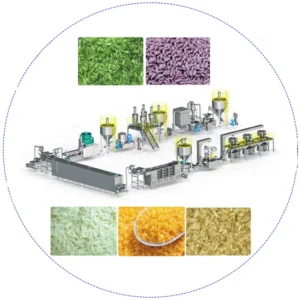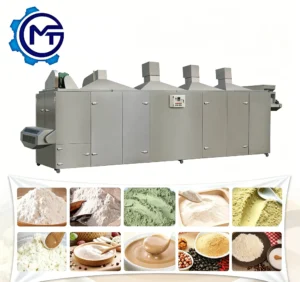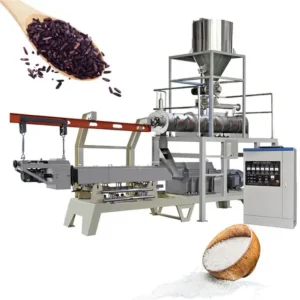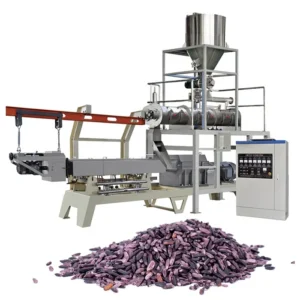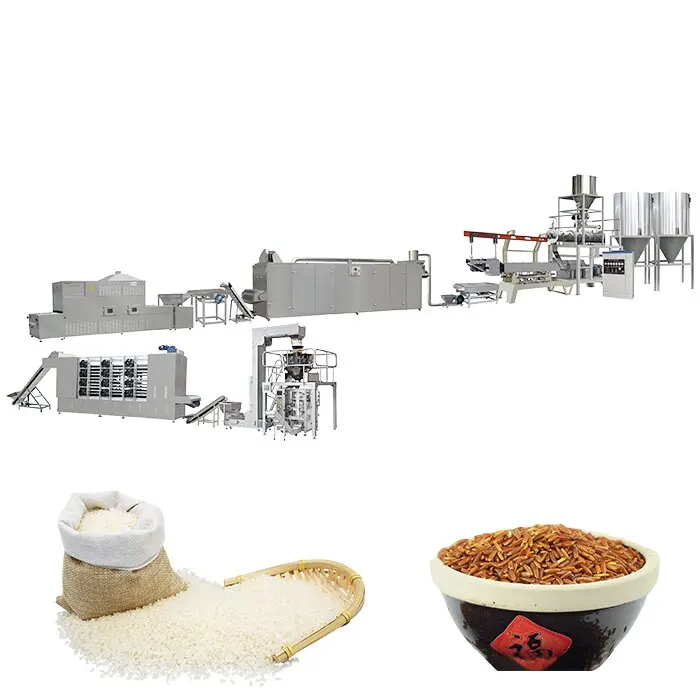
Thorough Pre-Sale Material Trials — Every grain blend runs through our in-house testing workshop before a single extruder is built for your line.
Technical Specifications
| Parameter | Value |
|---|---|
| Product Type | Fortified Artificial Rice Extrusion Production Line |
| Model Options | MT65 / MT70 / MT85 / MT75 / MT95 |
| Installed Power | 85 kW (MT65) / 120 kW (MT70) / 235 kW (MT85) / 180 kW (MT75) / 260 kW (MT95) |
| Power Consumption | 60 kW (MT65) / 85 kW (MT70) / 165 kW (MT85) / 135 kW (MT75) / 195 kW (MT95) |
| Output Capacity | 80–100 kg/h (MT65, basis to be confirmed) / 100–120 kg/h (MT70, basis to be confirmed) / 200–300 kg/h (MT85, basis to be confirmed) / 300–500 kg/h (MT75, basis to be confirmed) / 800–1000 kg/h (MT95, basis to be confirmed) |
| Overall Dimensions (L×W×H) | 28×1.2×2.2 m (MT65) / 30×1.5×2.2 m (MT70) / 34×3.5×4.3 m (MT85) / 32×3.5×4.3 m (MT75) / 36×3.5×4.3 m (MT95) |
| Screw Type | Twin-screw |
| Feeding System | Single or double screw feeding, selectable by material |
| Speed Control | Frequency speed controlling |
| Lubrication | Automatic lubricating and cooling system |
| Screw Material | Special wear-resistant technology |
| Drying Oven Heating Source | Electric or gas |
| Drying Oven Speed Control | Frequency motor controls mesh belt speed |
| Line Stations | Mixing, Extruding, Vibrating, Low-temperature drying, Cooling, High-temperature roasting, Cooling, Packing |
| Standards | CE certified, ISO certified |
Application Suitability
| Application | Material or Output |
|---|---|
| Fortified rice kernel production | Broken rice, rice bran, corn, millet blended with vitamins and minerals |
| Artificial rice for nutrition programmes | Wheat, oats, buckwheat with micro-nutrient premix |
| Reconstituted grain kernels | Starch-rich blends with beans and added fortificants |
| Specialty rice analogues | Multi-grain compositions targeting specific glycaemic or nutritional profiles |
Why "Rated Capacity" Means Nothing Without Your Raw Material
The number on the nameplate only matters once it is matched to what you actually feed the hopper.
I learned this the hard way in a humid plant outside Jeddah. We quoted a line for fortified artificial rice based on a standard rice flour formulation. The buyer arrived on commissioning day with a blend containing thirty percent chickpea flour. The screw torque alarm fired within minutes, and the die output stuttered badly. Four days of reconfiguration later we stabilised gelatinisation and kernel shape, but the delay cost everyone time and patience [NEED_CITE: raw material variability in extrusion processing]. When you source a Fortified Artificial Rice Making Machine for sale, the first conversation should always be about your exact grain blend, moisture content, and fat level — not the headline throughput figure.
Matching Every Station to the Extruder
Browse the full catalogue and you will see five extruder models spanning modest pilot-scale runs to continuous high-volume output. The real question is not which extruder you pick, but whether the dryer, roaster, and cooler downstream can absorb that extruder’s output without creating a bottleneck. Each supporting station in this Fortified Artificial Rice Making Machine for sale range is listed with its own throughput envelope so you can cross-check before committing to a layout.
Drying and Roasting Stages That Hold Kernel Integrity
Low-temperature drying followed by high-temperature roasting is not a luxury — it is what keeps reconstituted rice kernels from cracking when the end user boils them. The drying oven uses a frequency-controlled mesh belt, allowing the operator to adjust residence time based on ambient humidity and kernel size. Switching between electric and gas heating depends on your local utility cost and available connections [NEED_CITE: industrial drying energy source selection criteria]. Getting this stage right is the difference between a kernel that holds its shape in the pot and one that dissolves into porridge.
Reading the Spec Sheet Like a Process Engineer
Twin-screw extrusion gives you a wider operating window than single-screw designs when handling blends that contain both starchy grains and protein-rich legumes. The automatic lubricating and cooling system keeps barrel temperatures stable during long production runs, which matters because even a few degrees of drift can alter starch gelatinisation and change the final kernel density. Frequency speed controlling on both the main drive and the feeding system lets operators fine-tune shear input without stopping the line. Special wear-resistant screw material extends intervals between screw and die replacements — an important consideration when your recipe includes abrasive mineral premixes. The choice between single and double screw feeding depends on whether your raw material is free-flowing flour or a sticky, high-moisture blend.
The Hidden Cost of Undersized Supporting Equipment
A common mistake is specifying the extruder correctly and then pairing it with a dryer that cannot keep up. The result is a backlog of semi-dried kernels sitting on trays, absorbing moisture from the air and losing dimensional consistency. I have watched entire batches of artificial rice crack during storage because the cooling stage was too short and residual heat continued driving moisture migration [NEED_CITE: post-extrusion moisture management in grain products]. An undersized roaster produces the same problem in reverse — kernels pass through before reaching the surface temperature needed for proper crust formation. These mismatches only reveal themselves weeks after startup, when customer complaints start arriving.
What Sets This Equipment Range Apart
Complete station coverage from mixing through packing means you evaluate every machine from one catalogue rather than juggling separate vendors whose throughput ratings never quite align. Screw configuration and die design are specified to your raw material and target kernel shape, not copied from a generic build. The in-house testing workshop runs your actual grain blend before the line ships, so product development happens in our facility instead of on your factory floor during commissioning. Frequency-controlled drives and automatic lubrication are standard across all five extruder models, not offered as costly upgrades. Electrical schematics and voltage confirmation are completed before production begins, preventing the frustrating delays that occur when a machine arrives wired for a voltage your plant does not supply.
Documentation & Verification
- Line layout and capacity calculation showing each station matched to your target output
- Screw and die configuration record tied to your specific grain and fortificant blend
- Electrical schematic and voltage confirmation signed off before fabrication starts
- Factory test record and trial run report on your raw material before dispatch
- CE declaration of conformity and ISO certificate included with shipment
- Wear parts list specifying screws, dies, and oven mesh belts for first reorder
Installation, Commissioning & Support
- Overall dimensions up to 36×3.5×4.3 m require confirmed floor space and ceiling clearance before delivery
- Installed power up to 260 kW demands a dedicated circuit with confirmed voltage and frequency
- Line arrives in modular sections for staged assembly aligned to your commissioning schedule
- First-run parameter setting covers screw speed, barrel temperature profile, and mesh belt residence time
- Operator training addresses frequency drive adjustment and automatic lubrication system monitoring
- Spare wear parts including screws, dies, and mesh belts itemised for initial inventory planning
Before You Send an Inquiry
Share your raw material composition — including the percentage of broken rice, legumes, starch, and any micro-nutrient premix — along with your target daily output and kernel dimensions. Specify your local voltage, frequency, and whether your facility uses electric or gas for thermal processes. If you already operate upstream milling or downstream packing equipment, let us know the interface requirements so the Fortified Artificial Rice Making Machine for sale integrates without gap or overlap.
Frequently Asked Questions
Q: How do I choose between the five extruder models for my production target?
A: Model selection depends on your raw material blend and the output capacity you need sustained across a full shift. We review your formulation, run a trial in the testing workshop, and recommend the model whose throughput envelope matches your target without forcing downstream stations into bottleneck conditions.
Q: Which supporting stations are essential to prevent line bottlenecks?
A: The dryer, cooler, and roaster must each handle at least the extruder’s peak output. We provide a line layout and capacity calculation document that cross-references every station’s throughput rating against your chosen extruder model before the order is confirmed.
Q: How are voltage and frequency requirements handled for different export markets?
A: We confirm your plant’s voltage, frequency, and phase during the specification stage and record these in the electrical schematic before production begins. This prevents commissioning delays caused by mismatched motors or control panels [NEED_CITE: voltage and frequency standards by export market].
Q: What screw and die options exist for different grain compositions?
A: Screw configuration and die geometry are selected based on your raw material’s starch content, protein level, and target kernel density. The configuration record is documented and supplied with your machine so future reorders are consistent.
Q: Are spare wear parts included with the first delivery?
A: A wear parts list covering screws, dies, and oven mesh belts is provided so you can plan your first reorder before the initial set reaches end of life. Availability and lead times are confirmed at the quotation stage.