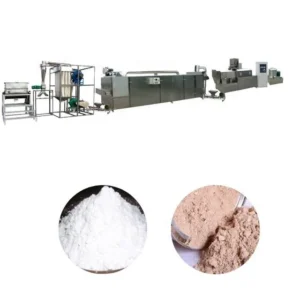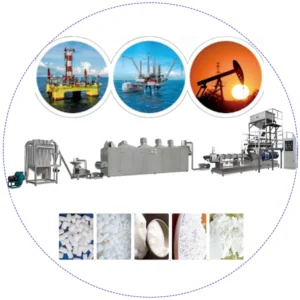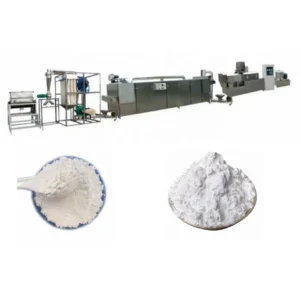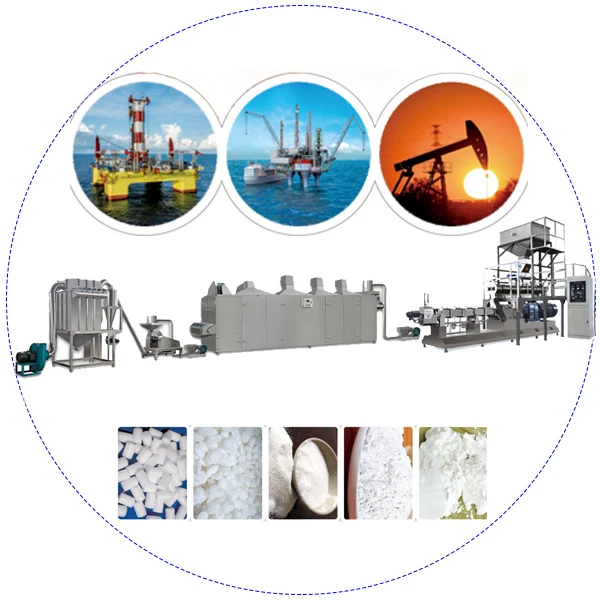
Line Throughput Matched Across Every Station — each mixer, extruder, dryer and grinder sized to the same capacity target so no single unit chokes the output of a modified starch processing line.
Technical Specifications
| Parameter | Value |
|---|---|
| Product Type | Modified & Pregelatinised Starch Extrusion Line |
| Raw Material Compatibility | corn starch, cassava starch, potato starch, maize starch, tapioca starch, rice flour, soybean flour, nutrition grain flours |
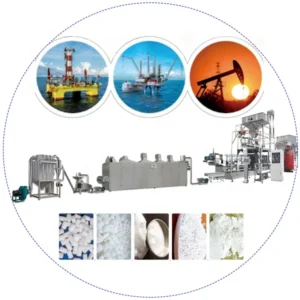
| Output Products | modified starch, pregelatinized starch, oil drilling starch |
| Capacity Range | 150 kg/h, 300 kg/h, 500 kg/h, 1 ton/h, 2 ton/h (basis not stated in source — confirm raw material type, moisture content, and target product specification) |
| Screw Type | twin-screw |
| Line Flow | Mixing → Extrusion → Drying → Grinding → Blending → Packing |
| Assembly State | complete line with supporting stations |
| Control System | available with PLC or MCC control (verify configuration) |
| Voltage & Frequency | configurable to target market supply (confirm before production) |
| Automation Level | high automatization (verify against final configuration) |
| Certification | CE (verify certificate validity and scope) |
Application Suitability
| Application | Material or Output |
|---|---|
| Textile sizing agent production | modified corn or cassava starch for warp yarn treatment |
| Papermaking additive processing | pregelatinised starch for surface sizing and coating |
| Oil drilling fluid preparation | cross-linked modified starch for fluid-loss control |
| Nutrition food ingredient supply | pregelatinised starch from maize or rice flour for instant porridge |
| Chemical binder manufacturing | modified tapioca or potato starch for adhesive formulations |
Why Matching Dryer Capacity to Extruder Output Matters on a Modified Starch Processing Line
An extruder rated at 500 kg/h paired with a dryer that handles only 300 kg/h caps the entire line well below its nameplate number.
I have watched starch processors invest heavily in a high-output modified starch processing line only to discover during commissioning that the dryer or grinding station cannot keep pace. The extruder runs at full throughput for twenty minutes, then operators must throttle it back while the dryer catches up. That stop-and-start rhythm degrades starch gelatinisation consistency and shortens screw life. [NEED_CITE: extrusion line throughput balancing for starch applications]
The consequence is not just lost volume. Partial loads inside the dryer lead to uneven moisture content across batches, which means the grinder downstream receives feed that varies in hardness and residual moisture. End users in textile or oil drilling markets specify tight viscosity windows, and inconsistent drying pushes product outside those limits.
Every Station Sized to the Same Output Target
A modified starch processing line built as a matched system begins with the buyer’s target throughput and works backward through each station. The mixer must deliver batch volumes that align with the extruder feed rate, the dryer must remove moisture at a rate that matches extruder discharge, and the grinder must process dried output without creating a backlog. Sizing each station independently is how bottlenecks appear during the first production run rather than on the layout drawing.
How Raw Material Choice Shifts the Entire Equipment Balance
Corn starch, cassava starch, potato starch and tapioca starch each carry different moisture profiles and gelatinisation temperatures. Switching from a standard corn variety to a high-amylose local source changes the shear and residence time required inside the barrel. That shift cascades through the dryer because the extrudate leaves the die at a different moisture level, and it changes grinding behaviour because the gelatinised structure fractures differently. A line configured once for a single feedstock needs recalibration when the raw material changes. [NEED_CITE: starch gelatinisation behaviour across botanical sources]
Reading the Specification Sheet Beyond the Nameplate Number
The capacity range available for this line spans from small-batch runs up to ton-per-hour scale, but each figure depends on the raw material moisture content, the target degree of modification, and the final particle size required after grinding. A pregelatinized starch extrusion machine for sale at a stated hourly output means little if the basis for that output is not defined. Requesting the capacity calculation document shows whether the number reflects the buyer’s actual feedstock and product specification or a generic test condition.
Screw Configuration and Die Design for Starch Modification
Twin-screw extrusion gives processors control over shear intensity and residence time by adjusting the screw element sequence and die geometry. Forwarding elements, kneading blocks and reverse elements each influence how thoroughly starch granules are disrupted during gelatinisation. The die opening diameter determines the pressure profile at the barrel exit, which affects expansion ratio and the porosity of the extrudate before it enters the dryer. Selecting screw elements and die plates based on the buyer’s specific starch source and target modification level is what separates a line that runs consistently from one that requires constant adjustment.
The Hidden Cost of Unmatched Supporting Stations
When a line is assembled from separate vendors without a single entity verifying throughput across every junction, the gaps show up during installation. A dryer that is physically larger than the extruder output demands wastes energy running at partial load, while an undersized grinder forces operators to stockpile semi-finished material on the floor. These mismatches do not appear on individual equipment quotations because each vendor guarantees only their own station. [NEED_CITE: equipment integration risks in starch processing projects]
What Sets This Equipment Range Apart
Every supporting station from mixing through packing is specified under one supplier, so throughput calculations span the full line rather than stopping at individual machine boundaries. Screw configuration and die design are documented against the buyer’s raw material and target product before production begins. An in-house testing workshop allows trial runs on customer-supplied starch samples before the line ships, reducing the risk of discovering incompatibilities during on-site commissioning. The line is available for applications spanning industrial modified starch and nutrition-grade pregelatinised starch, with documentation covering electrical schematics, capacity calculations and factory test records.
Documentation & Verification
- Line layout drawing showing throughput match across mixer, extruder, dryer, grinder and packing stations
- Machine specification sheet with screw configuration and die design record for buyer’s starch type
- Electrical schematic with voltage and frequency confirmation for target installation site
- Factory test record and trial run report on buyer-supplied raw material before shipment
- CE declaration of conformity covering the complete extrusion and supporting equipment assembly
- Wear parts list identifying screws, dies and barrel sections with replacement intervals
Installation, Commissioning & Support
- Foundation layout provided with load-bearing requirements for extruder and dryer station footprints
- Power distribution plan specifying dedicated circuits for main drive motor and heating zones
- Pre-assembled stations shipped in modular sections for on-site alignment and connection
- Commissioning includes screw configuration verification and barrel temperature profile tuning on buyer’s starch
- Operator training covers die changeover, screw element replacement and control system navigation
- Spare wear parts package includes matched screw elements and die plates for initial replacement cycle
- Maintenance schedule documents lubrication intervals for gearbox and barrel cooling system checks
Preparing Your Inquiry for a Starch Line Proposal
To size a modified starch processing line accurately, share the botanical source and moisture content of the starch you intend to process, along with the target product specification such as viscosity range or particle size after grinding. Confirm the electrical supply standard at your installation site including voltage and frequency, and note any existing upstream or downstream equipment the new line must integrate with. If a trial run on your actual raw material is required before shipment, provide a representative sample in sufficient quantity for testing.
Frequently Asked Questions
Q: Which supporting stations are included and how is throughput matched between them?
A: The line covers mixing, extrusion, drying, grinding, blending and packing. Each station is sized to the same throughput target based on the buyer’s raw material and product specification, so no single unit bottlenecks the others. A capacity calculation document confirms the match before production begins.
Q: What raw materials can this modified starch processing line handle?
A: The line processes corn starch, cassava starch, potato starch, maize starch, tapioca starch, rice flour, soybean flour and nutrition grain flours. Screw configuration and barrel temperature profile are adjusted to each feedstock’s gelatinisation behaviour before the trial run.
Q: How is capacity verified on the buyer’s actual raw material?
A: An in-house testing workshop runs the buyer’s starch sample through the extruder and supporting stations before shipment. The trial run report documents actual throughput, moisture content after drying and particle size after grinding against the buyer’s product specification.
Q: How are voltage, frequency and control language confirmed before production?
A: The electrical schematic is prepared after the buyer confirms the installation site’s power supply standard. Control system language and PLC interface labels are specified during the quotation stage so operators can navigate the system from the first day of commissioning.