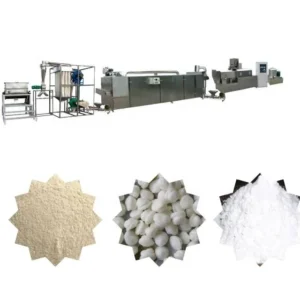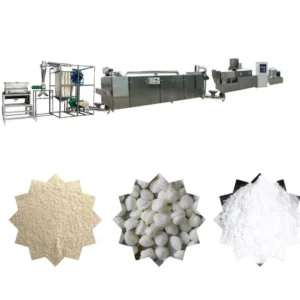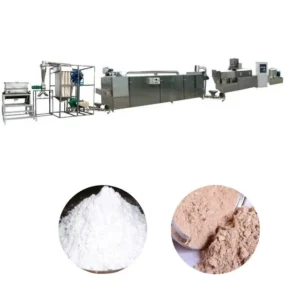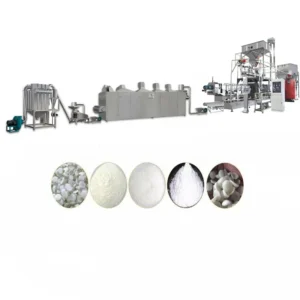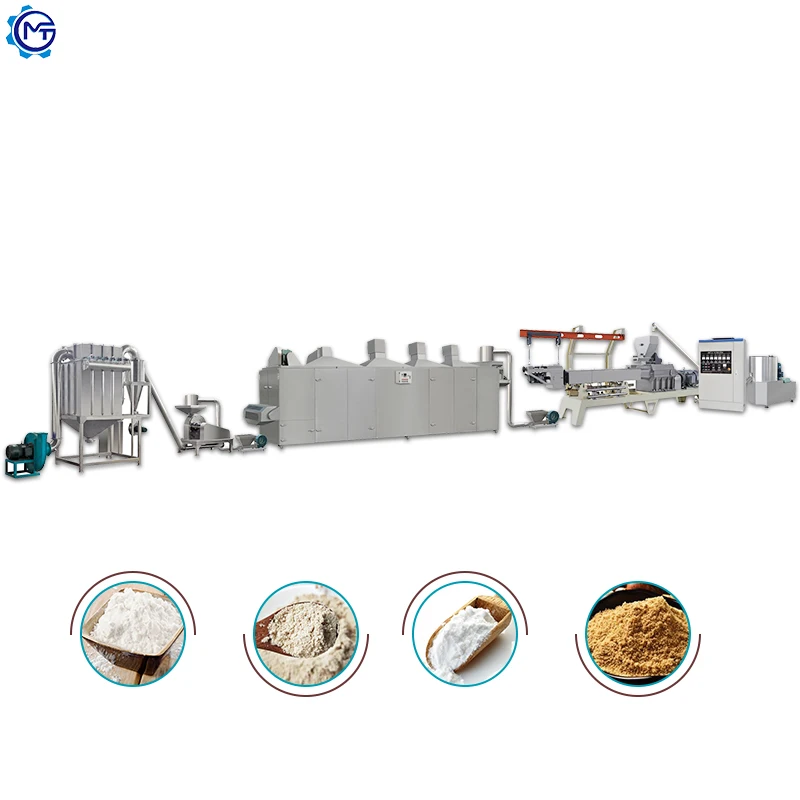
Complete Station Coverage — Every mixer, twin-screw extruder, dryer and grinder in the modified starch processing line is specified individually so throughput can be verified at each stage before ordering.
Technical Specifications
| Parameter | Value |
|---|---|
| Product Type | Modified Starch Processing Line |
| Capacity Range | 80–500 kg/h (basis not stated in source — confirm raw material type, moisture and product specification) |
| Extruder Type | Twin screw extruder |
| Screw & Barrel Material | 45 steel |
| Frame Material | Stainless steel 201 |
| Contact Material | Food grade stainless steel 304 |
| Voltage & Frequency | Three phases 380V/50Hz; Single phase 220V/50Hz (customizable to local supply) |
| Rated Power | Approx. 100 kW (electricity-heated); 50–60 kW (gas or diesel heated) |
| Energy Options | Electricity / Gas / Diesel / Steam |
| Mixer Motor | 4.0 kW |
| Mixer Batch Output | 3.0–4.0 kg per batch (basis not stated — confirm batch cycle time) |
| Mixer Dimensions | 1.2 × 0.9 × 1.4 m |
| Screw Conveyor Motor | 1.1 kW |
| Screw Conveyor Output | 0–150 kg/h (basis not stated — confirm material bulk density) |
| Screw Conveyor Dimensions | 2.5 × 0.6 × 2.3 m |
| Process Flow | Mixer → Screw Conveyor → Twin Screw Extruder → Shifter → Air Conveyor → Dryer → Air Conveyor → Conditioning → Conveyor → Grinder |
| Certification | CE |
| Warranty | One year warranty with life-time technical guidance support |
Application Suitability
| Application | Material or Output |
|---|---|
| Pregelatinized starch for food processing | Corn starch, wheat flour, potato starch |
| Modified starch for paper and industrial use | Corn starch, wheat flour with chemical or physical modification |
| Starch gelatinization and denaturation | Raw starch requiring enhanced viscosity and gelling properties |
| Fortified and nutritional starch bases | Blended starch with added nutrients or functional ingredients |
| Instant starch powders for consumer products | Pregelatinized starch with controlled solubility in cold water |
Why Dryer Capacity Decides the Line’s Actual Output
A modified starch processing line full equipment range only performs as fast as its slowest station, and that station is almost always the dryer.
I have seen lines where the twin-screw extruder was rated for a certain throughput on paper, but the dryer downstream could not remove moisture quickly enough to meet the target specification for pregelatinized starch. The result is a bottleneck that forces the entire line to slow down. In one project in South Asia, the buyer specified a dryer based on generic starch moisture assumptions rather than the actual moisture content leaving their extruder with their particular raw material. Commissioning took considerably longer than planned while the drying profile was reworked [NEED_CITE: drying curve requirements for pregelatinized starch at varying feed moisture levels]. When you survey a modified starch processing line full equipment range, verify that the dryer capacity is matched to the extruder output on your specific starch type, not on a catalogue average.
How Each Station Fits the Starch Modification Process
The modified starch processing line full equipment range begins with the mixer, where raw starch is blended with water and any modifying agents to achieve a uniform feed. The 4.0 kW mixer handles batches of 3.0 to 4.0 kg per cycle, producing a consistent slurry or dampened powder before it enters the screw conveyor. From there, material moves through the twin-screw extruder where high temperature and shear force gelatinize and denature the starch granules.
After extrusion, the shifter and air conveyors transport the extrudate to the dryer, where residual moisture is brought down to the level required for stable storage and downstream grinding. The conditioning stage allows the dried product to stabilize before the grinder reduces it to the target particle size. Each station in this modified starch processing line full equipment range operates independently, so a processor expanding an existing line can specify individual machines without replacing the entire setup.
Matching Energy Source to Local Utility Reality
Heating and drying are the most energy-intensive stages in starch modification. The line supports electricity, gas, diesel and steam as energy options for the dryer and barrel heating zones, with rated power ranging from approximately 100 kW in a fully electric configuration down to 50–60 kW when gas or diesel is used. In regions where industrial electricity tariffs are high or grid reliability is uncertain, switching the dryer to gas or steam can significantly alter operating costs [NEED_CITE: industrial energy cost comparison for starch drying operations].
Steam is often available in facilities that already operate boilers for other processes, making it a practical choice for larger plants. For smaller operations or regions without gas infrastructure, diesel-fired dryers offer a workable alternative. Confirming the energy source during the specification stage avoids costly retrofits after installation and ensures the electrical schematic matches the site’s actual supply conditions.
What the Screw and Barrel Specifications Mean for Starch Processing
The twin-screw extruder uses 45 steel screws and barrels, a material selected for its wear resistance under the high-temperature, high-pressure conditions required for starch gelatinization. Unlike single-screw designs, the twin-screw configuration provides positive conveying, which is important when processing viscous, high-moisture starch masses that would otherwise stall in the barrel. The intermeshing screws create a self-wiping action that reduces material buildup and improves heat transfer uniformity across the barrel length.
Barrel temperature profiling is critical in starch modification because different raw materials gelatinize at different temperatures. Corn starch, wheat flour and potato starch each have distinct gelatinization windows, and the screw configuration must be adjusted to match the residence time and shear profile to the target product. A configuration that works on standard corn starch may fail on high-amylose varieties, producing incomplete gelatinization and reduced viscosity in the final powder. The 45 steel construction holds up under repeated configuration changes without requiring full barrel replacement each time the screw setup is modified.
Contact surfaces throughout the food-contact stations are built from food grade stainless steel 304, meeting hygiene requirements for starch destined for food applications while the structural frame uses stainless steel 201 to manage equipment cost without compromising corrosion resistance in typical processing environments.
The Cost of Overlooking Station-to-Station Matching
When the mixer batch cycle does not align with the extruder feed rate, the extruder starves intermittently, causing uneven gelatinization and inconsistent product quality downstream. Similarly, if the air conveyor capacity is undersized relative to the extruder output, material backs up between stations, leading to moisture reabsorption and product degradation before it reaches the dryer. These mismatches are rarely visible in individual machine specifications but become obvious during commissioning [NEED_CITE: throughput balancing principles in multi-station food processing lines].
Processors who select machines individually from different vendors without a unified line layout often discover these gaps only after all equipment is installed. Resolving them requires either derating the faster stations or adding buffer hoppers, both of which add cost and complexity that could have been avoided with a matched specification from the start.
Why Sourcing the Full Range from One Supplier Matters
Every station in this modified starch processing line full equipment range is specified with throughput data that accounts for the upstream and downstream machines, eliminating the guesswork of assembling a line from separate vendors. The twin-screw extruder screw configuration and die design are matched to the buyer’s specific raw material, whether that is standard corn starch, high-amylose corn, wheat flour or potato starch, rather than relying on a generic build.
The in-house testing workshop runs trial production on the buyer’s actual raw material before shipment, confirming gelatinization temperature, viscosity and final product specification rather than leaving these variables to on-site troubleshooting. Electrical schematics and voltage specifications are confirmed for the target market before production begins, preventing commissioning delays caused by mismatched power supply. Food-grade stainless steel 304 is used throughout contact surfaces, with documentation covering material grades, test records and CE conformity available for each station.
Documentation & Verification
- Line layout showing throughput calculation for each station on buyer’s starch type
- Screw and die configuration record matched to raw material and target viscosity
- Electrical schematic with voltage and frequency confirmed for destination market
- Factory test record on customer-supplied raw starch before dispatch
- Material certificates for food grade stainless steel 304 contact surfaces
- CE declaration of conformity covering the full line assembly
Installation, Commissioning & Support
- Foundation plan accounting for twin-screw extruder vibration and dryer thermal expansion requirements
- Dedicated power circuit sized for 100 kW electric or 50–60 kW gas-assisted configuration
- Modular station layout allowing phased installation from mixer through grinder
- On-site commissioning with temperature profile tuning on buyer’s raw starch
- Operator training covering screw configuration changes for different starch varieties
- Wear parts inventory list including spare screws, barrel segments and grinder screens
What We Need to Specify Your Line
To configure the right modified starch processing line full equipment range for your project, share the specific starch type you will process, the target product specification including final moisture and particle size, and your required hourly output. We also need your facility’s available voltage, frequency and preferred energy source for the heating and drying stages, along with workshop floor dimensions to plan the station layout.
Frequently Asked Questions
Q: How do I verify the actual capacity of each station in the line?
A: Each station is rated based on specific raw material conditions and product specifications. The line layout document includes throughput calculations for your particular starch type, moisture content and target output, rather than generic catalogue figures. A factory trial run on your raw material confirms these numbers before shipment.
Q: Which stations use food grade stainless steel 304 versus 201?
A: All surfaces that contact the starch during mixing, extrusion, conveying, drying and grinding use food grade stainless steel 304. Structural frames and non-contact components use stainless steel 201 to balance corrosion resistance with equipment cost. Material certificates are provided for both grades.
Q: How should I choose between electricity, gas, diesel and steam for the dryer?
A: The choice depends on your local utility cost and availability. Fully electric configurations draw approximately 100 kW, while gas or diesel options reduce electrical demand to 50–60 kW. If your facility already operates a boiler, steam integration can further reduce operating costs. Confirm local energy tariffs before finalizing the specification.
Q: What equipment is included versus what must be sourced separately?
A: The full range covers the mixer, screw conveyor, twin-screw extruder, shifter, air conveyors, dryer, conditioning unit, conveyor and grinder. Upstream raw material silos, downstream packing systems and dust collection are typically sourced separately unless specifically requested as part of the project scope.
Q: How are voltage and control language confirmed before shipment?
A: During the specification stage, your local voltage, frequency and preferred control interface language are recorded and confirmed on the electrical schematic. The factory test is conducted under those confirmed settings, and the operation manual is prepared in the agreed language before dispatch.