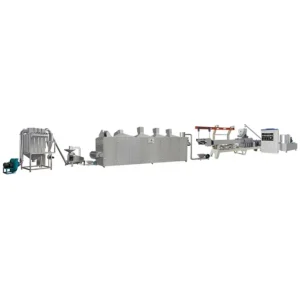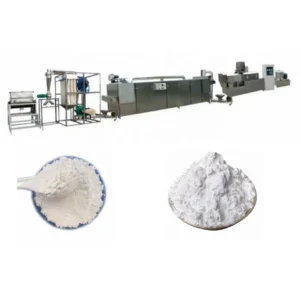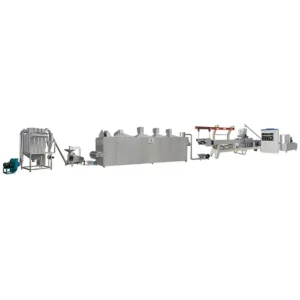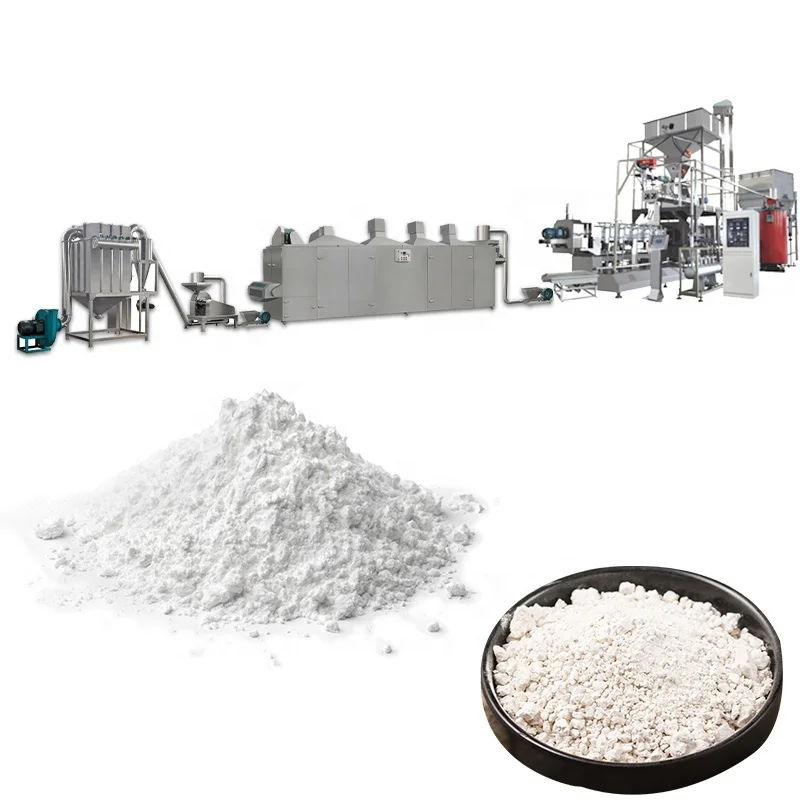
Throughput-Matched Stations — Every mixer, extruder, dryer, grinder and packer in the modified starch production line equipment for sale is supplied and balanced by MT so no single station chokes the line.
Technical Specifications
| Parameter | Value |
|---|---|
| Product Type | Modified Starch Production Line |
| Model | MT65 / MT70 / MT85 |
| Extruder Type | Double-screw (Twin-screw) |
| Output Capacity | MT65: 100–150 kg/h, MT70: 200–250 kg/h, MT85: 300–500 kg/h (basis not stated in source — confirm raw material type, moisture content and target starch modification degree) |
| Total Installed Power | MT65: 60 kW / MT70: 80 kW / MT85: 145 kW |
| Extruder Power | 22 kW |
| Mixer Power | 3 kW |
| Mixer Output | 70–100 kg/h (basis not stated in source — confirm raw material and moisture) |
| Roasting Oven Power | 1.1 kW (source value — verify against industrial dryer rating) |
| Control System | PLC and MCC |
| Line Stations | Mixing → Extrusion → Drying → Grinding → Blending → Packing |
| Overall Dimensions (L×W×H) | MT65: 24000×1200×2200 mm / MT70: 26000×1500×2200 mm / MT85: 29000×3500×4300 mm |
| Raw Materials | Corn starch, cassava starch, potato starch, maize starch, tapioca starch, rice flour, soybean flour |
| Standards | CE (since 2014), ISO |
Application Suitability
| Application | Material or Output |
|---|---|
| Pre-gelatinized starch for instant food bases | Corn starch, tapioca starch, potato starch |
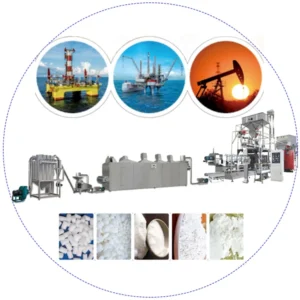
| Modified starch for textile sizing and paper coating | Maize starch, cassava starch |
| Modified starch for oil drilling fluids | Corn starch, potato starch with target viscosity profile |
| Fortified nutrition powder ingredients | Rice flour, soybean flour blended with starch carriers |
| Industrial chemical binders | High-amylose corn starch, tapioca starch |
Why "Nominal Capacity" Misleads Starch Buyers
A line rated on one starch type often stalls on another.
When a modified starch production line equipment for sale is quoted with a headline output figure, that number almost always assumes a specific raw material at a specific moisture level. Switch from corn starch to potato starch without recalibrating the screw configuration, barrel temperature profile and dryer residence time, and the extruder barrel gums up within hours. I watched a Southeast Asian plant lose five full days of production because the line was originally trialed on cassava starch while the buyer intended to run potato starch — the viscosity gap was so wide the die face clogged repeatedly. Throughput matching across every station only matters if the base raw material is confirmed first [NEED_CITE: twin-screw extrusion behavior across different starch sources].
Screw Configuration Dictates What Your Starch Becomes
Twin-screw extrusion gives processors control over shear intensity, residence time and temperature gradient — the three variables that determine the degree of starch gelatinization and molecular modification. The screw element arrangement and die geometry must be specified to the buyer’s actual starch source and target functional property, whether that is cold-water swelling viscosity for instant foods or thermal stability for industrial adhesives. A generic screw build copied from another application will either under-gelatinize the product or degrade the polymer chain beyond recovery.
Drying and Grinding Must Keep Pace with Extrusion Output
The extruder pushes modified starch out continuously, but if the downstream dryer cannot handle that volume at the required moisture reduction rate, wet product backs up and the entire line slows. Similarly, the grinding station must achieve the target particle size distribution without overheating the starch, which would undo the modification achieved in the barrel. This modified starch production line equipment for sale keeps every station throughput-matched under one supplier, so the dryer, grinder and blender are sized to the extruder’s actual output on your raw material rather than a generic catalog rating [NEED_CITE: industrial starch drying rate requirements].
What the Power and Dimension Figures Actually Mean
The jump from MT65 at 60 kW to MT85 at 145 kW reflects more than motor size — the MT85 line stretches nearly 29 meters and requires a 4.3-meter ceiling clearance, signaling a longer barrel, larger dryer and higher-capacity grinding and blending stations. The 22 kW extruder drive across the range provides sufficient torque for the shear forces needed in starch gelatinization, but the actual modification degree depends on screw speed, feed rate and barrel zone temperatures set through the PLC. The mixer’s 3 kW motor handles dry blending of raw starch with reagents before extrusion; if your formulation includes liquid additives or high-moisture components, confirm the mixer duty matches your recipe before locking the line configuration.
The Cost of Skipping a Raw Material Trial
Buyers who approve a line layout based on catalog capacity and skip the pre-shipment trial run often discover mismatched stations only after installation. A dryer that handles corn starch moisture perfectly may leave potato starch too wet for the grinder, forcing manual intervention and inconsistent product quality. Die designs optimized for one starch viscosity can produce uneven expansion or incomplete gelatinization on another, resulting in batches that fail the buyer’s own downstream specification [NEED_CITE: pre-gelatinized starch quality parameters for food applications].
Why Procurement Through One Equipment Range Matters
MT supplies the full station sequence — mixing, extrusion, drying, grinding, blending and packing — so throughput calculations are built on matched equipment rather than assembled from separate vendor catalogs. Screw configuration and die design are specified to the buyer’s starch type and target modification degree, not pulled from a generic template. An in-house testing workshop runs trial production on the buyer’s actual raw material before the line ships, catching viscosity and gelatinization mismatches early. PLC and MCC control is integrated across all stations from one control architecture. Electrical schematics confirm voltage, frequency and control language for the destination market before production begins.
Documentation & Verification
- Line layout drawing with throughput calculation matched to your starch type and target output
- Screw element arrangement and die design record specific to your raw material formulation
- In-house trial run report produced on your actual starch sample before shipment
- Electrical schematic confirming voltage, frequency and PLC language for your facility
- CE declaration of conformity and ISO certificate for the complete line assembly
Installation, Commissioning & Support
- MT85 line requires a 29×3.5 m clear floor area with 4.3 m ceiling height for the dryer section
- Total power draw up to 145 kW demands dedicated supply circuit with confirmed voltage and frequency
- Line arrives in station modules; assembly sequence follows the supplied layout drawing
- PLC and MCC commissioning includes parameter setting for your specific starch recipe
- Operator training covers screw configuration adjustment for different starch sources
- Wear parts list identifies screws, dies and mixer blades with recommended replacement intervals
What to Include in Your Inquiry
To configure the right modified starch production line equipment for sale for your plant, share your primary starch raw material and any secondary ingredients, the functional property your end market requires (such as target viscosity or gelatinization degree), and your intended daily output. Confirm your facility’s available floor space and ceiling height, local voltage and frequency, and preferred PLC operating language. If you can send a raw material sample, a pre-shipment trial run can be scheduled before the line enters production.
Frequently Asked Questions
Q: How is the output capacity of each line configuration verified?
A: The capacity figures for MT65, MT70 and MT85 depend on the specific starch raw material, its moisture content and the target modification degree. We confirm throughput by running your actual material in our testing workshop before finalizing the line specification, rather than quoting a generic catalog number that may not apply to your formulation.
Q: Which electrical specifications are confirmed before the line is built?
A: Voltage, frequency and PLC control language are confirmed during the specification stage, before production starts. The electrical schematic reflects your facility’s power supply and operator requirements, ensuring the line commissions without delays caused by mismatched electrical standards.
Q: How are screw and die designs chosen for different starch types?
A: Screw element arrangement, barrel temperature zones and die geometry are specified based on your raw material’s gelatinization behavior and the functional property your end product requires. Corn, cassava, potato and tapioca starches each demand different shear profiles and residence times inside the twin-screw extruder.
Q: Will a trial run on my raw material happen before the line ships?
A: Yes. Your raw material sample is processed through the extruder and supporting stations in our testing workshop. The trial run report documents output rate, product quality and station throughput balance, and any configuration adjustments are made before dispatch.
Q: Are replacement screws and dies available when wear parts need changing?
A: A wear parts list is supplied with the line, identifying screws, dies and other consumables with their specifications. Replacement parts are manufactured to the same configuration as the originals, so the line maintains its modification performance after maintenance.