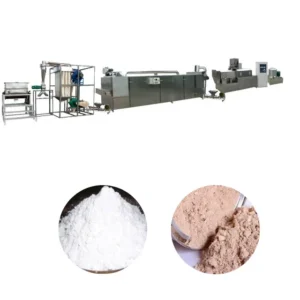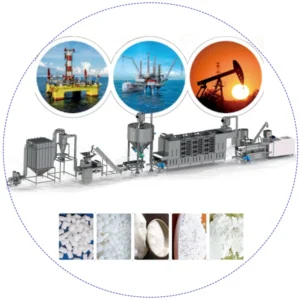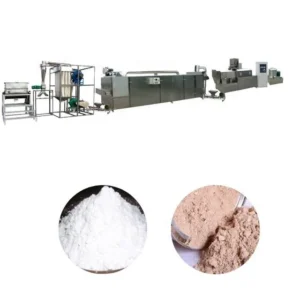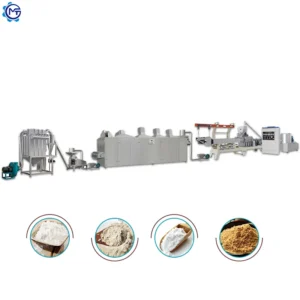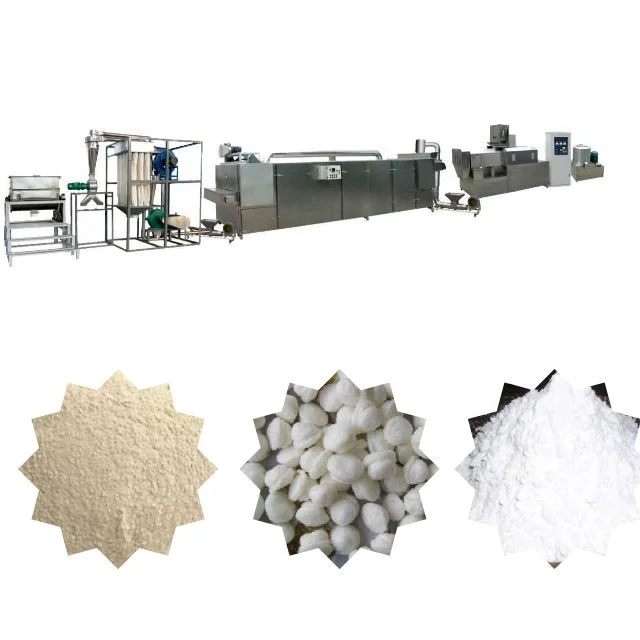
Integrated Line Engineering — A modified starch processing line full equipment range where mixing, extrusion, drying and grinding stations are capacity-matched under a single supplier to prevent hidden bottlenecks.
Technical Specifications
| Parameter | Value |
|---|---|
| Product Type | Modified Starch Processing Line (Twin-Screw Extrusion) |
| Model Options | MT70 / MT85 / MT75 |
| Screw Configuration | Twin-screw, 38CrMoAl alloy |
| MT70 Installed Power | 160 kW |
| MT70 Power Consumption | 120 kW |
| MT70 Output Capacity | 150–200 kg/h (basis not stated in source — confirm raw material type, moisture content and target starch modification degree) |
| MT70 Overall Dimensions | 41000 × 1500 × 2200 mm |
| MT85 Installed Power | 190 kW |
| MT85 Power Consumption | 140 kW |
| MT85 Output Capacity | 300–400 kg/h (basis not stated in source — confirm raw material type, moisture content and target starch modification degree) |
| MT85 Overall Dimensions | 43000 × 1500 × 3200 mm |
| MT75 Installed Power | 210 kW |
| MT75 Power Consumption | 150 kW |
| MT75 Output Capacity | 300–500 kg/h (basis not stated in source — confirm raw material type, moisture content and target starch modification degree) |
| MT75 Overall Dimensions | 45000 × 1500 × 3500 mm |
| Extruder Screw Diameter (MT70) | 70 mm |
| Extruder Screw Length (MT70) | 1510 mm |
| Extruder Main Motor (MT70) | 30 kW |
| Extruder Heating Zones (MT70) | 7 zones × 2 kW = 14 kW |
| Barrel Cooling | Dedicated barrel cooling system |
| Mixer Batch Options | 20–30 kg / 70–80 kg / 170–180 kg |
| Mixer Power | 4 kW / 7.5 kW / 15 kW |
| Mixer Material | 201SS or 304SS stainless steel |
| Dryer Type | 5-layer baking oven |
| Dryer Dimensions | 5000 × 1200 × 2300 mm |
| Dryer Power | 3 kW |
| Dryer Fuel Options | Gas / Diesel / Electricity / Steam |
| Dryer Speed | Inverter controlled |
| Grinder Type | Pulse grinder with cyclone discharge and dust collector |
| Voltage | 380V 50Hz 3-phase (configurable to 380V/60Hz, 415V/60Hz, 220V/60Hz) |
| Control | PLC and MCC |
| Contact Material | Food-grade stainless steel |
| Warranty | 1 year, lifetime maintenance |
Application Suitability
| Application | Material or Output |
|---|---|
| Pre-gelatinized starch production | Corn starch, wheat starch |
| Modified starch for food ingredients | Corn, wheat and specialty starch sources |
| Expanded corn starch processing | Corn starch with controlled moisture and shear |
| Industrial modified starch | Starch sources requiring controlled gelatinization degree |
| Nutritional starch bases | Pre-gelatinized starch for infant formula and dietary products |
What the Quoted Capacity Figure Leaves Out About Modified Starch Lines
The capacity number on a modified starch processing line full equipment range proposal means very little unless it states the raw material type, moisture content and the target modification degree.
I learned this the hard way. A client purchased one of these lines after watching a trial run on standard corn starch. The numbers looked right, the texture was consistent, and the output matched expectations. Then they shipped the machine home and fed it their high-amylose specialty starch. Gelatinization was uneven, the extrudate stuck to the dryer belts, and the final powder had a gritty texture that their customers rejected outright [NEED_CITE: starch modification degree and amylose content effects on extrusion behavior]. We had to send an engineer overseas to re-profile the barrel temperature and reconfigure the screw elements. The issue was not the extruder itself — it was that the line had never been tested on the buyer’s actual raw material before it left the factory.
Matching Every Station to Prevent Downstream Chokepoints
A modified starch processing line full equipment range is only as productive as its weakest station. If the mixer batches 180 kg but the extruder can only accept 70 kg/h, the mixer sits idle between batches. If the dryer cannot handle the moisture load coming off the extruder, material backs up and gelatinization continues uncontrolled. Each station on the MT70, MT85 and MT75 lines is specified so that the mixer batch size, extruder throughput, dryer belt speed and grinder feed rate align to a single target output.
Barrel Temperature Control and Starch Gelatinization
The twin-screw extruder uses a dedicated barrel cooling system alongside seven independently controlled heating zones. During starch modification, the material must pass through precise temperature windows — too low and gelatinization is incomplete, leaving raw starch granules in the final powder; too high and the starch degrades, losing the functional properties the buyer needs [NEED_CITE: thermal degradation thresholds in starch extrusion processing]. The cooling system pulls heat from zones where shear generates excess temperature, maintaining the profile that the screw configuration and die design demand.
Reading the Specs: What Matters for Starch Extrusion
The L/D ratio of the extruder screw — 1510 mm length on a 70 mm diameter for the MT70 — determines how long the starch remains inside the barrel under heat and shear. A longer residence time allows more complete gelatinization but increases the risk of thermal degradation if temperature control is imprecise. The 38CrMoAl screw material resists the abrasive wear that starch causes over extended production runs, which matters because worn screw flights change the shear profile and shift the modification degree. The pulse grinder with cyclone discharge and integrated dust collector produces a consistent particle size in the final powder — inconsistent grind size means the starch hydrates unevenly when the end user incorporates it into their food or industrial formulation. Available voltage configurations from 380V/50Hz to 415V/60Hz ensure the motor and heating elements operate within their rated range at the installation site [NEED_CITE: voltage and frequency standards by export market].
The Cost of Skipping the Raw Material Trial
When a modified starch processing line ships without a trial run on the buyer’s specific starch source, the first production run becomes the trial — on the buyer’s factory floor, with the buyer’s raw material cost and the buyer’s delivery deadlines at stake. A screw configuration designed for standard corn starch will produce different shear, expansion and density results on high-amylose or waxy maize starch. The dryer temperature and belt speed set for one moisture content will over-dry or under-dry material with a different starting point. These mismatches surface only during live production, when reconfiguration costs multiply [NEED_CITE: commissioning delays from unconfirmed raw material specifications].
Why Source the Full Range from One Supplier
The MT70, MT85 and MT75 models share a common control architecture, so operators trained on one line can operate any of the three without relearning the interface. The screw configuration and die design are specified to the buyer’s raw material and target starch modification type rather than copied from a generic template. Every line goes through a trial run in the testing workshop using the buyer’s actual starch before it ships, producing a test report that documents output, texture and gelatinization degree. Food-grade stainless steel contact surfaces throughout the line — from mixer to grinder — meet hygiene standards for food ingredient production. The 5-layer dryer with inverter speed control and selectable fuel options adapts to whatever utility supply exists at the installation site.
Documentation & Verification
- Line layout showing station-by-station throughput calculation for your target starch output
- Screw and die configuration record matched to your specific starch source and modification type
- Trial run report documenting gelatinization degree and powder texture on your raw material
- Electrical schematic confirming voltage, frequency and control language before production
- CE declaration of conformity and ISO certificate for customs and regulatory clearance
- Wear parts list covering screws, dies, grinder blades and filter pockets with reorder codes
Installation, Commissioning & Support
- Foundation must support 41–45 meter line length depending on model selected with level floor tolerance
- Dedicated electrical circuit required matching confirmed voltage and frequency rating at 120–210 kW installed power
- Line arrives factory-assembled in sections and requires on-site station alignment and utility connection
- First startup includes barrel temperature profiling and screw speed tuning for your starch modification target
- Operator training covers PLC interface, batch recipe management and emergency stop procedures
- Spare screw elements, die inserts, grinder rotor blades and filter pockets supplied with initial shipment
What to Include in Your Inquiry
Provide your starch source type — corn, wheat, potato or specialty — along with the amylose content and any existing modification specifications your market requires. Confirm the daily or hourly output target so we can match the correct extruder model with the appropriate mixer batch size and dryer capacity. Share your site voltage, frequency and the fuel type available for the dryer so these are locked in before production begins.
Frequently Asked Questions
Q: How is the output capacity of a modified starch processing line verified before shipment?
A: We run your actual raw material through the line in our testing workshop and document the throughput, gelatinization degree and final powder texture in a trial run report. This confirms whether the quoted capacity holds under your specific starch type, moisture content and modification target rather than on a generic reference material.
Q: What voltage and control system options are available for different export markets?
A: The line is configurable for 380V/50Hz, 380V/60Hz, 415V/60Hz or 220V/60Hz three-phase supply. The PLC and MCC control system language is set to match the operator’s working language. Voltage and control language are confirmed before production to prevent commissioning delays at the installation site.
Q: How are the mixer, extruder and dryer capacities matched to prevent bottlenecks?
A: Each station is selected based on the target line output and the specific starch processing requirements. The mixer batch size feeds the extruder continuously, the 5-layer dryer belt speed is set to handle the moisture load from extrusion, and the grinder feed rate matches the dried output so no single station limits throughput.
Q: Can the dryer fuel type be matched to our on-site utility supply?
A: The 5-layer dryer is available with gas, diesel, electricity or steam heating, selected at the time of order to match the fuel infrastructure at your facility. Inverter speed control allows belt speed adjustment during production to fine-tune drying time and final moisture content.
Q: What spare wear parts ship with the line and how are reorders handled?
A: The initial shipment includes spare screw elements, die inserts, grinder blades and filter pockets sufficient for early production runs. A complete wear parts list with part numbers is provided so reorders can be placed with sufficient lead time to avoid production interruptions when replacement is due.