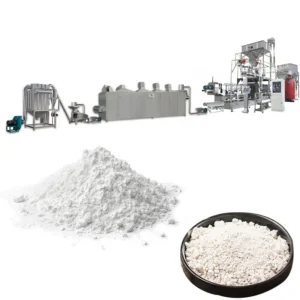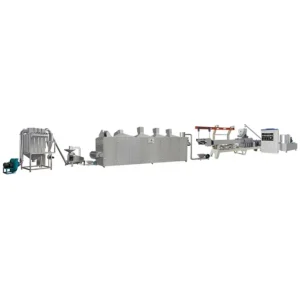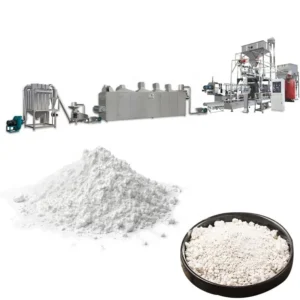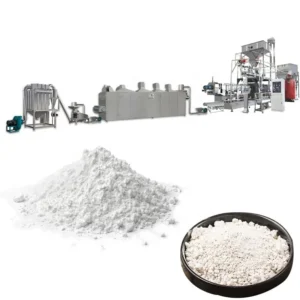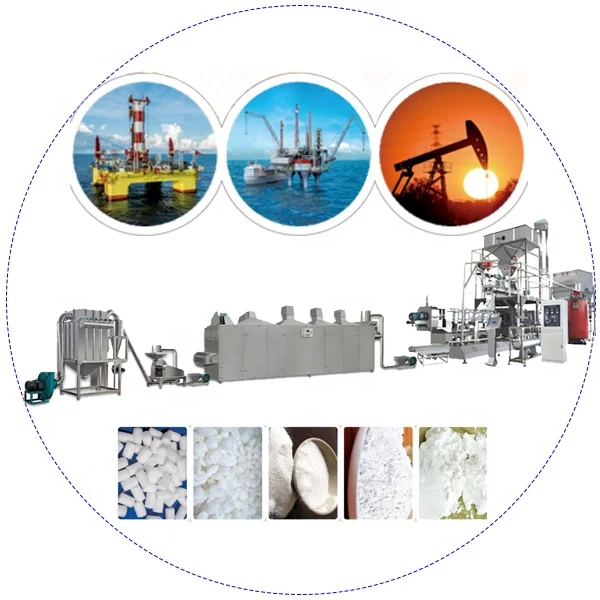
Screw and die configuration specified to your raw material — every MT70 modified starch processing line is built around the buyer’s actual starch source and target modification level, not a generic build copied across applications.
Technical Specifications
| Parameter | Value |
|---|---|
| Product Type | Modified Starch Processing Line |
| Model | MT70 |
| Screw Type | Twin screw |
| Raw Materials | Corn starch, wheat flour, rice flour, soybean flour, potato starch, and other grain flours |
| Rated Power | 45–200 kW (basis to be confirmed by specific model variant) |
| Output Capacity | 100–1500 kg/h (basis to be confirmed by raw material type, moisture content, and target starch specification) |
| Weight | 1000–5000 kg (basis to be confirmed — single extruder or complete line) |
| Voltage & Frequency | 220–440 V, tri-phase (configurable to 380 V 50 Hz, 415 V 60 Hz, 220 V 60 Hz) |
| Control System | PLC and MCC control |
| Line Stations | Twin screw extruder, cooling conveyor, pulse grinder with cyclone discharge and dust collector |
| Contact Materials | Food-grade stainless steel (except PVC conveyors) |
| Fuel Options | Gas, diesel, electricity, steam (to be confirmed at quotation stage) |
| Certification | CE, ISO certified |
Application Suitability
| Application | Material or Output |
|---|---|
| Food-grade modified starch for sauces, bakery, and instant foods | Corn starch, wheat flour, potato starch, tapioca starch |
| Pre-gelatinised starch for instant food and nutritional powders | Rice flour, corn starch, soybean flour |
| Industrial modified starch for oil drilling fluids | Corn starch, potato starch |
| Modified starch for papermaking and corrugated board adhesives | Wheat flour, corn starch |
| Starch-based nutritional and infant formula powder bases | Rice flour, soybean flour, grain blends |
What a Nominal Capacity Figure Leaves Out About Your Starch Line
A capacity number without raw material and moisture context is not a capacity — it is a starting guess.
I once watched a buyer receive a line quoted on corn starch parameters, only to run cassava starch through it and find the gelatinisation temperature was off by over ten degrees. The drying section could not bring moisture down to spec, and the entire first production run was downgraded. The modified starch processing line full equipment range was never the problem — the problem was that throughput had been confirmed on the wrong material. Output capacity, screw speed, barrel temperature profile, and dryer retention time all shift when you change from one starch source to another [NEED_CITE: gelatinisation temperature ranges across corn, potato, tapioca, and wheat starch].
Extruder Configuration That Follows Your Starch Source
The twin screw extruder sits at the centre of any modified starch processing line, and its screw configuration determines whether you get consistent gelatinisation or uneven shear across the barrel. For corn starch, the screw profile needs to manage a higher gelatinisation onset compared to potato or tapioca starch, which means different kneading block arrangement and barrel zone temperature settings. The die design then controls expansion and density of the extrudate before it reaches the cooling conveyor, and a mismatch here shows up immediately as inconsistent particle size after grinding.
Cooling and Grinding as a Matched Pair
The cooling conveyor stabilises the extrudate temperature before it enters the pulse grinder, preventing moisture condensation inside the grinding chamber. The pulse grinder uses cyclone discharge with an integrated dust collector to achieve a consistent particle size distribution, which is critical when your end customer specifies mesh size for bakery or sauce applications. If the grinder capacity is undersized relative to the extruder output, material backs up on the conveyor and the line cannot sustain its target throughput regardless of what the nameplate says [NEED_CITE: particle size specification requirements for food-grade and industrial modified starch].
Reading the Specs That Actually Matter
The rated power band of 45–200 kW reflects the range across model variants configured for different throughputs and starch types — a line set up for high-volume corn starch pre-gelatinisation draws substantially more energy than one running small-batch rice flour modification. Voltage and frequency are configurable across 220–440 V tri-phase, which matters because commissioning delays from power supply mismatches are among the most common avoidable problems on international machinery installations. The PLC and MCC control system manages barrel temperature zones, screw speed, and feed rate in coordination, so batch-to-batch consistency depends on how those parameters are tuned during commissioning to your specific starch source and target modification level. Food-grade stainless steel contact materials throughout the processing path ensure compliance with food safety requirements when producing starch for human consumption applications.
The Hidden Cost of Mismatched Line Stations
When an extruder is specified without matching dryer or grinder capacity, the bottleneck is invisible until installation day. The line may run fine during a short factory test on a small sample, but sustained production reveals that one station cannot keep pace with the others. Buyers then face the choice of running below rated output or adding a second grinder after the fact, which means additional floor space, electrical circuits, and dust collection ductwork that were never in the original layout [NEED_CITE: throughput matching across extrusion line stations].
Why Source the Full Line from One Equipment Range
Every station in this modified starch processing line — mixing, extrusion, cooling, grinding, and packing — is sourced from one supplier, so throughput is matched across every station rather than assembled from separate vendors with mismatched capacities. The screw configuration and die design are specified to your raw material and target product, not pulled from a generic template. An in-house testing workshop allows trial runs on your actual starch before shipment, producing a trial run report that documents real output and product quality. Electrical schematics and voltage confirmation are completed before production begins, preventing commissioning delays at your facility. Documentation includes line layout and capacity calculation showing matched throughput at every station.
Documentation & Verification
- Line layout and capacity calculation document showing matched throughput across every station for your starch type
- Screw and die configuration record specified to your raw material and target modification level
- Factory trial run report on your actual starch raw material conducted before shipment
- Electrical schematic and voltage confirmation document matching your facility power supply
- CE declaration of conformity and ISO certificate for customs and regulatory clearance
Installation, Commissioning & Support
- Foundation and floor space planning based on the complete line footprint from extruder through pulse grinder
- Dedicated electrical circuit sized to the confirmed 45–200 kW rated power and your local voltage configuration
- On-site assembly and alignment of the twin screw extruder, cooling conveyor, and grinder stations
- First-run parameter tuning of barrel temperature zones and screw speed on your specific starch raw material
- Operator training covering PLC and MCC control interface, daily maintenance, and screw wear inspection
- Wear parts list with lead times for screws, dies, and grinder components to support your maintenance schedule
What to Prepare Before Requesting a Quotation
To size the modified starch processing line full equipment range correctly, we need your starch raw material type and source origin, target moisture content and mesh size specification, daily or hourly production target, and your facility voltage and frequency. Share your existing upstream batching or downstream packing equipment details if the line must integrate with an installed system, and let us know if you want a trial run on your raw material before shipment.
Frequently Asked Questions
Q: How is output capacity verified on my specific starch raw material and moisture level?
A: Output capacity is confirmed through a trial run in the testing workshop using your actual starch raw material at your specified moisture content. The resulting trial run report documents real throughput, product moisture, and particle size so you know what the line produces before it ships, rather than relying on a generic capacity figure.
Q: What screw configuration and die design will be specified for my target modified starch product?
A: The screw configuration and die design are selected based on your specific starch source, target modification level, and desired extrudate density. A configuration record is provided documenting the kneading block arrangement, screw element sequence, and die geometry chosen for your application.
Q: Can the line be matched to my existing upstream batching or downstream packing equipment?
A: Yes, the line layout is designed to interface with your existing upstream batching system or downstream packing line. Throughput at every station is calculated to match your installed equipment so no single station becomes a bottleneck during continuous production.
Q: What voltage, frequency, and control language options are confirmed before production?
A: Voltage and frequency are confirmed from 220–440 V tri-phase options to match your facility supply, and the PLC control language is set to your preference. An electrical schematic and voltage confirmation document is provided before production begins to prevent commissioning delays.
Q: Is a trial run on my raw material conducted before shipment, and what documentation is provided?
A: A trial run is conducted in the in-house testing workshop using your raw material before shipment. You receive a trial run report documenting throughput, product quality parameters, and the specific machine settings used, so your team can reference it during installation and commissioning.