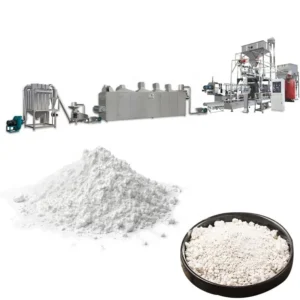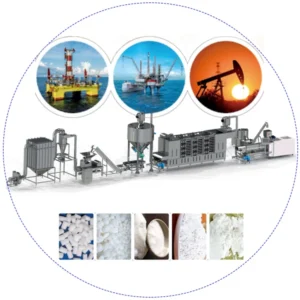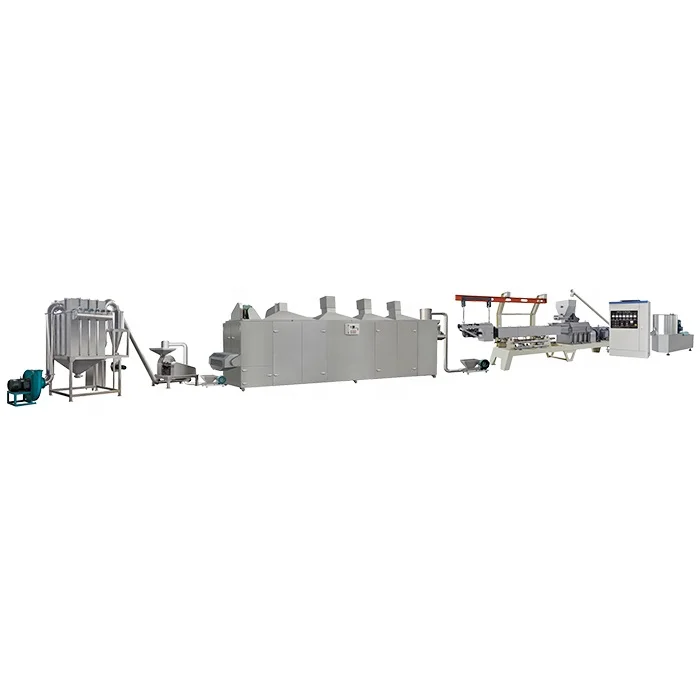
Complete Station Coverage — every mixer, twin-screw extruder, dryer and grinder in one modified starch processing line is specified for matched throughput before the layout is drawn.
Technical Specifications
| Parameter | Value |
|---|---|
| Product Type | Modified Starch Extrusion Production Line |
| Models Available | MT70, MT85, MT75 |
| Screw Type | Twin-screw |
| Screw Diameter (MT70) | 70 mm |
| Screw Length (MT70) | 1520 mm |
| Screw Material | 38CrMoAl |
| Installed Power | 160 kW (MT70), 190 kW (MT85), 210 kW (MT75) |
| Power Consumption | 120 kW (MT70), 140 kW (MT85), 150 kW (MT75) |
| Output Capacity (MT70) | 150–200 kg/h (basis not stated in source — confirm raw material type, moisture content and target modification degree) |
| Output Capacity (MT85) | 300–400 kg/h (basis not stated in source — confirm raw material type, moisture content and target modification degree) |
| Output Capacity (MT75) | 300–500 kg/h (basis not stated in source — confirm raw material type, moisture content and target modification degree) |
| Overall Dimensions (MT70) | 41000 × 1500 × 2200 mm |
| Overall Dimensions (MT85) | 43000 × 1500 × 3200 mm |
| Overall Dimensions (MT75) | 45000 × 1500 × 3500 mm |
| Voltage & Frequency | 380V 50Hz Three Phase (configurable to 415V/60Hz, 220V/60Hz, etc.) |
| Control System | PLC and MCC |
| Barrel Temperature Control | Individual heating zones with integrated cooling |
| Main Motor Power (MT70 Extruder) | 30 kW |
| Feeding / Cutting / Oil Pump (MT70) | 0.75 kW / 0.75 kW / 0.37 kW |
| Heating Ring Configuration (MT70) | 7 zones × 2 kW = 14 kW |
| Mixer Capacity Options | 20–30 kg/time, 70–80 kg/time, 170–180 kg/time |
| Mixer Power Options | 4 kW / 7.5 kW / 15 kW |
| Mixer Material | 201SS or 304SS stainless steel |
| Dryer Type | 5-layer baking oven |
| Dryer Dimensions | 5.0 × 1.2 × 2.3 m |
| Dryer Power | 3 kW |
| Dryer Fuel Options | Gas / Diesel (electricity and steam also available) |
| Dryer Speed Control | Inverter-based |
| Dryer Weight | 1800 kg |
| Dryer Material | 201 stainless steel (standard) |
| Grinder Type | Pulse grinder with cyclone discharge and dust collector |
| Assembly State | Complete line, factory-assembled and tested before shipment |
| Warranty | 1 year complete warranty with lifetime maintenance |
| Certification | CE, ISO |
Application Suitability
| Application | Material or Output |
|---|---|
| Food-grade modified starch for thickeners and stabilizers | Potato starch, cassava starch, corn starch, wheat flour |
| Textile sizing agents | Modified corn and wheat starch for warp yarn treatment |
| Paper coating and surface sizing | Pregelatinised starch from cassava and potato sources |
| Building material additives | Modified starch for gypsum board and dry-mix mortar |
| Oil drilling fluid additives | Pre-gelatinised corn and cassava starch |
| Casting binder compounds | Modified starch for sand mould binding |
Why Starch Source Matters More Than the Nameplate Capacity
A line rated for corn starch can stall on cassava if the screw configuration is not re-matched to the raw material.
I have stood in workshops where a modified starch processing line sat idle for weeks because the screw profile was copied from a corn starch reference and the buyer’s cassava feed required completely different shear and residence time settings. The extruder barrel temperatures climbed, the gelatinisation degree fell short of specification, and the entire downstream dryer and grinder simply recirculated under-processed material. No amount of operator adjustment compensates for a screw and die combination that was never matched to the actual starch source [NEED_CITE: starch gelatinisation behaviour across tuber and cereal sources]. The full equipment range shown here lets you verify that every station — mixer, extruder, dryer, grinder — is sized and configured for your specific raw material before the line is built.
Matching Every Station in the Modified Starch Processing Line
A modified starch processing line is only as fast as its slowest station. The mixers listed here span from 20–30 kg per batch up to 170–180 kg per batch, with power options from 4 kW to 15 kW, so the blending stage can keep pace with whichever extruder model you select. The 5-layer dryer uses inverter speed control and multiple fuel options to handle varying moisture loads coming off the extruder die. When throughput balance is verified at the layout stage, you avoid the common problem of an extruder pushing material faster than the dryer can remove moisture.
Controlling Gelatinisation Across Starch Varieties
Potato starch gelatinises at a lower temperature range than corn starch, and cassava falls somewhere between them. The twin-screw extruder in this range uses seven individually controlled heating zones with integrated barrel cooling, allowing the temperature profile to be shaped to the specific starch source. The 38CrMoAl screw material resists the abrasive wear that raw starch granules produce over extended production runs. Screw configuration — including element spacing, kneading block arrangement and die aperture — is specified against the buyer’s raw material and target modification type, not taken from a generic catalogue build [NEED_CITE: twin-screw element configuration for starch modification].
Reading the Specs Against Your Production Target
The three extruder models — MT70, MT85, MT75 — cover distinct installed power tiers from 160 kW to 210 kW, and the corresponding actual power consumption ranges from 120 kW to 150 kW. The MT70 extruder unit alone draws 30 kW on the main motor, with separate drives for feeding, cutting and lubrication. Overall line lengths run from 41 m to 45 m, so floor space planning should account for the full footprint including mixer, conveyor, dryer and grinder stations. Voltage is configurable across common industrial standards — 380V/50Hz, 415V/60Hz, 220V/60Hz — and must be confirmed with the destination site’s electrical infrastructure before production starts. The PLC and MCC control architecture allows the entire modified starch processing line to be monitored from a single interface, with language and alarm settings matched to the operator team.
What Happens When Dryer and Grinder Are Undersized
I have seen lines where the extruder was correctly specified but the dryer could not remove moisture fast enough, forcing the operator to reduce feed rate and run the extruder well below its capacity. The grinder downstream then received material that was still too moist, causing screen blinding and inconsistent particle size. On a modified starch processing line, the pulse grinder with cyclone discharge depends on the dryer delivering material at a stable moisture level. If any upstream station is undersized, the bottleneck propagates through every subsequent stage and the nameplate output becomes irrelevant [NEED_CITE: moisture balance between extrusion and drying in starch processing].
Why Buyers Specify the Full Range Here
Every station in this modified starch processing line is catalogued with its own capacity and utility data, so buyers can cross-check throughput matching before committing to a layout. Screw and die configurations are documented against the buyer’s raw material — potato, cassava, corn or wheat — rather than copied from a standard build. The in-house testing workshop runs trial extrusion on the buyer’s actual starch sample before the line ships, so gelatinisation degree and expansion behaviour are verified early. Electrical schematics, voltage and control language are confirmed during the specification stage, not discovered during commissioning. CE and ISO documentation accompanies every shipment, and the factory test record is provided alongside the operation manual.
Documentation & Verification
- Line layout and capacity calculation sheet covering mixer through grinder stations
- Screw and die configuration record matched to your starch source and modification target
- Electrical schematic with confirmed voltage, frequency and control language
- Trial run report on your raw material conducted in the testing workshop before dispatch
- CE declaration of conformity and ISO certificate for the complete line
- Operation and maintenance manual with wear parts list and packing photographs
Installation, Commissioning & Support
- Floor space of up to 45 m length requires level concrete foundation with anchor provisions for the 1800 kg dryer
- Dedicated three-phase circuit sized to the confirmed installed power tier (up to 210 kW for MT75)
- Line arrives in modular sections; extruder barrel and screw assembly is aligned on-site during commissioning
- PLC and MCC parameters are loaded with your recipe data and operator language during first startup
- Operator training covers barrel zone temperature adjustment, screw speed and feeder rate coordination
- Wear parts list includes 38CrMoAl screw elements, die plates and dryer belt sections for first replacement cycle
- Dryer fuel system — gas, diesel, electricity or steam — is connected to site utility during installation
What to Include in Your Inquiry
To match the right extruder model and supporting stations to your project, share your starch source (potato, cassava, corn or wheat), the target modification type, and your intended hourly output. Confirm your site voltage, frequency and preferred control language. If you have an existing upstream batching system or downstream packing line, describe the interface points so the layout accounts for them. Requesting a trial run on your raw material in the testing workshop is recommended before the line enters production.
Frequently Asked Questions
Q: How is output capacity verified against my specific starch source and modification target?
A: The capacity figures listed for each model are nominal references. Actual throughput depends on your starch type, moisture content and the modification degree required. We run a trial on your raw material in the testing workshop before shipment and document the results, so the confirmed output reflects your actual production conditions rather than a generic benchmark.
Q: What voltage, frequency and control language options are available for my destination market?
A: The standard configuration is 380V 50Hz three-phase, but the line can be built for 415V/60Hz, 220V/60Hz and other industrial standards. The PLC and MCC control system supports multiple operator languages. Voltage and language must be confirmed before production begins to avoid commissioning delays.
Q: How do I ensure the dryer and grinder capacity matches the extruder output?
A: The full equipment range includes dryer and grinder specifications alongside each extruder model, so throughput balance is checked at the layout stage. The 5-layer dryer uses inverter speed control and selectable fuel sources to match the moisture load, and the pulse grinder handles the dried output with cyclone discharge.
Q: Can I run a trial on my raw material before the line ships?
A: Yes. The in-house testing workshop conducts extrusion trials using your actual starch sample. The trial run report documents gelatinisation degree, expansion behaviour and output rate, and the screw and die configuration is adjusted based on these results before the production line is finalised.
Q: What supporting equipment is included, and where does packing fit into the line scope?
A: The line covers mixer, twin-screw extruder, dryer and pulse grinder as standard stations. Packing is handled through a third-party partner and can be integrated into the layout. The line layout document shows the recommended interface point for your chosen packing system.