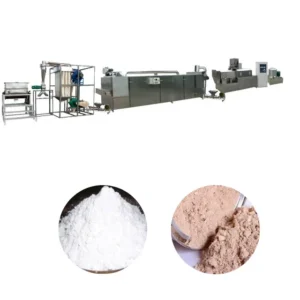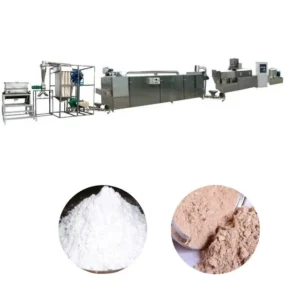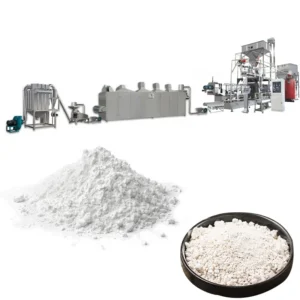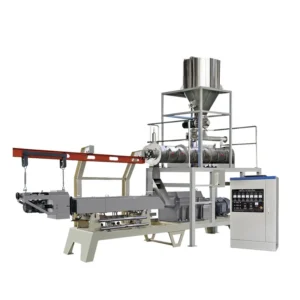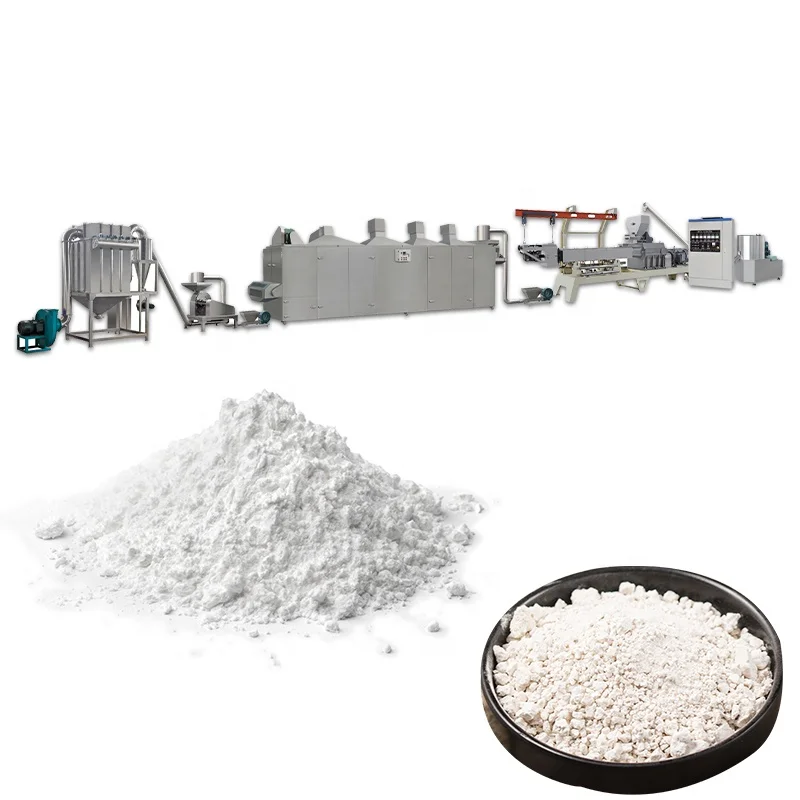
Precision-Modified Starch Extrusion Lines — every station from batching to packing is throughput-matched under one manufacturer, eliminating the dryer bottleneck that plagues fragmented starch line assemblies.
Technical Specifications
| Parameter | Value |
|---|---|
| Product Type | Modified Starch Twin-Screw Extrusion Production Line |
| Models Available | MT70 / MT85 / MT100 |
| Screw Type | Twin-screw |
| Screw Diameter | 70 mm (MT70) |
| Screw Length | 1520 mm (MT70) |
| Screw Material | 38CrMoAl |
| Main Motor Power | 30 kW (MT70 extruder) |
| Installed Power | 160 kW (MT70 line) / 190 kW (MT85 line) / 210 kW (MT100 line) |
| Power Consumption | 120 kW (MT70 line) / 140 kW (MT85 line) / 150 kW (MT100 line) |
| Output Capacity | 150–200 kg/h (MT70, basis to be confirmed) / 300–400 kg/h (MT85, basis to be confirmed) / 300–500 kg/h (MT100, basis to be confirmed) |
| Voltage & Frequency | 380 V, 50 Hz, Three Phase (configurable to 380 V/60 Hz, 415 V/60 Hz, 220 V/60 Hz) |
| Barrel Temperature Control | 7 heating zones × 2 kW with integrated cooling system |
| Extruder Dimension | 2900 × 900 × 1820 mm (MT70) |
| Overall Dimensions | 41000 × 1500 × 2200 mm (MT70 line) / 43000 × 1500 × 3200 mm (MT85 line) |
| Contact Material | Food-grade stainless steel (PVC on select conveyors) |
| Control System | Available with PLC and MCC control |
| Fuel Options for Dryer | Gas, diesel, electricity, or steam |
| Line Stations | Mixing, batching, conveying, twin-screw extrusion, drying, cooling, packing |
| Standards | CE, ISO |
Application Suitability
| Application | Material or Output |
|---|---|
| Pregelatinised starch for oil drilling fluids | Corn starch, cassava starch, wheat starch |
| Modified starch for textile sizing and paper coating | Starch derivatives requiring specific viscosity profiles |
| Functional starch for bakery and sauce formulations | Thermally modified starch with controlled gelatinisation |
| Industrial starch for construction and adhesive use | High-substitution modified starch from varied botanical sources |
Why Nominal Capacity Ratings Mislead Starch Buyers
A modified starch processing line equipment rating means nothing unless verified against your actual raw material and moisture content.
Buyers frequently specify a line based on a brochure figure, only to discover during commissioning that the extruder cannot sustain that throughput on their specific starch source. A machine rated for corn starch at a particular moisture level may lose significant output when fed cassava or potato starch, throwing the entire drying and packing sequence out of rhythm. The modified starch processing line equipment must be configured around the botanical source and the target degree of modification, not a generic laboratory benchmark [NEED_CITE: starch gelatinisation behaviour across botanical sources].
How Screw Configuration Dictates Gelatinisation Uniformity
The twin-screw architecture allows operators to rearrange screw elements to control shear intensity and residence time within the barrel. For modified starch processing line equipment, this configurability is essential because different starch granule structures demand different mechanical energy inputs to achieve uniform gelatinisation. A tightly intermeshing screw profile generates high shear for rapid granule disruption, while a more open arrangement provides gentler treatment suitable for sensitive derivatives.
Barrel Cooling and the Control of Peak Temperature
Starch modification occurs within a narrow thermal window. Exceed it and you degrade molecular weight; fall short and gelatinisation remains incomplete. The seven heating zones with integrated cooling circuits on this modified starch processing line equipment allow precise management of the temperature profile along the barrel length. Each zone can be independently regulated, which is critical when transitioning between starch types that have different gelatinisation onset temperatures [NEED_CITE: thermal profiles for starch modification in twin-screw extrusion].
Reading the Specification Sheet with a Process Engineer’s Eye
The 1520 mm screw length on the MT70 provides an L/D ratio that determines how long material stays under thermal and mechanical stress. A longer residence time supports higher degrees of modification but reduces throughput; a shorter one favours volume over conversion depth. The 38CrMoAl screw material resists abrasive wear from starch granules, preserving element geometry over extended production campaigns. The 30 kW main motor must deliver sufficient torque to push viscous, partially gelatinised starch through the die plate without stalling, which is why installed power figures alone do not tell the whole story. Dryer fuel options — gas, diesel, electricity, or steam — should be selected based on local utility costs and the moisture removal load dictated by extruder output.
The Hidden Cost of Mismatched Dryer Capacity
An extruder producing material faster than the dryer can handle creates a queue of wet, partially modified starch that degrades on the conveyor. Conversely, an oversized dryer wastes energy and can over-dry product, altering viscosity characteristics. When stations are sourced from separate vendors, throughput alignment becomes the buyer’s problem. This line addresses that risk by matching every station under one supply scope, though verification before order remains essential [NEED_CITE: throughput matching in multi-station food processing lines].
Why Sourcing the Entire Line from One Builder Matters
Single-supplier responsibility means throughput calculations, utility planning, and control integration are handled before equipment leaves the factory. The screw and die configuration is specified to the buyer’s starch source rather than borrowed from a generic build. An in-house testing workshop allows trial runs on the customer’s actual raw material before shipment, revealing gelatinisation behaviour and throughput reality. Voltage, frequency, and control language are confirmed during the engineering phase to prevent commissioning delays. Documentation — from line layout to trial run reports — is issued as a unified package rather than collected from multiple sources.
Documentation & Verification
- Line layout and capacity calculation matched to your starch source and target modification degree
- Screw and die configuration record specific to your raw material before order placement
- Electrical schematic with voltage and control language confirmation for your facility
- Factory trial run report on your actual starch material before shipment
- CE declaration of conformity and ISO certificate included with shipping documentation
Installation, Commissioning & Support
- Foundation must accommodate the 41-metre line length with level tolerance for conveyor alignment
- Dedicated three-phase circuit required for the 160 kW installed power draw on the MT70 line
- Stations arrive as modular units requiring on-site mechanical and electrical integration
- First-run parameter setting covers barrel temperature profile and screw speed calibration
- Operator training addresses screw element rearrangement for different starch sources
- Wear parts list identifies screws, dies, and heating rings requiring periodic replacement
Preparing Your Inquiry
Provide the botanical source of your starch, the target modification or gelatinisation degree, and your required hourly output on that specific material. Include your facility’s voltage and frequency standard, preferred control language, and available floor space to support layout planning. Indicate whether you require a trial run on your raw material before the line ships.
Frequently Asked Questions
Q: How is output capacity verified against the buyer’s actual starch raw material and moisture content?
A: Capacity figures in specifications assume a reference starch source and moisture level. Before order confirmation, the buyer’s actual material is run in the testing workshop to measure real throughput, gelatinisation degree, and downstream dryer load. The resulting trial report forms the basis for final line configuration and guaranteed output.
Q: What screw and die configuration is selected for different starch types and target modification degrees?
A: Screw elements are rearranged to adjust shear intensity and residence time according to the starch granule structure and desired conversion level. Die aperture and land length are selected to control expansion and density of the extrudate. The configuration record is documented and shared with the buyer before production begins.
Q: How is dryer capacity matched to extruder output to avoid line bottleneck?
A: Dryer length, belt width, and heat input are calculated based on the moisture removal load at the extruder’s verified throughput. Because all stations are supplied under one scope, throughput alignment is engineered during the layout phase rather than left to on-site adjustment, preventing wet product queues or energy waste.
Q: Which voltage and frequency options are available, and how is control system language confirmed before shipment?
A: The line is configurable to 380 V/50 Hz, 415 V/60 Hz, 220 V/60 Hz, and other regional standards. Electrical schematics and control language are confirmed during the engineering phase. The PLC and MCC panels are programmed and labelled in the buyer’s preferred language before the line leaves the factory.
Q: What does the in-house trial run on customer raw material cover before the line ships?
A: The trial run uses the buyer’s supplied starch to measure throughput, gelatinisation uniformity, extrudate texture, and dryer performance. Parameters including screw speed, barrel temperature profile, and die selection are recorded. A trial report documenting these results accompanies the shipment and serves as the commissioning baseline.