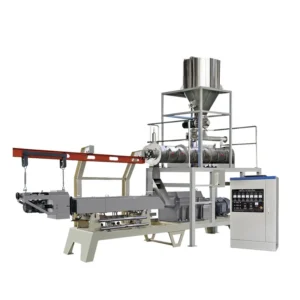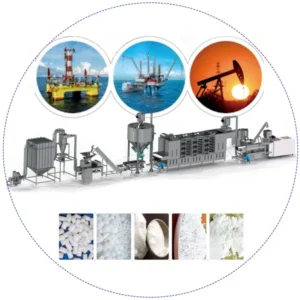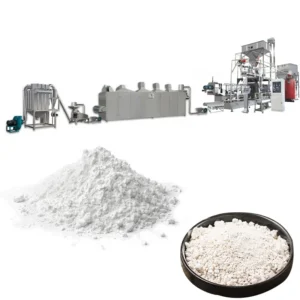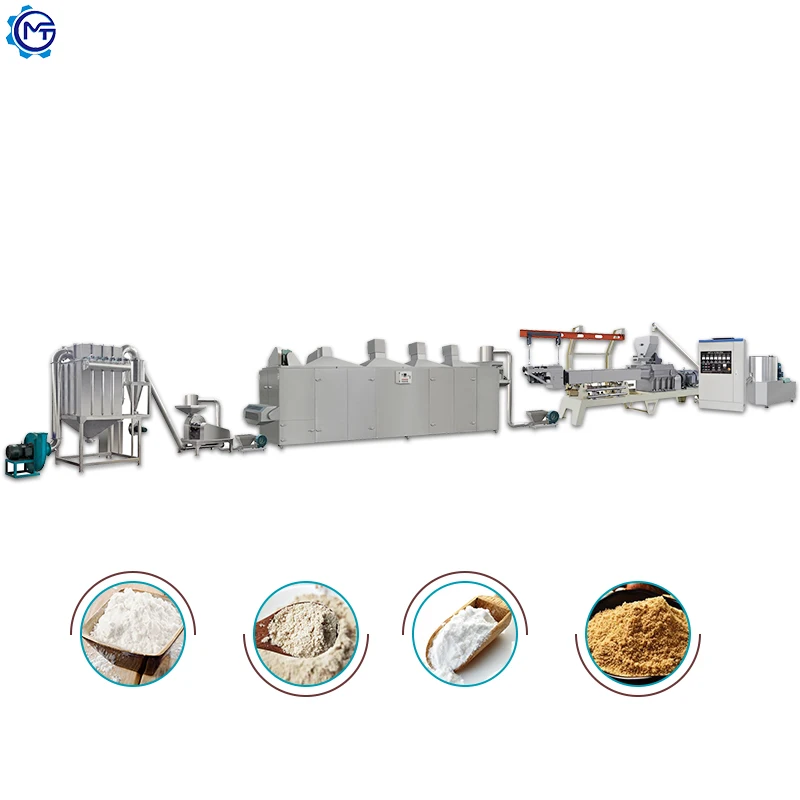
Integrated Line Throughput — every station from the mixer through to the grinder is sized so that no single unit bottlenecks the modified starch processing line manufacturer delivers.
Technical Specifications
| Parameter | Value |
|---|---|
| Product Type | Modified Starch Processing Line |
| Extruder Type | Twin-screw extruder |
| Raw Materials | Wheat flour, corn starch, potato starch |
| Output Capacity | 80–500 kg/h (basis not stated in source — confirm raw material type, moisture content and target starch modification degree) |
| Process Flow | Mixer → Screw conveyor → Twin screw extruder → Shift → Air conveyor → Dryer → Air conveyor → Conditioning → Conveyor → Grinder |
| Frame Material | Stainless steel 201 |
| Contact Material | Food grade stainless steel 304 |
| Barrel & Screw Material | 45 steel |
| Energy Options | Electricity, gas, diesel, or steam |
| Electrical Power (electricity-heated line) | Approximately 100 kW (rated or peak not specified) |
| Electrical Power (gas/diesel-heated line) | Approximately 50–60 kW (rated or peak not specified) |
| Voltage & Frequency | Three phases 380V/50Hz; single phase 220V/50Hz (customizable to customer local voltage) |
| Motor Brand | Siemens (made in China) or China top brand |
| Inverter Brand | Delixi or Delta |
| Mixer Main Motor | 4.0 kW |
| Mixer Dimensions | 1.2 × 0.9 × 1.4 m |
| Screw Conveyor Main Motor | 1.1 kW |
| Screw Conveyor Dimensions | 2.5 × 0.6 × 2.3 m |
| Assembly State | Complete line with supporting equipment |
| Certification | CE |
| Warranty | One year |
Application Suitability
| Application | Material or Output |
|---|---|
| Food-grade modified starch production | Corn starch, wheat flour processed into functional powders with controlled viscosity and gelling behavior |
| Pregelatinized adhesive starch for industrial use | Corn starch or potato starch converted for paper coating and corrugated board bonding |
| Nutritional and functional starch ingredients | Wheat flour and potato starch modified for instant food, soup bases and bakery premixes |
Why Starch Source Determines Everything Before the Extruder Even Starts
The raw material defines the screw profile, barrel temperature curve and moisture target — not the other way around.
I have watched operators dial in every parameter on corn starch, get a clean run through the die, then switch to cassava or potato starch the next morning and find the material gelling inside the barrel before it reaches the die face. The gelatinisation onset temperature shifts by more than ten degrees between starch families, and the shear sensitivity varies just as sharply. A modified starch extrusion equipment for sale that performs beautifully on one feedstock can block completely on another if the screw elements and barrel zones are not reconfigured. [NEED_CITE: gelatinisation temperature differences across starch types]
How Each Station Earns Its Place in the Sequence
A modified starch processing line manufacturer must justify every machine between the raw material inlet and the final bagging point. The mixer blends starch with water and any minor additives to a uniform moisture level before the screw conveyor meters it into the twin-screw extruder at a controlled rate. Inside the extruder, the material experiences a precise combination of shear, pressure and heat that ruptures starch granules and rearranges their molecular structure. The shift valve at the extruder discharge directs the hot, expanded mass into the air conveyor, which carries it into the dryer where residual moisture is driven off to the target level. From there the material passes through a conditioning stage that equalises temperature and moisture before the grinder reduces it to the required particle size distribution.
Multi-Energy Drying and What It Means for Your Factory Floor
Not every plant has access to the same utility infrastructure, and the dryer is the single largest energy consumer on this line. The dryer section supports electricity, gas, diesel or steam heating, which means the same modified starch processing line can be configured for a facility running a natural-gas boiler or one relying entirely on electrical resistance elements. Gas and diesel options pull the electrical load down to roughly 50–60 kW, while a fully electric-heated line draws closer to 100 kW. This choice affects not only the transformer capacity you need on site but also the cable sizing, breaker ratings and MCC panel layout. Specifying the energy source early prevents costly rewiring after the equipment arrives. [NEED_CITE: industrial dryer energy source selection criteria]
Reading the Specs That Actually Govern Starch Modification
The twin-screw configuration matters because starch modification demands both mixing intensity and residence time control; intermeshing screws create self-wiping action that prevents material from stagnating and degrading inside the barrel. Barrel and screw material is 45 steel, chosen for its wear resistance under the abrasive load that raw starch imposes at high screw speeds. Food grade stainless steel 304 covers all surfaces the product touches after the barrel exit, which is necessary for food and pharmaceutical starch grades where metal migration limits apply. The inverter selection — Delixi or Delta — governs how precisely the screw speed can be ramped during start-up and shut-down, reducing the volume of off-spec material produced during those transitions. Voltage customisation from 380V/50Hz to other local standards ensures the motors and heaters reach their rated output without running hot or underpowered.
What Happens When Stations Are Sized Independently
An extruder running at full output feeds a dryer that cannot evaporate moisture fast enough, and the downstream grinder receives material that is still too damp to fracture cleanly. The result is a bottleneck that sits invisible until commissioning day, when operators realise they must throttle the extruder to match the slowest station. The grinder then produces a broader particle size spread because the feed moisture varies, and the final starch fails the viscosity specification the buyer committed to. I have been called to lines where the fix was not a parameter adjustment but a hardware swap — a larger dryer or a second grinder added after the fact, at double the cost of specifying it correctly in the first place. [NEED_CITE: throughput balancing in food extrusion lines]
Why Buyers Source the Full Line from One Supplier
The modified starch processing line is designed so that every station — mixer, screw conveyor, extruder, dryer, grinder — is matched for throughput under one engineering scope, eliminating the blame-shifting that occurs when separate vendors supply each machine. Screw configuration and die design are specified to the buyer’s exact starch source and target modification degree, not copied from a generic catalogue build. An in-house testing workshop runs trial batches on customer-supplied raw material before the line ships, which means the process parameters are documented and transferable rather than discovered during on-site commissioning. CE certification covers the full assembly, simplifying import clearance and regulatory compliance in markets that require conformity documentation. Pre-sales engineering continues through layout design, voltage confirmation and on-site operator training so that the line is production-ready when the first bag is filled.
Documentation & Verification
- Line layout drawing showing footprint and utility connection points for every station
- Capacity calculation sheet stating raw material type and moisture assumptions
- Screw and die configuration record matched to your starch source
- Electrical schematic confirming voltage, frequency and breaker sizing
- Factory test report from trial runs on your supplied raw material
- CE declaration of conformity covering the complete assembly
Installation, Commissioning & Support
- Foundation plan provided showing load points for the extruder and grinder
- Power supply spec listing total kW draw based on your chosen heating energy
- Machines ship in modular sections sized for standard container loading
- Commissioning engineer sets screw speed, barrel temperature and dryer curve on site
- Operator training covers start-up sequence, cleaning and screw element inspection
- Wear parts list identifies screws, dies and grinder blades with reorder intervals
What We Need Before Quoting Your Line
Send the exact starch source you will run — corn, wheat, potato or a blend — along with the target modification type, whether pregelatinisation, cross-linking or oxidation. Confirm your local voltage and frequency, the heating energy available on site and the language you want on the control interface. If you have existing upstream batching or downstream packing equipment, share the model and throughput so the new line can be matched. The more specific your raw material data, the more reliable the trial run before shipment.
Frequently Asked Questions
Q: How is throughput balanced between the extruder, dryer and grinder?
A: Each station on the modified starch processing line is selected so its maximum throughput matches the extruder output at the buyer’s specified raw material and moisture level. The capacity calculation sheet documents these assumptions, and the factory trial run confirms that no station becomes a bottleneck under actual production conditions.
Q: Does the energy source change the equipment configuration?
A: Yes. Choosing gas, diesel or steam for the dryer reduces electrical load to approximately 50–60 kW, while an all-electric line draws around 100 kW. The MCC panel, cable sizing and heater elements are all specified accordingly, so confirming your site utilities early is essential.
Q: Can the screw and die setup handle multiple starch types?
A: The twin-screw extruder is reconfigurable. Screw elements and die geometry are specified to the buyer’s primary starch source, and alternative configurations can be supplied for different materials. Running trials on each starch type before shipment locks in the correct barrel temperature profile and moisture target.
Q: Which stations can be purchased separately from the full line?
A: The mixer, screw conveyor and air conveyors are available as individual units, but the extruder, dryer and grinder are engineered as a matched set. Purchasing them independently risks throughput imbalance unless the buyer provides detailed upstream and downstream equipment specifications for integration.