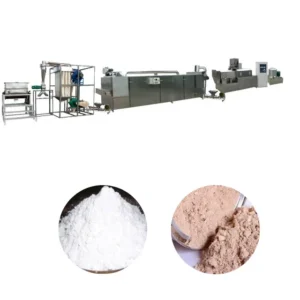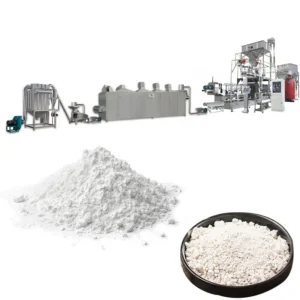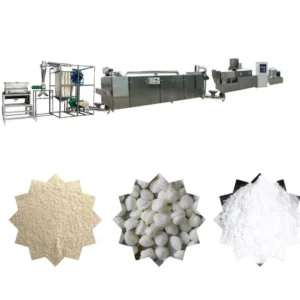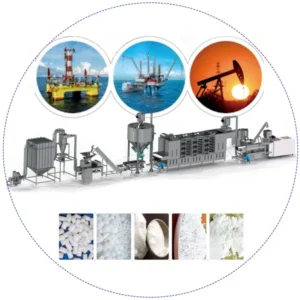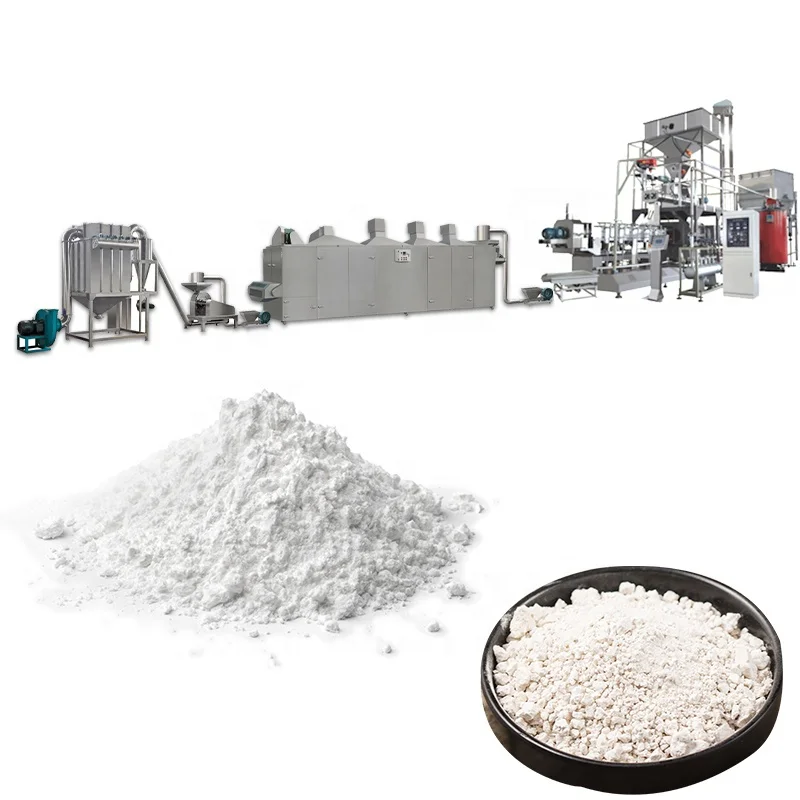
Matched Extruder and Dryer Throughput — every station in this modified starch production line is sized against real output on your specific raw material, preventing downstream bottlenecks.
Technical Specifications
| Parameter | Value |
|---|---|
| Product Type | Modified Starch Production Line (Twin-Screw Extrusion) |
| Model Range | MT65 / MT70 / MT85 |
| Extruder Type | Twin-screw, co-rotating with sectional modules |
| Installed Power (MT65) | 72 kW |
| Installed Power (MT70) | 92 kW |
| Installed Power (MT85) | 108 kW |
| Power Consumption (MT65) | 50 kW |
| Power Consumption (MT70) | 65 kW |
| Power Consumption (MT85) | 75 kW |
| Output Capacity (MT65) | 140–160 kg/h (basis to be confirmed) |
| Output Capacity (MT70) | 240–260 kg/h (basis to be confirmed) |
| Output Capacity (MT85) | 500–600 kg/h (basis to be confirmed) |
| Dimensions (MT65) | 2200×1000×2300 mm |
| Dimensions (MT70) | 2600×1000×2300 mm |
| Dimensions (MT85) | 4500×1000×2600 mm |
| Line Stations | Mixing, Extrusion, Drying, Grinding, Blending, Packing |
| Contact Material | Stainless steel (mixer and screw conveyor) |
| Safety Interlocks | Auto shut-off on mixer top cover and discharge |
| Control System | Automatic dosing unit (PLC / MCC configuration to be confirmed) |
| Certification | CE and ISO compliant |
| Warranty | 24 months with lifetime service support |
Application Suitability
| Application | Material or Output |
|---|---|
| Drilling fluid adhesive production | Native corn and cassava starch, 60–80 mesh |
| Wallpaper paste and construction binder | Rice flour, corn flour, pregelatinized starch |
| Textile sizing and printing thickener | Modified starch from wheat or corn base |
| Food additive binder and stabilizer | Denatured starch for bakery and frozen food use |
| Paper coating and surface sizing agent | Pregelatinized starch from native rice or corn |
Why Capacity Figures Depend on Your Raw Material
A modified starch production line equipment manufacturer must specify throughput against the actual starch variety and moisture content you will run.
Buyers often receive quotations showing a single capacity number without disclosing the raw material basis behind it. In practice, cassava starch gelatinizes at a notably different temperature than corn starch, and rice flour demands different screw shear profiles entirely. When I set up lines across South Asia and Africa, I learned that arriving on site to discover the trial used a different starch meant recalibrating screw speed and barrel zones from scratch, adding days to commissioning [NEED_CITE: gelatinization temperature differences across starch varieties]. This modified starch production line equipment manufacturer addresses that gap by requiring a raw material sample for in-house trial runs before any capacity figure is committed.
Station-by-Station Catalogue for Modified Starch Processing
The full sequence begins with a stainless steel mixer equipped with safety interlocks on the top cover and discharge opening, feeding into a screw conveyor that delivers a consistent supply to the twin-screw extruder. From the extruder barrel, material passes onto a cooling conveyor before entering the dryer, then through a grinder and blender before final packing. Each station in this modified starch production line equipment manufacturer catalogue is specified individually so that a buyer can understand exactly which machine occupies each position in the layout and how its throughput aligns with the extruder’s real output on a given starch type.
Twin-Screw Extrusion Mechanics for Starch Modification
The co-rotating twin-screw extruder uses sectional screw modules that can be rearranged to create distinct processing zones along the barrel — forward transport, high-shear mixing, liquid injection for reagent addition, de-gassing, and final cooking or forming. This modularity is what allows the same extruder platform to produce pregelatinized starch, denatured starch, or chemically modified starch simply by changing screw element sequencing and barrel temperature profiles. For buyers evaluating a modified starch production line equipment manufacturer, understanding which screw configuration will be supplied for their specific application is more consequential than comparing motor power alone [NEED_CITE: twin-screw sectional configuration for starch processing]. The die design further determines whether the output exits as expanded pellets suitable for grinding into powder or as a denser strand for direct drying.
Interpreting the Power and Capacity Data
Installed power on the three models ranges from 72 kW on the MT65 to 108 kW on the MT85, with actual consumption notably lower at 50 kW, 65 kW, and 75 kW respectively. The gap between installed and consumed power reflects motor start-up loads and peak torque demands during starch gelatinization rather than steady-state running. Capacity values — such as 140–160 kg/h for the MT65 — carry no stated raw material basis in current documentation, which means the figures must be validated against the buyer’s specific starch variety, moisture percentage, and target degree of modification before they can serve as reliable production targets. Barrel dimensions scale accordingly, with the MT85 at 4500 mm in length providing a longer residence time necessary for more complex modification chemistries. Control system options are listed as an automatic dosing unit, though whether PLC or MCC architecture will be supplied should be confirmed during the specification phase.
The Cost of Mismatched Line Stations
When the dryer capacity falls short of the extruder’s real output, partially dried starch accumulates, leading to inconsistent moisture content that ruins downstream grinding and blending uniformity. An undersized grinder then becomes the next bottleneck, forcing the operator to slow the entire extruder to match, effectively running the most expensive machine in the line below its capable output. I have seen installations where a correctly sized extruder sat idle for hours each shift because the cooling conveyor could not handle the throughput on a high-moisture cassava formulation [NEED_CITE: downstream bottleneck effects in starch extrusion lines]. These mismatches rarely appear in quotation comparisons because each station is often quoted in isolation without a unified throughput calculation tying them together.
Reasons Buyers Source This Line From One Supplier
Throughput matching across every station is calculated against your starch variety before the layout is finalized, so the mixer, extruder, dryer, grinder, and blender all operate at compatible rates. Screw configuration and die design are specified to your raw material rather than copied from a generic build, reducing the commissioning adjustments needed on site. An in-house testing workshop allows trial runs on your actual starch sample before shipment, meaning product development begins well before the line arrives at your facility. Pre-sales consultation extends through engineer design, on-site installation, commissioning, and operator training, giving you a single point of accountability from inquiry through steady production. CE and ISO compliance documentation accompanies every shipment, satisfying import requirements across regulated markets without requiring separate certification audits by the buyer.
Documentation & Verification
- Line layout showing capacity calculation for each station matched to your starch variety
- Screw and die configuration record specific to your raw material and target modification type
- Electrical schematic with voltage and frequency confirmed for your facility before production
- Trial run report conducted on your actual starch sample in the testing workshop
- Factory test record verifying throughput and safety interlocks before dispatch
- CE declaration of conformity and ISO certificate included with customs documentation
Installation, Commissioning & Support
- Foundation planning accounts for the MT85 footprint of 4500×1000 mm and dryer length
- Electrical supply matched to confirmed voltage and frequency with dedicated circuits for the 75 kW extruder load
- Equipment ships in modular station units for sequential assembly on your workshop floor
- Screw speed and barrel zones calibrated on site against your production starch formulation
- Operator training covers safety interlock procedures on the mixer and emergency shut-off routines
- Wear parts list provided for screws, dies, and conveyor components with recommended stock levels
- Maintenance schedule aligned with continuous starch processing duty cycles and cleaning intervals
What to Include With Your Inquiry
Specify the exact starch variety you intend to process — corn, cassava, rice, or wheat — along with its mesh size and typical moisture content at intake. Confirm your facility’s available voltage, frequency, and any required control system language. Share your target daily output and available floor space including ceiling height so that the dryer and cooling conveyor can be dimensioned correctly. If you have existing upstream batching or downstream packing equipment, provide those details so the line integrates without redundant stations. Sending a raw material sample for the in-house testing workshop will yield the most accurate capacity and configuration proposal.
Frequently Asked Questions
Q: How is line capacity verified, and what raw material premise does each kg/h figure depend on?
A: Capacity figures such as the MT65’s 140–160 kg/h are based on specific starch varieties and moisture levels that must be confirmed for each buyer. We conduct trial runs using your actual raw material in our testing workshop and issue a report documenting the verified throughput before the line enters production, ensuring the quoted output matches your formulation.
Q: How do you match dryer, grinder, and blender capacity to the extruder output?
A: Each downstream station is sized based on the extruder’s real throughput on your specific starch, not on a nominal maximum rating. The line layout document shows the calculated output at every station so you can verify that no single machine restricts the overall production rate or causes material accumulation.
Q: What screw and die configurations are available for different starch types?
A: Sectional screw modules are arranged differently for corn, cassava, rice, or wheat starch based on their gelatinization temperature and shear sensitivity. The screw configuration record supplied with your line documents the exact element sequence and die geometry selected for your raw material and target modification type.
Q: Can I see a trial run on my own raw material before shipment?
A: Yes. You send a starch sample to our testing workshop, and we run it through the extruder with the proposed screw and die configuration. A trial run report covering throughput, product texture, and moisture content is issued before shipment so you know the line will perform as expected on arrival.