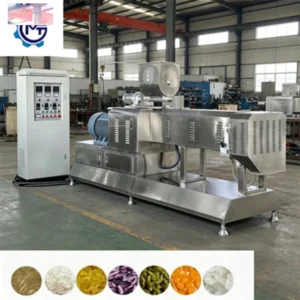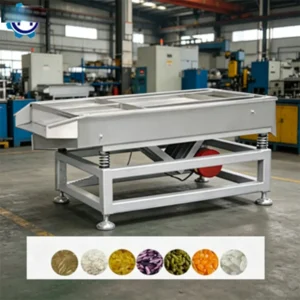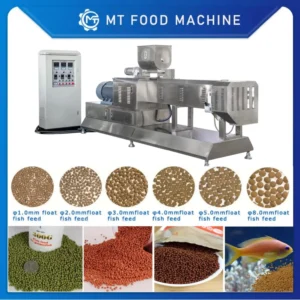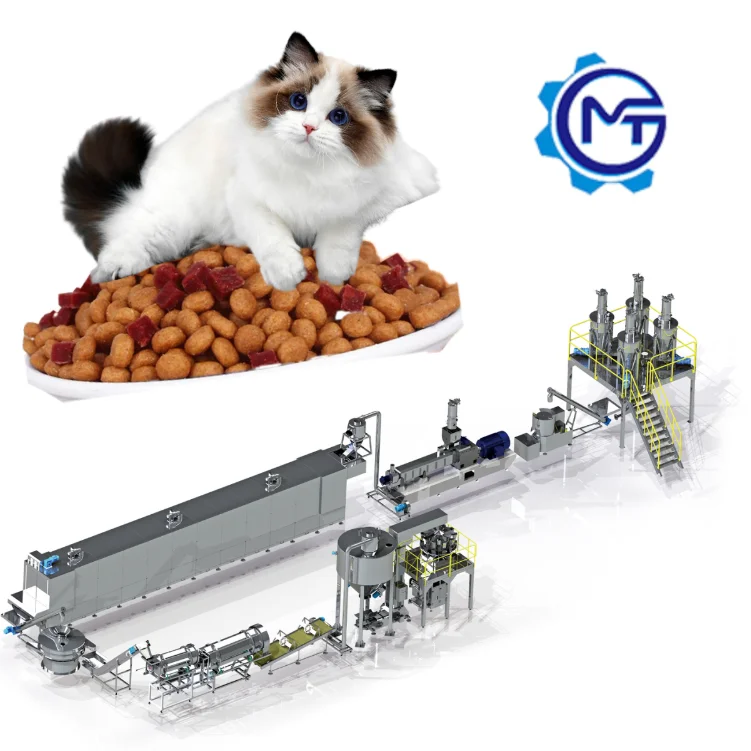
Integrated Line Throughput — Every station from the mixer to the packaging head is sized against the MT70 extruder output so no single module chokes the chain.
Technical Specifications
| Parameter | Value |
|---|---|
| Model | MT70 |
| Product Type | Pet Food Processing Line |
| Output Capacity | 200–250 kg/h (basis not stated in source — confirm raw material formulation, moisture content, and kibble size) |
| Rated Power | 45 kW |
| Voltage & Frequency | 380 V 50 Hz, Three Phase |
| Screw Type | Twin-screw (source value — verify against manufacturer catalog) |
| Control System | Advanced sensors and precision controls (PLC or MCC not specified in source) |
| Line Stations | Mixing, extrusion, drying, packaging |
| Contact Materials | Food-grade, FDA and CE compliant |
| Recipe Adaptability | Dry kibble, semi-moist pet food, treats |
Application Suitability
| Application | Material or Output |
|---|---|
| Dry kibble for dogs and cats | Corn, rice, meat meal, poultry by-product meal at controlled moisture |
| Semi-moist pet food | High-meat-content dough with humectants and glycerin |
| Pet treats and dental chews | Starch-protein blends with fiber reinforcement |
| Breed-specific kibble formats | Die changes matched to kibble geometry and density targets |
Why "200–250 kg/h" Means Nothing Without the Raw Material Context
The rated capacity only holds when the screw profile, die geometry, and moisture level are matched to your exact formulation.
I worked with a buyer who sourced a pet food making machine full equipment range based purely on a brochure figure. Their recipe carried a high meat-meal percentage that demanded a different shear profile inside the barrel. Output dropped well below half on day one, and it took three days of screw-element swapping before the extruder stabilized. That is the gap between a catalog number and a production number — and it is the reason every capacity figure on this page carries a material caveat [NEED_CITE: extrusion output dependency on raw material formulation].
Mapping the Full Equipment Chain
A pet food making machine full equipment range is only as reliable as its weakest station. The MT70 line begins with a ribbon or paddle mixer sized to the extruder’s intake rate, moves through the twin-screw barrel where starch gelatinization and protein texturization occur, then feeds a multi-pass dryer calibrated for the target moisture drop. Packaging is the final link — an auger or weigh-fill head matched to the cooler discharge rate. When any one of these stations is undersized, upstream product piles up; when oversized, you pay for dead capacity.
Balancing Throughput Across Every Module
Extruder output fluctuates with recipe changes — a dense dental-chew formula runs slower than a light corn-based kibble. The dryer must handle the peak scenario, not the average. I have seen lines where the dryer belt was specified to a lighter recipe, forcing the operator to throttle the extruder back whenever the mix changed [NEED_CITE: dryer capacity and extruder throughput matching]. The MT70 configuration addresses this by sizing each downstream module to the maximum realistic discharge, not the mid-range estimate.
Reading the Specs That Actually Matter
The twin-screw architecture gives the MT70 a self-wiping action that handles high-fat and high-protein recipes more cleanly than a single-screw design, reducing barrel residue between batch changeovers. The 45 kW drive provides enough torque for viscous semi-moist doughs while still running lighter dry-kibble mixes at higher screw speeds. Voltage at 380 V 50 Hz three-phase is standard for many Asian and Middle Eastern grids, but buyers targeting the Americas or parts of Southeast Asia need to confirm whether a transformer or motor swap is required before the crate ships. The control interface uses advanced sensors to monitor barrel temperature zones and screw speed — variables that directly influence expansion ratio, kibble density, and the final crunch texture a pet owner expects.
The Hidden Cost of Skipping Configuration Details
Ordering a line without specifying screw elements and die orifice diameter leads to kibble that either floats when it should sink or crumbles during packaging. A mismatch between dryer capacity and extruder output forces operators to run at reduced feed rates, eroding margin on every shift [NEED_CITE: cost impact of extruder-dryer mismatch in pet food lines]. Incorrect voltage at the site can trip breakers during motor start-up or, worse, degrade the heating elements over time. These are not warranty issues — they are specification gaps that shift cost and delay onto the buyer.
Why Source This Line from Meiteng
The MT70 is sold as a complete system, meaning throughput calculations cover every station rather than relying on third-party dryers or packagers bolted on later. Screw and die configurations are documented against your raw material before the machine leaves the floor, not guessed from a generic template. An in-house testing workshop runs your actual formulation — or the closest available substitute — so density, expansion, and texture data exist before you commit to container loading. Food-grade contact materials across the barrel, die, and conveyance points meet FDA and CE requirements without needing aftermarket coatings. Electrical schematics and voltage confirmations are issued during the order phase so the installation team meets a live panel, not a surprise.
Documentation & Verification
- Line layout showing throughput balance across MT70 mixer, extruder, dryer, and packaging head
- Screw and die configuration record written against your raw material formulation
- Electrical schematic confirming voltage and frequency for your facility grid
- Trial run report documenting kibble density and expansion on your recipe before dispatch
- CE declaration of conformity covering the full integrated line
- Wear parts list identifying screw elements, die inserts, and dryer belt segments
Installation, Commissioning & Support
- Foundation must level the extruder and dryer within tolerance across the 45 kW motor mount points
- Dedicated three-phase 380 V 50 Hz circuit with breaker sizing to handle start-up surge current
- Line arrives in modular sections; mechanical and electrical coupling performed on site
- First-run commissioning verifies screw speed, barrel zone temperatures, and dryer retention time against target kibble density
- Operator training covers recipe changeover procedures and sensor calibration routines
- Spare screw elements and die plates stocked against the documented configuration
Before You Send an Inquiry
Provide your raw material list with approximate percentages, target kibble dimensions, and daily production goal so the layout can be drawn to real numbers. State your facility voltage, frequency, and available floor length — the dryer alone dictates a significant portion of the footprint. Confirm whether you need operator-panel language localization and whether any upstream milling or downstream coating equipment is already in place.
Frequently Asked Questions
Q: Which stations are included in the MT70 pet food processing line?
A: The base configuration covers a mixer, the twin-screw extruder, a multi-pass dryer, and a packaging station. Additional modules such as a flavouring drum, coating line, or cooling conveyor can be inserted between the dryer and packaging head depending on the product format and throughput target you specify during layout planning.
Q: How is throughput balanced between the extruder and the dryer?
A: Each dryer is sized against the maximum realistic extruder discharge, accounting for recipe moisture and required final water content. This prevents the common bottleneck where a dryer rated for a lighter formula cannot keep up when a denser, wetter recipe runs through the MT70 barrel.
Q: Can the same line run dry kibble and semi-moist treats without major reconfiguration?
A: Yes. The twin-screw barrel handles both formulations by adjusting screw-element staging, moisture addition, and barrel-zone temperatures. Die changes and dryer retention-time adjustments complete the switch, typically within a single shift changeover window.
Q: What supporting equipment can be added to the base MT70 configuration?
A: Flavouring drums for fat or palatant coating, cooling conveyors to bring kibble to packaging temperature, and secondary seasoning systems are all available. Each is throughput-matched to the MT70 discharge rate so no station becomes a bottleneck.
Q: How does the layout adapt to different factory footprints?
A: The dryer can be configured in single-pass or multi-pass belt arrangements, and the conveyance path between stations can be routed in linear or L-shaped layouts. Floor-plan constraints and future expansion corridors are factored into the drawing before the line enters production.