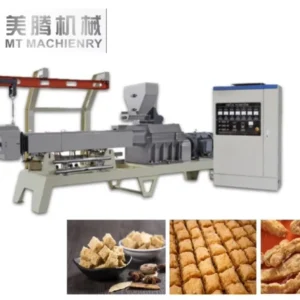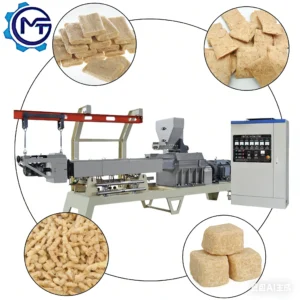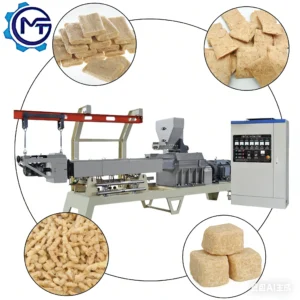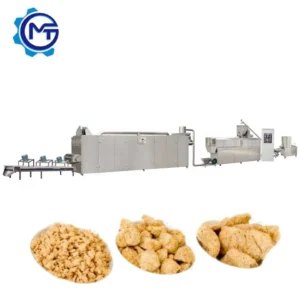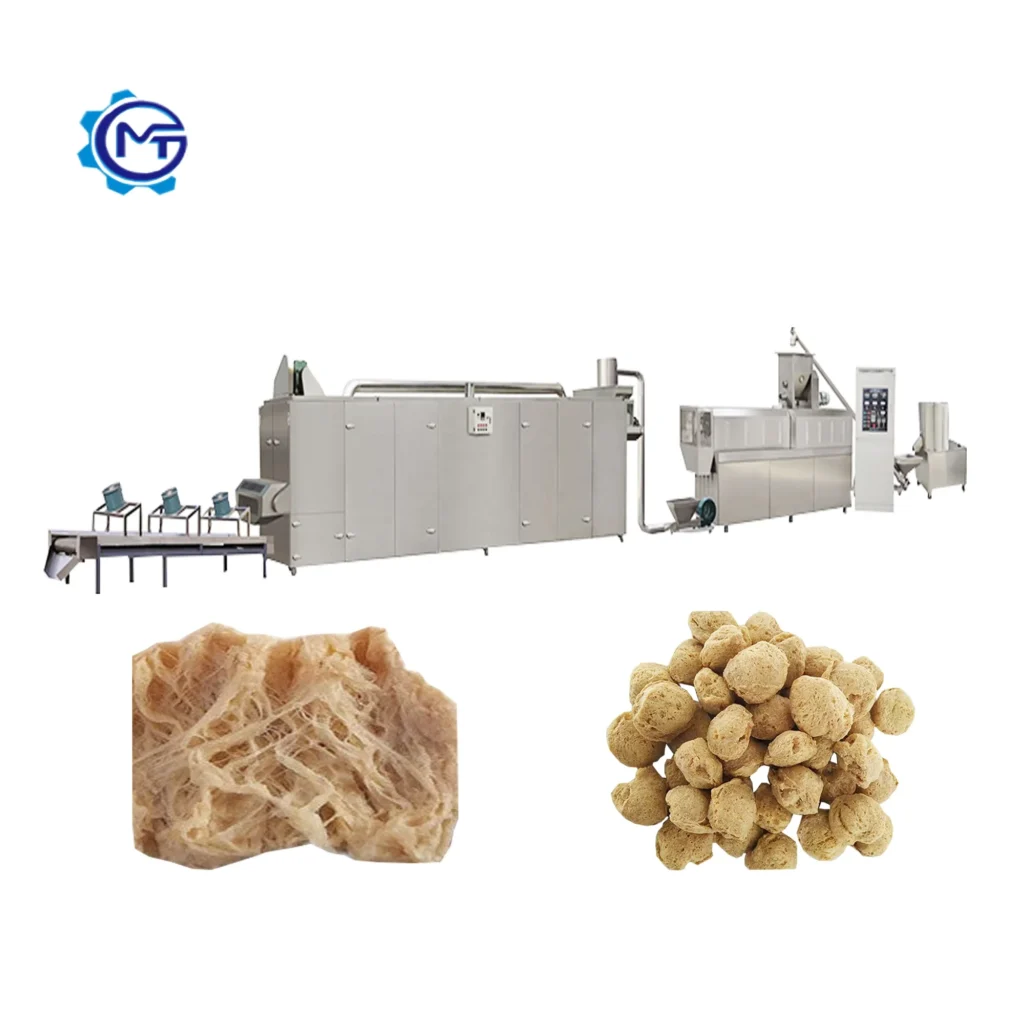
Line Throughput Matching — every station from the 4kW mixer through the far infrared dryer is sized so extruded TVP never waits on a bottleneck upstream or downstream.
Technical Specifications
| Parameter | Value |
|---|---|
| Product Type | Textured Vegetable Protein Extrusion Line |
| Line Models Available | MT65 / MT70 / MT85 |
| Output Capacity (MT65) | 150–200 kg/h (basis not stated in source — confirm raw material formulation, moisture content, product format) |
| Output Capacity (MT70) | 200–300 kg/h (basis not stated in source — confirm raw material formulation, moisture content, product format) |
| Output Capacity (MT85) | 600–800 kg/h (basis not stated in source — confirm raw material formulation, moisture content, product format) |
| Installed Power (MT65 / MT70 / MT85) | 85 kW / 120 kW / 195 kW |
| Real Power Consumption (MT65 / MT70 / MT85) | 65 kW / 90 kW / 165 kW |
| Overall Dimensions (MT65 / MT70 / MT85) | 18000×1300×2300 mm / 20000×1500×2400 mm / 24000×3500×4300 mm |
| Extruder Type | Double Screw (Twin-Screw) |
| Mixer Tank Volume | 150 kg |
| Mixer Rotary Speed | 385 rpm |
| Mixer Power | 4 kW |
| Mixer Output | 300–600 kg/h |
| Dryer Type | High-temperature Roaster with Far Infrared Heater |
| Dryer Effective Belt Length | 3.5 m |
| Dryer Far Infrared Heater Power | 3.9 kW × 24 |
| Construction Material | Food-grade stainless steel (all contact surfaces) |
| Line Stations | Mixing → Conveying → Extrusion → Conveying → Drying → Cooling → Packing |
| Certification | CE |
| Warranty | 1 year |
Application Suitability
| Application | Material or Output |
|---|---|
| Textured vegetable protein (TVP) chunks and granules | Low-temperature soybean meal, peanut meal |
| Plant-based ham and sausage ingredients | Soy tissue protein with controlled fiber density |
| Vegetarian canned food and quick-frozen meals | Extruded protein pieces with defined oil/water absorption |
| Fast-food chain plant-protein patties and fillings | Pea or soy-based meal blends (formulation-dependent) |
| Nutritional protein supplements and meat analogues | Defatted meal feedstock at controlled moisture |
Why "Rated Capacity" Means Nothing Without Your Raw Material
We test on your actual meal formulation before the line ever ships.
A plant based meat processing equipment manufacturer quote might promise 300 kg/h, but that figure assumes a specific soybean meal protein content, moisture level, and particle size. Switch to a pea-protein blend with different starch gelatinisation behaviour and the extruder barrel temperature profile no longer matches — fibre structure collapses, output drops, and operators spend days chasing settings that were never calibrated for what is actually in the hopper [NEED_CITE: raw material variability in plant protein extrusion]. I learned this the hard way on a West African site where soy-based trial data meant nothing once the buyer switched to a local pea-meal mix.
Protein Fibre Formation Under High Shear
The twin-screw extruder subjects low-temperature soybean meal or peanut meal to high temperature, high pressure, and intense mechanical shear inside the barrel. Spherical protein molecules are opened into elongated chain structures that align as they pass through the die, producing the layered, fibrous bite that end users associate with real meat. Barrel zones and screw pitch are arranged so residence time and shear gradient stay consistent from feed inlet to die face.
Matching Dryer Capacity to Extruder Output
Moisture leaving the die must be reduced quickly and evenly to lock in fibre structure. The far infrared roaster on this line uses 24 heater elements across a 3.5 m effective belt, giving extruded TVP enough dwell time for uniform moisture removal without surface scorching [NEED_CITE: far infrared drying kinetics for extruded protein]. When extruder throughput rises on the MT85 model, belt speed and heater staging are adjusted so the dryer never becomes the constraint that forces operators to slow the whole line down.
What the Power and Dimension Figures Actually Tell You
Installed power versus real consumption gaps — 85 kW versus 65 kW on the MT65, 195 kW versus 165 kW on the MT85 — reflect motor start-up peaks and heater ramp-up rather than steady-state draw. Knowing the real consumption figure lets you size the transformer and circuit breakers at the buyer’s facility accurately. The overall length difference between MT65 at 18 m and MT85 at 24 m comes mainly from the extended dryer and additional cooling conveyors required for higher volumes, so workshop floor plans must account for the longest footprint plus maintenance clearance on both sides.
The Cost of Skipping the Trial Run
Lines configured only on paper arrive at the site with generic screw and die setups that may produce the wrong density or fibre alignment for the buyer’s actual formulation. Operators then spend weeks adjusting barrel temperatures and feed rates, burning raw material and labour hours while the product fails texture specs that downstream customers already agreed on [NEED_CITE: commissioning delays due to untested extrusion parameters]. Downtime during this period is rarely accounted for in the original project budget.
Why Buyers Source This Line From Meiteng
Complete station matching means the mixer, extruder, dryer, and cooling conveyor are all specified against one throughput target rather than assembled from separate vendors with mismatched capacities. Screw configuration and die geometry are chosen after a trial run on the buyer’s own soybean or peanut meal in the in-house testing workshop, so fibre density and chewiness are validated before the crate is sealed. Food-grade stainless steel contact surfaces throughout the line meet hygiene expectations for both human food and export-market audits. Electrical schematics, voltage confirmation, and control language are locked down during the order stage, preventing the on-site rewiring delays that push commissioning past the deadline.
Documentation & Verification
- Line layout drawing with throughput calculation for your target TVP format
- Screw and die configuration record matched to your meal formulation
- Trial run report produced on your raw material before dispatch
- Electrical schematic confirming voltage, frequency, and control language
- CE declaration of conformity for the complete extrusion line
- Wear parts list identifying screws, dies, and seals with replacement intervals
Installation, Commissioning & Support
- Foundation plan accounts for the MT85 footprint of 24000×3500 mm and dynamic loads from the twin-screw extruder
- Dedicated power circuit sized to real consumption of 165 kW on the MT85, with breaker and cable specs confirmed pre-shipment
- Line arrives in modular sections for sequential assembly from mixer through packing station
- First-run parameters set against trial run data so barrel temperatures and screw speed match your formulation from day one
- Operator training covers die changes, moisture adjustment at the mixer, and dryer belt speed tuning
- Initial spare set of screws, dies, and seals included for the first scheduled replacement cycle
What to Share With Your Inquiry
Send the exact soybean or peanut meal specification — protein percentage, moisture content, and particle size — along with the TVP chunk or granule format you need. Confirm your workshop length and ceiling height so the longest line model can be evaluated against available floor space. State the local voltage and frequency, and let us know whether your operators require control labels and HMI text in a language other than English.
Frequently Asked Questions
Q: How is line capacity verified against my specific soybean meal formulation and moisture content?
A: We run a trial on your actual raw material in the in-house testing workshop before shipment. Barrel temperature, screw speed, and die geometry are adjusted until fibre density and output meet the agreed specification, and the results are documented in a trial run report that ships with the line.
Q: What screw and die configuration is selected for my target fibre density and chewiness?
A: Screw pitch, kneading block arrangement, and die orifice diameter are chosen based on your meal protein level and the texture your downstream products require. The configuration record is provided so you can reorder identical wear parts when replacements are needed.
Q: How are voltage, frequency, and control language confirmed before shipment?
A: During the order stage we collect your site electrical data and operator language preference, then issue an electrical schematic for your approval. Motors, heaters, and the MCC panel are built to those confirmed values, eliminating on-site rewiring or reprogramming during commissioning.
Q: What spare wear parts ship with the line, and when is the first replacement due?
A: An initial set of screws, dies, and seals is included. The wear parts list specifies expected service intervals based on your formulation’s abrasiveness, so you can plan the first reorder well before production is interrupted.
Q: Can I arrange a trial run on my raw material at the factory before the line ships?
A: Yes. You can send a representative batch of your soybean or peanut meal to the testing workshop. We extrude sample TVP under production conditions, record all process parameters, and ship the sample product back to you for evaluation alongside the trial run report.