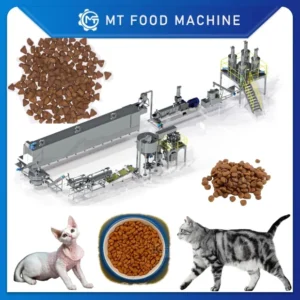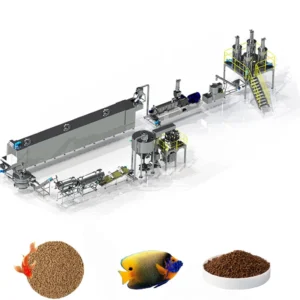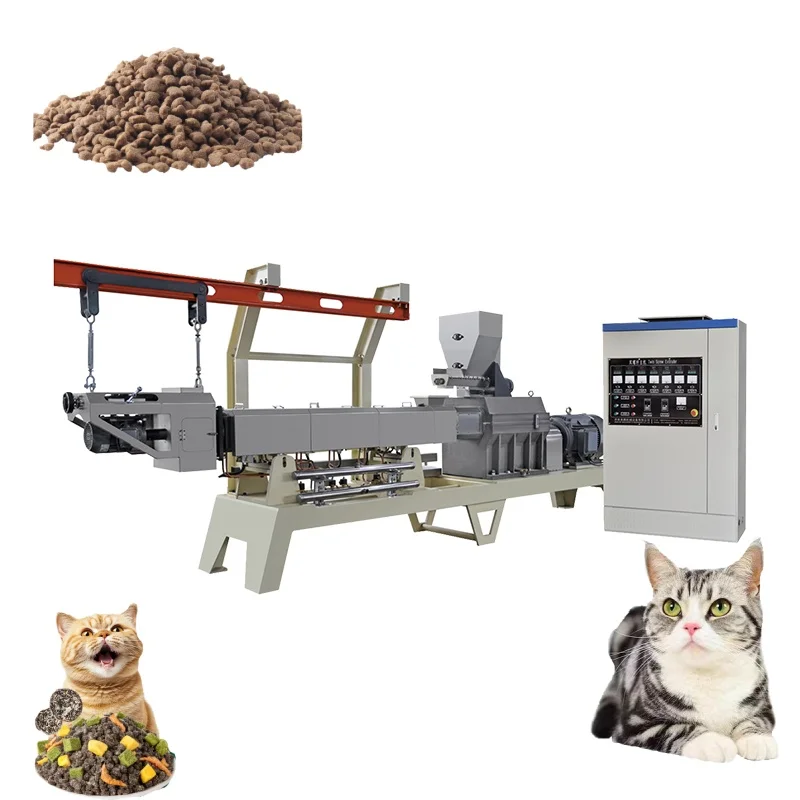
Integrated extrusion stations — throughput calculated across mixing, extrusion, drying and packing so no single node bottlenecks your pet food line.
Technical Specifications
| Parameter | Value |
|---|---|
| Product Type | Pet Food Extrusion Production Line |
| Output Capacity | Up to 3 tons per hour (basis not stated in source — confirm raw material, moisture content, and product format) |
| Applications | Dog food, cat food, aquatic fish feed (floating or sinking) |
| Process Documentation | Fish feed process drawing included |
| Warranty | 1 year |
| Control System | PLC / MCC (confirm with manufacturer) |
| Voltage & Frequency | Configurable to target market (confirm local grid standards) |
| Screw Configuration | Specified to buyer’s raw material and target product |
| Standards | CE and ISO certified facility (confirm applicability to this line) |
Application Suitability
| Application | Material or Output |
|---|---|
| Dry kibble production for dogs and cats | Corn, meat meal, soy protein, vitamin premix blends |
| Floating and sinking aquatic feed | Fish meal, wheat flour, starch binders for catfish, tilapia, shrimp |
| Multi-format feed manufacturing on one platform | Die and screw adjustments to switch between pet and aquatic formats |
Why "Up to 3 Tons per Hour" Means Nothing Without the Formula
Capacity is only real when tied to your exact raw material and moisture profile.
I once watched a line quoted at a generous hourly output choke within the first shift because the supplier sized the dryer for a different starch content than what the buyer actually ran. The extruder pushed product faster than the dryer could handle, and kibble piled up with surface moisture still trapped inside. That is the pet food making machine full equipment range conversation most quotations skip [NEED_CITE: extrusion line throughput matching between stations]. When throughput is calculated station by station against your formulation, the number on the spec sheet holds up on your factory floor.
Station-by-Station Throughput Matching
A pet food making machine full equipment range is only as fast as its slowest node. The extruder may push product at a given rate, but if the dryer belt length, the flavouring drum residence time, or the packing speed cannot keep pace, the entire line idles waiting for the bottleneck to clear. Every station in this line is calculated against the others so output flows continuously from batching through to the final bag.
Screw and Die Configuration Against Your Formula
Generic screw builds copied from a standard template produce kibble with the wrong density or texture for your market. The screw configuration and die design on this line are specified after reviewing your raw material sheet — protein content, starch ratio, fat level, and target moisture. This is where the pet food making machine full equipment range earns its output claim [NEED_CITE: twin-screw extrusion screw configuration for pet food density control]. A trial run in the testing workshop on your actual material confirms the result before the line ships.
Reading the Specs That Actually Matter
The output capacity listed here requires confirmation against your raw material basis — corn-heavy formulations extrude differently than high-protein meat meal blends, and moisture content at the conditioner directly affects expansion rate. The control system option between PLC and MCC determines whether your operators adjust barrel temperature zones from a touchscreen or from hardwired motor control centres, a choice that affects both daily operation and maintenance access. Voltage and frequency must match your local grid before the electrical cabinets are built; a 50 Hz motor running on a 60 Hz supply will overspeed and fail prematurely. The included process drawing maps the full station sequence so you can verify the layout fits your workshop footprint before production begins.
The Hidden Cost of an Unmatched Dryer
When the dryer capacity falls behind the extruder, kibble exits with internal moisture still above the safe storage threshold. Within days, mould develops inside sealed bags, and an entire production run is written off. I have seen this happen on lines where the buyer focused the budget on the extruder and treated the dryer as an afterthought [NEED_CITE: moisture content thresholds for dry pet food shelf stability]. Matching dryer belt length and air temperature to the extruder output rate is not optional — it is where product safety is won or lost.
Why Source the Full Range From One Supplier
Every station from batching to packing is supplied under one responsibility, so throughput calculations hold across the entire line rather than across separate vendor contracts. Screw and die configurations are specified to your raw material profile, not pulled from a generic build library. An in-house testing workshop runs your actual formulation before shipment, producing a trial report you can review before the crates leave the factory. The line covers dry pet food, aquatic feed, and format switching through die and screw adjustments on the same platform. Pre-sales engineering through on-site commissioning and operator training is handled by the same team that configured the line.
Documentation & Verification
- Line layout and capacity calculation matched to your raw material and target kibble format
- Screw and die configuration record specifying pitch, flight depth, and die bore to your formulation
- Electrical schematic with confirmed voltage, frequency, and control language for your facility
- Trial run report on your actual raw material from the in-house testing workshop before dispatch
- CE declaration of conformity and ISO certificate from the manufacturing facility
Installation, Commissioning & Support
- Foundation and floor space planning based on the full station sequence from batching to packing
- Dedicated electrical circuits sized to the confirmed motor load across extruder, dryer, and packing stations
- Assembly sequence and rigging plan for the extruder barrel sections and dryer belt modules on arrival
- First-run parameter setting including barrel temperature zones, screw speed, and die pressure against your formulation
- Operator training covering screw changeover, die cleaning, and control system navigation in your confirmed language
- Wear parts list specifying screw segments, die plates, and cutter bearings with recommended replacement intervals
What to Prepare Before Requesting a Quotation
Share your raw material formulation including protein source, starch ratio, and target moisture content at the conditioner. Specify your daily production target and the kibble size range your market expects. Confirm the voltage, frequency, and control language your operators will use on the floor. If you have existing upstream mixers or downstream packing equipment, note their throughput so the new line can be matched to them rather than oversized.
Frequently Asked Questions
Q: How is the output capacity verified before the line ships?
A: The capacity figure is confirmed through a trial run using your actual raw material in the in-house testing workshop. The resulting report documents output rate, kibble density, and moisture content at each station. This run verifies that the screw configuration, die design, and dryer settings hold your target throughput on your specific formulation, not on a generic test batch.
Q: Which stations are included, and how is throughput matched across them?
A: The line covers batching, mixing, extrusion, drying, flavouring, cooling, and packing. Throughput at each station is calculated against the extruder output rate so that the dryer belt speed, flavouring drum residence time, and packing head capacity all keep pace without product queuing or idle gaps between stations.
Q: Can the line produce both dog food and fish feed on the same platform?
A: Yes. Switching between dry kibble for dogs or cats and floating or sinking aquatic feed requires screw segment and die plate changes, along with adjustments to barrel temperature and moisture at the conditioner. The process drawing included with the line documents the station sequence for each format.
Q: What electrical and control options are available for different export markets?
A: Voltage and frequency are configured to your local grid standards before the electrical cabinets are assembled. The control system is available with PLC or MCC options, and the interface language is set to match your operators. Confirm these requirements during the specification stage to avoid commissioning delays on site.