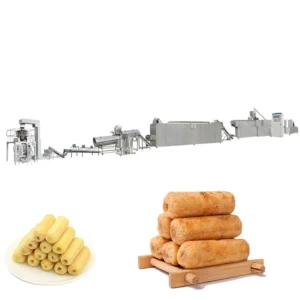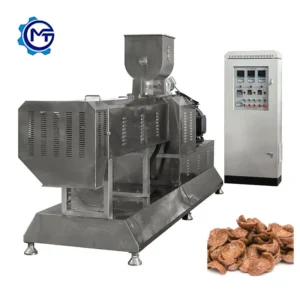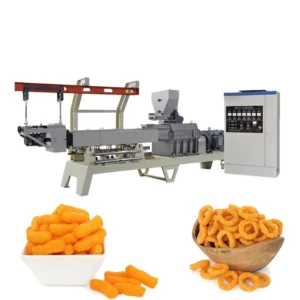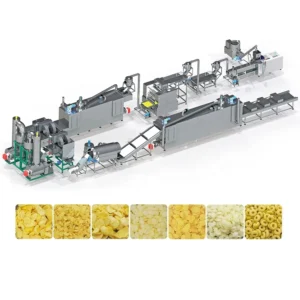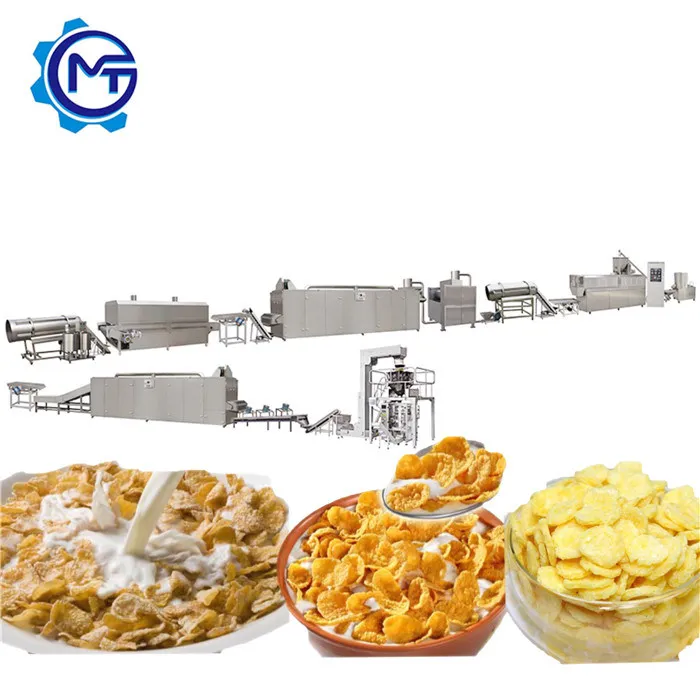
Matched Line Throughput — Every station from the twin-screw extruder through flaking, roasting, and coating is sized as one coordinated set so no single machine holds back the rest of the corn flakes production sequence.
Technical Specifications
| Parameter | Value |
|---|---|
| Product Type | Corn Flakes Production Line |
| Models Available | MT70, MT85, MT75 |
| Extruder Type | Twin-screw |
| MT70 Installed Power | 160 kW |
| MT70 Power Consumption | 120 kW |
| MT70 Capacity | 150–200 kg/hr (basis not stated in source — confirm raw material, moisture and product format) |
| MT70 Overall Dimensions | 41 × 1.5 × 2.2 m |
| MT85 Installed Power | 190 kW |
| MT85 Power Consumption | 140 kW |
| MT85 Capacity | 300–400 kg/hr (basis not stated in source — confirm raw material, moisture and product format) |
| MT85 Overall Dimensions | 43 × 1.5 × 3.2 m |
| MT75 Installed Power | 210 kW |
| MT75 Power Consumption | 150 kW |
| MT75 Capacity | 300–500 kg/hr (basis not stated in source — confirm raw material, moisture and product format) |
| MT75 Overall Dimensions | 45 × 1.5 × 3.5 m |
| Control System | PLC |
| Flaking Roller Drive | Double motors, separate roller driving |
| Flaking Roller Pressure | Hydraulic system for double rollers |
| Flaking Roller Temperature Control | Infrared sensor |
| Dryer Heating Source | Gas or Electric |
| Hot Air Roasting Oven | Vibrating pan, conciliation burner, dual circulating fans, cyclone dust removal |
| Coating System | Double tumble sugar melter, elevator, coating drum, spraying nozzle |
| Screw Feature | Automatic lubricating and cooling, wear-resistant material |
| Raw Materials | Corn, rice, wheat, oat, barley powder |
| Production Procedure | Mixing → Extruding → Flaking → Drying → Hot Air Roasting → Sugar Coating (optional) → Drying → Cooling → Packing |
| Key Features | CE certified, ISO certified, complete line from batching to packing |
Application Suitability
| Application | Material or Output |
|---|---|
| Natural corn flakes production | Corn grits and corn flour |
| Sugar-coated breakfast cereals | Corn, rice, wheat base with sugar syrup coating |
| Shaped cereal snacks | Oat and barley powder, formed via die adjustment into ball, tube, ring, star, wheel, flower and heart shapes |
| Multi-grain breakfast cereal lines | Blends of corn, rice, wheat, oat and barley powder |
| Turnkey cereal factory projects | Full processing from raw material batching through to final packing |
Why "Rated Capacity" on a Corn Flakes Machine Means Nothing Without the Raw Material Spec
A capacity figure only matters when it is tied to the exact moisture content, particle size, and starch composition of the flour you will actually run.
I spent years on workshop floors in Shandong assembling extrusion lines, and one job stays with me. A buyer ordered a corn flakes line based on the brochure number. When his corn flour arrived, the moisture was several points off from what we had used during trial runs. Output dropped sharply on the first day, and we spent three days adjusting screw speed, barrel temperatures, and dryer retention time before the line stabilized. That experience is the reason I now ask every buyer for a raw material test report before I put a corn flakes machine complete equipment range on paper [NEED_CITE: importance of raw material moisture and particle size in twin-screw extrusion output].
How the Extruder Models Map to Your Production Target
The MT70, MT85, and MT75 twin-screw extruders cover different throughput bands within the corn flakes machine complete equipment range. Each model differs in installed power, physical footprint, and screw configuration options. Selecting the right extruder starts with the target flake format and the raw material blend — corn alone behaves differently under shear and heat than a corn-rice-wheat mix. The twin-screw design allows operators to adjust the screw profile and barrel temperature zones to match gelatinisation requirements for each recipe.
Matching Every Downstream Station to the Extruder Output
An extruder is only the beginning of the line. The hydraulic flaking mill must handle the full output of cooked extrudate without material backlog. The dryer and hot air roasting oven need sufficient belt length and airflow to bring moisture down to the level the market expects for a crisp bite. The sugar coating drum and double tumble melter must keep pace so that coated flakes do not sit and clump while waiting for the next batch. When every station in this corn flakes machine complete equipment range is specified together, throughput gaps disappear [NEED_CITE: throughput balancing across food processing line stations].
Reading the Spec Sheet Like a Process Engineer
The twin-screw configuration matters because corn flakes require controlled starch gelatinisation without excessive expansion — a single-screw setup would limit the ability to adjust shear and residence time independently. The hydraulic double-roller flaking system with infrared temperature monitoring keeps flake thickness consistent across the full roller width; uneven thickness means some flakes over-roast while others stay doughy. The hot air roasting oven uses two separate circulating fans and a cyclone dust removal device, which gives even surface blistering and prevents fine particle buildup inside the chamber. PLC control ties these stations together so that a recipe change — switching from natural to sugar-coated flakes, for example — can be managed through stored parameters rather than manual guesswork at each machine.
The Hidden Cost of Mismatched Line Components
When a buyer sources the extruder from one vendor and the dryer from another, the dryer is often undersized for the actual extruder output. The result is a bottleneck that forces the extruder to run below its capability. Flaking rollers that lack independent motor drives can produce uneven pressure, leading to flakes that vary in thickness and roast unevenly. A coating drum that is too small for the upstream throughput causes sugar syrup to pool, creating clumps that must be discarded [NEED_CITE: common causes of throughput loss in breakfast cereal lines]. These problems are not visible on a quotation — they only show up once the line is running.
Why Procure the Full Line from One Equipment Source
Every station on the MT corn flakes line — from the mixing and batching system through extrusion, flaking, drying, roasting, coating, cooling, and packing — is designed as one matched set so throughput is balanced across the entire process. Screw configuration and die design are specified to the buyer’s raw material and target flake density, not copied from a generic build. The in-house testing workshop allows trial runs on the buyer’s actual corn flour or multi-grain blend before shipment, so product development begins before installation rather than after. Pre-sales consultation covers line layout, utility planning, and phased installation scheduling. Ongoing support includes operator training, wear parts supply for screws and dies, and maintenance guidance.
Documentation & Verification
- Line layout and capacity calculation showing throughput at each station
- Screw and die configuration record matched to your raw material report
- Machine specification sheet with confirmed voltage, frequency, and PLC language
- Trial run report on your corn or multi-grain flour before dispatch
- Factory test record covering extruder, flaking mill, and roasting oven together
- CE declaration of conformity and ISO certificate for the complete line
Installation, Commissioning & Support
- Foundation and floor space planning based on the selected model footprint up to 45 × 1.5 × 3.5 m
- Dedicated power circuit sized for installed power up to 210 kW with confirmed voltage and frequency
- Assembly from shipped modules with mechanical and electrical connection at site
- First-run parameter tuning on your raw material for extrusion, flaking, and roasting stations
- Operator training covering PLC recipe management and screw changeover procedures
- Wear parts list including screws, dies, and flaking roller surfaces with reorder lead times
What to Prepare Before Sending an Inquiry
To size the right corn flakes machine complete equipment range for your project, share the raw material type along with any available moisture and particle size data. Confirm the target daily output and the flake format — natural, sugar-coated, or shaped variants. Provide the workshop dimensions and ceiling height, the local voltage and frequency standard, and the preferred PLC interface language. If you already have upstream milling or downstream packing equipment, note the interface points so the line layout accounts for them.
Frequently Asked Questions
Q: How is line capacity verified on the buyer’s actual raw material and moisture level?
A: Before shipment, the buyer’s corn flour or multi-grain blend is run through the extruder, flaking mill, dryer, and roasting oven in the testing workshop. The trial run report documents the actual throughput, flake thickness, moisture drop at each stage, and final texture, giving a verified baseline rather than a nominal figure.
Q: How are dryer and roasting oven capacities matched to the selected extruder model?
A: The dryer belt length, airflow volume, and roasting oven chamber size are calculated against the maximum output of the chosen extruder model. This ensures that cooked extrudate moves through drying and roasting without accumulation, keeping the entire corn flakes machine complete equipment range running at balance.
Q: What voltage, frequency, and PLC language options are confirmed before shipment?
A: Voltage and frequency are confirmed during the specification phase to match the buyer’s local grid. The PLC interface language is set to the operator’s preference. These details are locked in the machine specification sheet before production starts, preventing commissioning delays on site.
Q: Can the flaking roller gap and pressure be adjusted for different flake thickness targets?
A: Yes. The hydraulic system allows the operator to set roller pressure, and the gap is adjustable to produce flakes of varying thickness. The infrared sensor monitors roller temperature in real time, so adjustments can be made while the line is running without stopping to check manually.
Q: What spare wear parts are included and how are replacements supplied?
A: The initial shipment includes a wear parts list covering screws, dies, and flaking roller surfaces. Replacement parts are manufactured to the same configuration record used for the original build, ensuring fit and performance consistency throughout the life of the line.