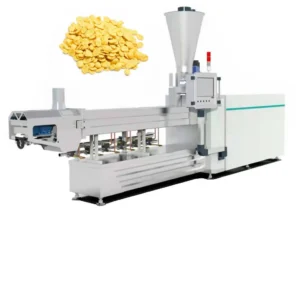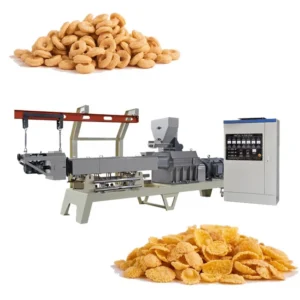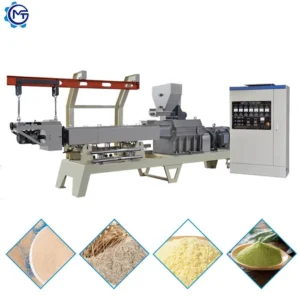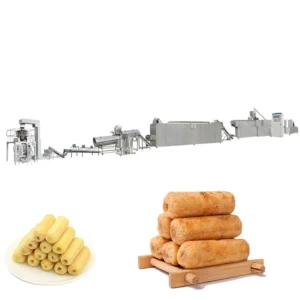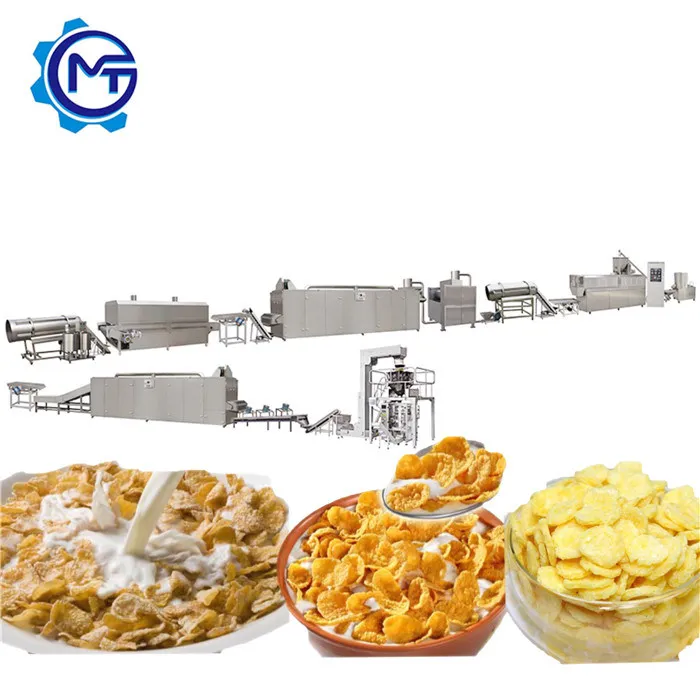
Matched Throughput Across Stations — every unit from the mixer to the flaking roll and roasting oven is sized so the corn flakes processing line equipment runs at a steady rate without one station starving or flooding the next.
Technical Specifications
| Parameter | Value |
|---|---|
| Product Type | Corn Flakes Breakfast Cereal Processing Line |
| Model | MT70 / MT85 / MT75 |
| Installed Power | 160 kW (MT70) / 190 kW (MT85) / 210 kW (MT75) |
| Power Consumption | 120 kW (MT70) / 140 kW (MT85) / 150 kW (MT75) |
| Capacity Range | 150–200 kg/h (MT70) / 300–400 kg/h (MT85) / 300–500 kg/h (MT75) (basis not stated in source — confirm raw material type, moisture content and product format) |
| Overall Dimensions | 41 × 1.5 × 2.2 m (MT70) / 43 × 1.5 × 3.2 m (MT85) / 45 × 1.5 × 3.5 m (MT75) |
| Extruder Type | Twin Screw (MT75 specified) |
| Screw Material | Special wear-resistant alloy |
| Control System | PLC control on flaking machinery; line-wide MCC and PLC control |
| Flaking Roller Drive | Double motors, separate roller driving; hydraulic system for double rollers |
| Flaking Temperature Control | Infrared sensor for even temperature pipe control |
| Dryer Heating Source | Gas / Electric |
| Roasting Oven | Hot air roasting with conciliation burner, dual circulating fans, cyclone dust removal, vibrating pan with high-temperature spraying tubes |
| Coating System | Double tumble for sugar melting, elevator, coating drum, spraying nozzle |
| Raw Materials | Corn, rice, wheat, oat, barley powder |
| Voltage & Frequency | Customized to customer’s local standard |
| Lubrication | Automatic lubricating system on extruder |
| Standards | CE certified; ISO certified |
Application Suitability
| Application | Material or Output |
|---|---|
| Natural corn flakes production | Corn grits or corn flour at controlled moisture |
| Sugar-coated breakfast cereals | Corn, rice, or wheat base with sugar syrup coating |
| Multi-grain cereal formats | Blends of oat, barley, wheat, and rice powder |
| Shaped cereal pieces | Ball, tube, stick, ring, fruit loop, star, wheel, flower, heart via die change |
Why Nominal Capacity Numbers Mislead on a Breakfast Cereal Line
Your actual grain blend and moisture content decide what the line really produces, not the model plate.
I once watched a Middle East customer unpack a corn flakes line that ran flawlessly during factory testing on standard corn grits. The moment they fed their local supplier’s corn flour — different particle size, slightly higher moisture — the flake thickness drifted, expansion dropped, and two weeks of on-site调试 followed before we dialed in a new screw combination and barrel temperature curve. That is why running a trial on the buyer’s exact raw material before shipment matters more than any brochure number [NEED_CITE: raw material variability impact on extrusion output].
How Screw Configuration Decides Flake Density
The twin-screw extruder at the heart of this breakfast cereal production line for sale handles corn, rice, wheat, oat, and barley powders, but each grain behaves differently under shear and heat. A screw combination optimized for corn grits may over-gelatinise oat starch, producing a dough too sticky for clean flaking. Matching screw pitch, kneading block arrangement, and die geometry to your specific formulation keeps the extrudate at the right moisture and expansion level so the downstream flaking rollers receive a consistent sheet.
Temperature Control from Barrel Through Roasting
Barrel zones, flaking roller surfaces, and the roasting oven each hold a separate temperature profile that must align. The flaking machinery uses an infrared sensor to regulate the temperature pipe, maintaining uniform heat across the roller face so flake thickness stays within spec. Downstream, the hot air roasting oven circulates air through two independent fans and a conciliation burner, giving operators separate control over top and bottom heat. Cyclone dust removal pulls fines out of the air stream, keeping the recirculated hot air clean so surface blistering on the flakes remains even across every batch [NEED_CITE: hot air circulation uniformity in cereal roasting].
Reading the Numbers That Matter
Installed power across the three models spans 160 kW to 210 kW, but actual power consumption sits at roughly 75 percent of that figure during steady-state running. The gap reflects motor start-up peaks and heater warm-up cycles rather than continuous draw, which affects how you size your transformer and dedicated circuit. The hydraulic system on the flaking rollers lets operators adjust nip pressure independently of motor speed, so you can change flake thickness without stopping the line. Automatic lubrication on the extruder main bearing runs on a timed cycle, cutting the chance of missed manual greasing during long shifts. Voltage and frequency are configured to your local grid before the control panel is wired, meaning the PLC screens and MCC starters arrive labeled in the correct language and rated for the right supply.
The Hidden Cost of Mismatched Stations
Pairing an extruder with a dryer or roasting oven that cannot keep up creates a bottleneck that no amount of extruder tuning will fix. Wet flakes pile up ahead of the dryer, cooling unevenly and developing hard spots that resist roasting. Oversized coating drums running half-empty waste sugar syrup and energy. These mismatches rarely show up in a single-machine quotation — they appear only when the whole line runs together under real production conditions [NEED_CITE: throughput balancing across cereal processing stations].
Why Buyers Source This Line Here
Every station from batching to packing comes from one supplier, so the extruder output, flaking capacity, dryer residence time, and coating drum volume are calculated together rather than assembled from separate vendors. Screw and die configurations are specified to your raw material blend and target flake density, not copied from a generic build. Before dispatch, your formulation runs through the in-house testing workshop so product development happens on real grain, not on assumptions. Electrical schematics arrive with voltage, frequency, and control language already confirmed to your site standard. CE and ISO documentation ships with the line, covering customs clearance and local inspection requirements without last-minute scrambles.
Documentation & Verification
- Line layout drawing with throughput calculation matched to your grain blend and target flake weight
- Screw and die configuration record specific to your raw material formulation
- Trial run report from in-house testing workshop on your actual corn, oat, or multi-grain powder
- Electrical schematic with confirmed voltage, frequency, and PLC screen language
- CE declaration of conformity and ISO certificate for customs and local compliance
- Wear parts list covering screws, dies, and flaking roller surfaces with part numbers
Installation, Commissioning & Support
- Floor plan and foundation load points mapped to the 41–45 m line footprint and 150 kW+ power draw
- Dedicated electrical circuit sized to confirmed voltage and frequency before panel wiring begins
- Modular station delivery with flaking hydraulic system and roasting oven ductwork assembled on site
- First-run parameter setting on your raw material with barrel temperature and nip pressure logged
- Operator training covering PLC screen navigation, screw change procedure, and sugar coating drum loading
- Spare screws, dies, and roller surfaces listed at order and shipped with initial installation kit
What We Need to Quote the Right Line
Send us the grain type and particle size you plan to run, the daily output target in kilograms, and whether you want natural flakes, sugar-coated, or both. Include your factory voltage and frequency, available floor length, and ceiling height so we can confirm the drying and roasting sections fit. If you need a trial run on your raw material before commitment, tell us the formulation and we will schedule it in the testing workshop.
Frequently Asked Questions
Q: How is line capacity verified against our specific raw material and moisture content?
A: Capacity depends on grain type, particle size, and incoming moisture. We run your actual formulation through the testing workshop, log the extruder throughput, flake yield, and roasting time, and report the numbers before you commit. Nominal model ratings are only a starting point.
Q: How are screw configuration and die design selected for corn versus oat versus multi-grain?
A: Each grain gelatinises at a different temperature and moisture level. We adjust screw pitch, kneading block count, and die opening to match your formulation so the extrudate reaches the flaking rollers at the correct density and plasticity.
Q: Is voltage, frequency, and control language confirmed before production?
A: Yes. We collect your site electrical standard during the quotation stage and wire the MCC and PLC panels accordingly. Screen text, warning labels, and motor nameplates all match your local requirements before the line ships.
Q: Can you run a trial on our raw material before shipment?
A: Our testing workshop runs your grain blend through the full extrusion-to-flaking sequence. You receive a trial run report with throughput data, flake thickness measurements, and the exact screw and die configuration used, so production starts from a proven baseline.