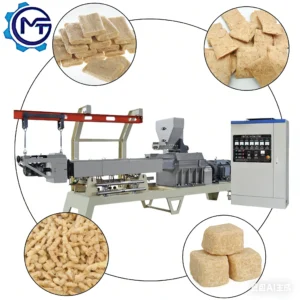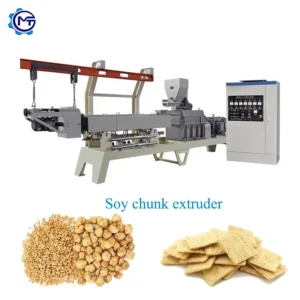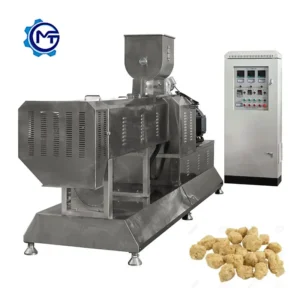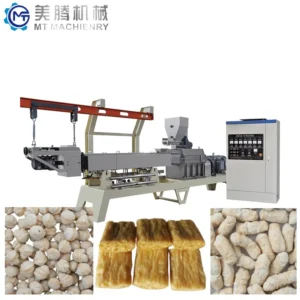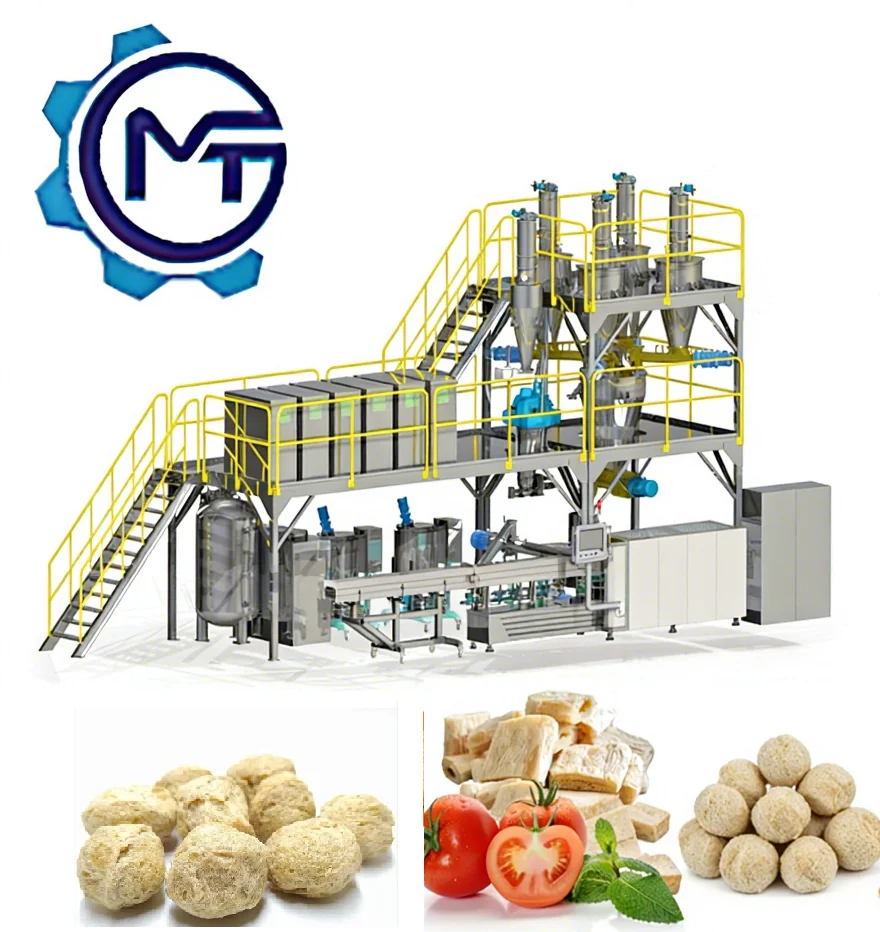
Thermomechanical Fiber Alignment — twin-screw extruders with screw lengths from 1,050 mm to 1,520 mm configured to defatted soya flour formulation, aligning barrel temperature profile and die geometry to the layered fiber structure your market expects.
Technical Specifications
| Parameter | Value |
|---|---|
| Product Type | Texturized Vegetable Protein (TVP) Production Line |
| Extruder Series | MT65 / MT70 / MT75 / MT85 |
| Screw Type | Twin-screw |
| Extruder Screw Length | 1,050 mm / 1,520 mm (varies by model) |
| Main Motor Power (Extruder) | 22 kW / 30 kW / 45 kW (model-dependent) |
| Installed Power (MT65) | 84 kW |
| Installed Power (MT70) | 160 kW |
| Installed Power (MT75) | 190 kW (verify against manufacturer catalog) |
| Installed Power (MT85) | 210 kW (verify against manufacturer catalog) |
| Power Consumption (MT65) | 59 kW |
| Power Consumption (MT70) | 120 kW |
| Power Consumption (MT75) | 140 kW |
| Power Consumption (MT85) | 140 kW |
| Output Capacity (MT65) | 100–150 kg/h (basis not stated in source — confirm raw material formulation and moisture content) |
| Output Capacity (MT70) | 150–200 kg/h (basis not stated in source — confirm raw material formulation and moisture content) |
| Output Capacity (MT75) | 150–200 kg/h (basis not stated in source — confirm raw material formulation and moisture content) |
| Output Capacity (MT85) | 250–300 kg/h (basis not stated in source — confirm raw material formulation and moisture content) |
| Mixer Type | Vertical mixing machine with stainless steel 304 mixing ruler |
| Mixer Capacity Options | 20–30 kg / 70–80 kg / 170–180 kg |
| Mixer Power Options | 4 kW / 7.5 kW / 15 kW |
| Dryer Type | Multi-layer dryer, double pitch roller chain drive, round-trip drying |
| Dryer Heating Options | Fuel / Gas / Electricity (buyer selectable) |
| Rotary Cutting Motor Power | 0.75 kW |
| Feeding Motor Power | 0.75 kW |
| Pump Motor Power | 0.37 kW |
| Extruder Heating Power | 10 kW / 14 kW (model-dependent) |
| Overall Dimensions (MT65) | 40,000 × 1,200 × 2,200 mm |
| Overall Dimensions (MT70) | 41,000 × 1,500 × 2,200 mm |
| Overall Dimensions (MT75) | 43,000 × 1,500 × 3,200 mm |
| Overall Dimensions (MT85) | 45,000 × 1,500 × 3,500 mm |
| Standards | CE; ISO |
Application Suitability
| Application | Material or Output |
|---|---|
| TVP / TSP soya nuggets and chunks | Defatted soya flour, low-temperature soya flakes |
| Vegetarian meat analogues with layered fiber | Soybean dregs, peanut dregs |
| Soya protein blocks for deep-freeze food | Low-temperature soya flakes with adjusted moisture |
| Fortified snack formats via screw reconfiguration | Cereal grains, blended protein formulations |
Why "150 kg/h" Means Nothing Without Your Raw Material
The output number on a quotation sheet only holds if it was measured on the flour you actually buy.
I have seen plant based meat processing line full equipment range specifications quoted on premium low-temperature soya flakes, then installed in factories running standard defatted soya flour with lower protein content and different water-holding capacity. The extruder barrel fills, the die pressure drops, and the fiber structure collapses. What was quoted at one throughput rate comes out at a fraction of that volume, and the purchasing team is left explaining the gap to production planning [NEED_CITE: raw material protein content effect on extrusion expansion].
Matching Extruder Screw Geometry to Target Fiber Structure
The twin-screw extruder series offers screw lengths of 1,050 mm and 1,520 mm, and the choice between them is not about capacity alone. A longer screw section extends residence time inside the barrel, which changes how completely the soy protein unfolds and realigns under shear and heat. For a plant based meat processing line full equipment range producing dense soya chunks with visible layered fiber, the screw configuration and die geometry must be specified together — one without the other produces either a mushy extrudate or a brittle pellet.
Dryer Sizing and the Bottleneck That Hides Until Week Three
The multi-layer dryer uses a double pitch roller chain drive with round-trip drying across multiple tiers, and the heating source is selectable between fuel, gas, and electricity. This matters because TVP exits the extruder at a moisture level far above the shelf-stable target, and the dwell time required to bring it down depends on chunk size and ambient humidity. If the dryer cannot hold the extruder’s output volume for the required duration, product queues on the conveyor and the entire plant based meat processing line full equipment range slows to match the slowest station [NEED_CITE: moisture content targets for shelf-stable TVP].
Reading the Power and Dimension Data
The installed power figures range from 84 kW on the MT65 to 210 kW on the MT85, but the consumption values — 59 kW to 140 kW — reflect what the line actually draws during steady-state extrusion. The gap between installed and consumed power covers the heater bands, feeder motors, and cutting motor that cycle on and off. For factory electrical planning, the consumption figure is the one to size your transformer and dedicated circuit around. The overall dimensions stretch from 40 meters to 45 meters in length, which dictates the minimum bay length before accounting for raw material staging and finished goods palletizing. The vertical mixer options span 20–30 kg to 170–180 kg batch capacity; matching mixer batch size to extruder throughput prevents the operator from either waiting on the next mix or dumping partially blended batches into the hopper.
What Happens When Stations Are Mismatched
When the mixer batch cycle runs longer than the extruder hopper drain time, the screw runs starved and the extrudate density fluctuates. When the air conveyor moves product faster than the dryer can accept it, nuggets stack on the belt and cool unevenly before entering the drying chamber. These are not hypothetical failures — they are the direct result of sourcing each station from a different vendor who sized their equipment to a different assumption. The plant based meat processing line full equipment range avoids this by specifying throughput across every station as a single system [NEED_CITE: throughput matching methodology for extrusion lines].
Why Procurement Consolidates Here
The line runs from vertical mixer through screw conveyor, twin-screw extruder, air conveyor, multi-layer dryer, and cooling machine as one integrated flow — not a collection of standalone machines assembled from separate quotations. Screw configuration and die design are specified to the buyer’s raw material formulation and target product density before production begins, rather than copied from a generic build sheet. An in-house testing workshop runs trial production on the customer’s actual defatted soya flour or low-temperature soya flakes before the line ships, so product development starts before installation rather than after. Electrical schematics and voltage confirmation are aligned to the factory’s power supply before the first panel is wired. Documentation covers every stage from line layout through factory test records.
Documentation & Verification
- Line layout showing throughput calculation across mixer, extruder, dryer, and cooling stations
- Screw and die configuration record matched to your soya flour protein content and target chunk density
- Trial run report produced on your actual raw material in the testing workshop before dispatch
- Electrical schematic with voltage and frequency confirmed against your factory supply specification
- Factory test record documenting steady-state output and moisture readings at each station
Installation, Commissioning & Support
- Foundation plan accounts for the 40–45 meter line length and dryer weight distribution across the multi-layer frame
- Dedicated circuit sized to the 59–140 kW consumption range depending on model, separate from lighting and auxiliary loads
- Extruder barrel sections and dryer tiers ship disassembled and require alignment on site before first heating cycle
- First commissioning run verifies screw configuration against the trial run report parameters before operator handover
- Wear parts list specifies screw elements, die plates, and cutter blades with reorder intervals based on soya flour abrasion
- Stainless steel 304 mixer contact parts require inspection of the mixing ruler edges at scheduled maintenance intervals
What to Include in Your Inquiry
To configure the plant based meat processing line full equipment range correctly, the technical discussion needs your raw material specification — particularly protein content and moisture level of the defatted soya flour or soya flakes you source locally — along with your target production volume per shift and the physical dimensions of the TVP nuggets or chunks your market requires. Confirm your factory voltage and frequency, and whether the dryer should be configured for gas, fuel, or electric heating based on available utilities.
Frequently Asked Questions
Q: How is output capacity verified against my raw material?
A: The capacity figures in the specification table are model-level ranges. Before the line is built, your actual defatted soya flour or soya flakes are run in the testing workshop, and the output is measured at steady state with your formulation’s protein content and moisture level. That trial run report becomes the baseline for acceptance.
Q: How do I choose between the MT65, MT70, MT75, and MT85?
A: Model selection depends on your target production volume per shift, but also on the screw length required for your target fiber structure. A higher-capacity model with a shorter screw section may not produce the layered fiber your market expects, so throughput and screw geometry are evaluated together.
Q: Can the dryer be set up for my factory’s available heating source?
A: Yes. The multi-layer dryer is configurable for fuel, gas, or electric heating. The choice affects both the dryer’s internal temperature profile and the utility infrastructure your factory needs to prepare before the line arrives. This is confirmed during the electrical schematic stage.
Q: Is a trial run performed before the line ships?
A: Yes. The testing workshop runs your specific raw material through the configured extruder and dryer, and the trial run report documents output rate, product density, moisture content, and fiber structure. This report ships with the line and serves as the commissioning reference.
Q: What supporting equipment is included to prevent station bottlenecks?
A: The line includes a vertical mixer sized to match extruder batch intake, a screw conveyor for controlled feeding, an air conveyor between extruder and dryer, and a cooling machine after the dryer. Each station is specified to the same throughput target so no single point constrains the line.