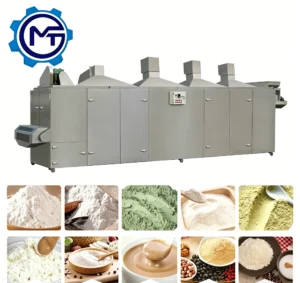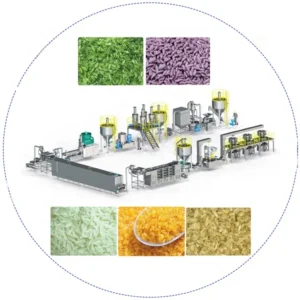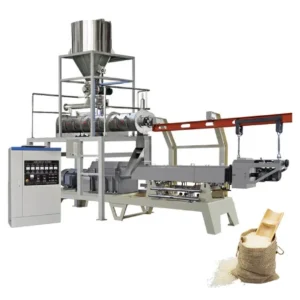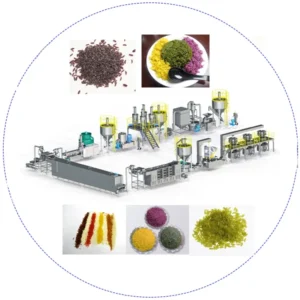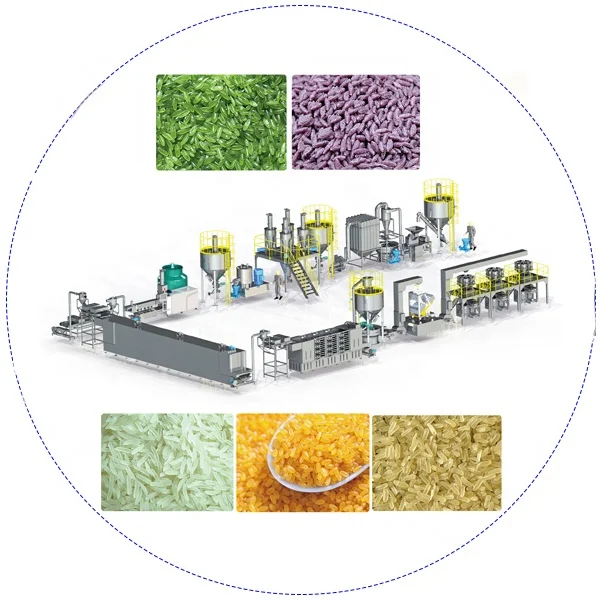
Full line integration — every station from mixing to packing is specified against the extruder output, so throughput stays balanced across the entire artificial and fortified rice line.
Technical Specifications
| Parameter | Value |
|---|---|
| Model | MT65 / MT70 / MT85 / MT75 / MT95 |
| Product Type | Fortified Rice Kernel and Artificial Rice Production Line |
| Screw Type | Twin-screw |
| Installed Power | MT65 85 kW / MT70 120 kW / MT85 235 kW / MT75 180 kW / MT95 260 kW |
| Power Consumption | MT65 60 kW / MT70 85 kW / MT85 165 kW / MT75 135 kW / MT95 195 kW |
| Output Capacity | MT65 80–100 kg/h / MT70 100–120 kg/h / MT85 200–300 kg/h / MT75 300–500 kg/h / MT95 800–1000 kg/h (basis not stated in source — confirm raw material composition and moisture content) |
| Overall Dimensions (L×W×H) | MT65 28×1.2×2.2 m / MT70 30×1.5×2.2 m / MT85 34×3.5×4.3 m / MT75 32×3.5×4.3 m / MT95 36×3.5×4.3 m |
| Control System | Frequency speed control with automated operation |
| Line Stations | Mixing, Extruding, Vibrating, Low temperature drying, Cooling, High temperature roasting, Cooling, Packing |
| Heating Source (Dryer) | Electric or gas |
| Dryer Feature | Circulation drying with frequency motor controlled mesh belt speed |
| Lubrication | Automatic lubricating and cooling system |
| Assembly State | Complete turnkey production line |
| Certification | CE |
Application Suitability
| Application | Material or Output |
|---|---|
| Fortified rice kernel production | Broken rice blended with vitamins, minerals, and trace elements |
| Artificial rice for nutrition programmes | Corn, millet, and starch-based pre-mixes with added micronutrients |
| Nutritional rice for institutional supply | Wheat, oats, and buckwheat blends enriched with iron and B-vitamins |
| Multi-grain artificial rice | Bean flour and mixed grain formulations for specialty food markets |
| Breakfast rice kernels | Rice flour and corn grits processed into quick-cook cereal formats |
What "Rated Capacity" Leaves Out on a Fortified Rice Production Line
A capacity figure without raw material context is just a label, not a commitment.
When buyers review a Fortified Rice Production Line full equipment range brochure, the headline number usually reflects a trial on standard rice flour at controlled moisture. Switch to a high-fibre multi-grain premix and that same extruder may run slower, require different screw pitch, or need the dryer belt to slow down for proper moisture removal. I learned this the hard way when a project in the Middle East ran perfectly on our test flour but underperformed on the buyer’s actual blend — starch content was lower, gelatinisation behaviour shifted, and we had to reconfigure the screw layout on site. [NEED_CITE: starch gelatinisation behaviour across grain formulations]
How Each Station Connects in the Fortified Rice Production Line Full Equipment Range
This Fortified Rice Production Line full equipment range covers eight stations arranged in sequence: mixing, extruding, vibrating, low temperature drying, cooling, high temperature roasting, a second cooling pass, and packing. The twin-screw extruder sits at the centre, but its output only matters if the dryer can handle the moisture load and the cooling conveyors can match the belt speed. Frequency-controlled motors on the dryer mesh belt let operators fine-tune residence time without stopping the line.
Why Raw Material Testing Matters Before the Line Ships
Every grain formulation behaves differently under heat and shear. Broken rice gelatinises at a different temperature than a buckwheat-heavy blend, and the starch-to-protein ratio affects how the extrudate expands through the die. Running a trial on the buyer’s actual raw material in the testing workshop reveals whether the standard screw configuration delivers the right kernel density or whether a revised pitch is needed. [NEED_CITE: twin-screw extrusion behaviour on variable starch formulations] Skipping this step means discovering the problem after the line is bolted to the factory floor.
Reading the Power and Capacity Data Correctly
The five extruder models span from 85 kW installed power on the MT65 up to 260 kW on the MT95, covering small-batch production to continuous industrial output. Power consumption figures sit below installed capacity because the motors rarely run at peak draw simultaneously — the automatic lubricating and cooling system cycles independently, and the frequency drives modulate screw speed to match load. Output capacity numbers in the table must be validated against the specific grain blend and moisture percentage; a corn-dominant mix will behave differently from a high-oat formulation at the same screw speed. Die aperture and cutting frequency also shape the final kernel dimensions, so two lines running identical throughput can produce visibly different rice grain sizes.
The Hidden Cost of Mismatched Station Capacity
When the dryer is sized for a lower output than the extruder actually delivers, wet kernels pile up on the mesh belt and stick together before moisture can escape. The result is uneven drying, kernel breakage during roasting, and a packing station that sits idle waiting for cooled product. [NEED_CITE: production line bottleneck effects in food extrusion] These losses do not show up in any specification sheet — they only appear once the line is running under real conditions, which is why throughput matching across every station is a non-negotiable part of the layout calculation.
Why Source the Full Line from One Supplier
Every station in this line is specified to match the extruder’s actual output rather than a generic capacity label, so the dryer length, cooling conveyor speed, and packing rate all align with what comes off the die. Screw configuration and die design are matched to the buyer’s grain formulation, not copied from a standard template. The in-house testing workshop runs the buyer’s raw material before shipment, catching formulation issues early. Pre-sales consultation covers line layout and utility planning, and on-site installation includes commissioning and operator training. Spare wear parts — screws, dies, and mesh belt sections — are documented and available when the first replacement cycle arrives.
Documentation & Verification
- Line layout and capacity calculation showing throughput balance across all eight stations
- Screw and die configuration record matched to your grain formulation and target kernel size
- Electrical schematic with voltage and frequency confirmation for your local grid standard
- Trial run report on your raw material from the in-house testing workshop
- Machine specification sheet covering every station from mixer to packer
- CE declaration of conformity for the complete production line
Installation, Commissioning & Support
- Foundation plan accounts for the MT95 footprint of 36×3.5×4.3 m and dryer weight distribution
- Electrical room must supply the confirmed voltage and frequency with dedicated circuits for each 260 kW extruder drive
- Line arrives in modular sections; assembly sequence and rigging points documented per station
- Commissioning includes screw speed calibration, dryer belt tensioning, and roasting temperature profiling
- Operator training covers frequency drive adjustment, automatic lubrication monitoring, and daily mesh belt inspection
- Wear parts list covers screws, dies, and dryer belt links with reorder intervals noted
What We Need to Move Forward
Share the grain formulation you plan to run — ingredient percentages, moisture content, and target kernel dimensions — so we can size the extruder and configure the screw layout. Let us know your local voltage standard, frequency, and preferred control language. If you have an existing mixing or packing station that the line needs to integrate with, send the throughput data and interface dimensions so we can match the connection points.
Frequently Asked Questions
Q: What supporting equipment is included and how is throughput matched between stations?
A: The line covers mixing, extruding, vibrating, low temperature drying, cooling, high temperature roasting, a second cooling stage, and packing. Each station is sized against the extruder’s actual output on your grain formulation so material flows continuously without pile-ups or idle time between stages.
Q: Which extruder model fits my target capacity and factory space?
A: Five models span from the MT65 at 80–100 kg/h up to the MT95 at 800–1000 kg/h, with overall lengths from 28 m to 36 m. The right choice depends on your confirmed raw material composition, moisture level, and available floor length including utility corridors.
Q: What drying and cooling options are available and how do they integrate with extruder output?
A: The dryer supports electric or gas heating with circulation airflow and a frequency-controlled mesh belt, letting operators adjust residence time to match extruder throughput. Two cooling stages — one after low temperature drying and one after roasting — bring kernels to packing temperature without condensation risk.
Q: How are voltage, frequency, and control language confirmed before production?
A: The electrical schematic is finalised during the layout stage based on your local grid standard. Control language and HMI interface are agreed before assembly so the frequency drives, automated operation panel, and safety interlocks all ship in the correct configuration.
Q: What spare parts and wear components are supplied with the initial shipment?
A: A documented wear parts list covers screws, die plates, and dryer belt sections. Quantities are calculated based on your production schedule so replacements are on hand before the first change-out is due, avoiding unplanned downtime.