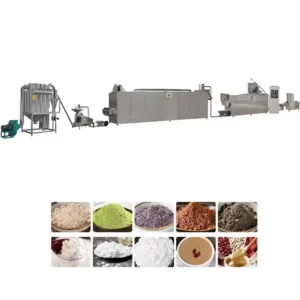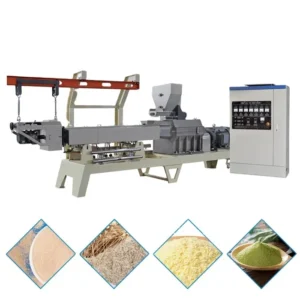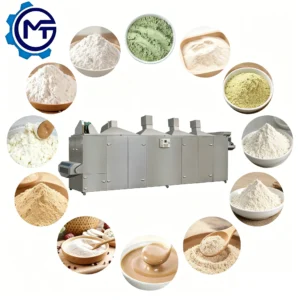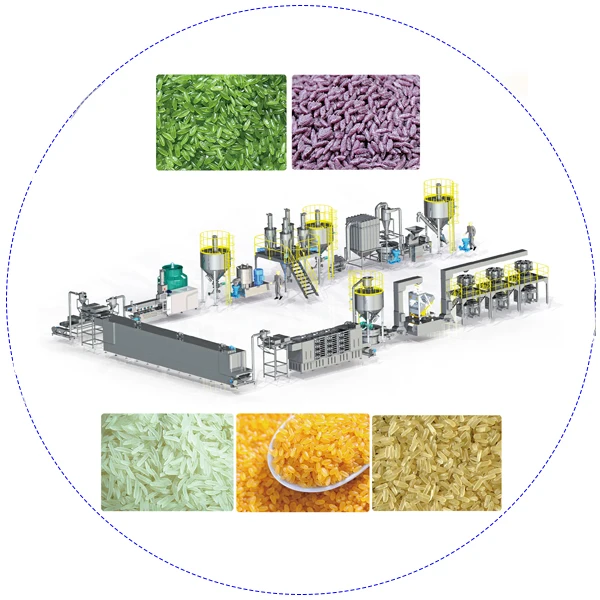
Matched Throughput Across Every Station — each segment from mixing to packing is sized against your specific nutrient premix and base grain, preventing bottleneck scenarios common in assembled lines.
Technical Specifications
| Parameter | Value |
|---|---|
| Model | MT65 / MT70 / MT85 / MT75 / MT95 |
| Product Type | Artificial Rice & Fortified Rice Kernel Extrusion Production Line |
| Screw Type | Twin-screw (single or double screw feeding system available based on material) |
| Installed Power | 85 kW (MT65) / 120 kW (MT70) / 235 kW (MT85) / 180 kW (MT75) / 260 kW (MT95) |
| Power Consumption | 60 kW (MT65) / 85 kW (MT70) / 165 kW (MT85) / 135 kW (MT75) / 195 kW (MT95) |
| Output Capacity | 80–100 kg/h (MT65) / 100–120 kg/h (MT70) / 200–300 kg/h (MT85) / 300–500 kg/h (MT75) / 800–1000 kg/h (MT95) (basis not stated in source) |
| Overall Dimensions (L×W×H) | 28×1.2×2.2 m (MT65) / 30×1.5×2.2 m (MT70) / 34×3.5×4.3 m (MT85) / 32×3.5×4.3 m (MT75) / 36×3.5×4.3 m (MT95) |
| Control System | Frequency speed control with high automation |
| Screw Material | Special wear-resistant alloy |
| Heating Source (Dryer) | Electric or gas |
| Dryer Type | Circulation mesh-belt drying oven with variable-frequency motor speed control |
| Line Stations | Mixing → Extruding → Vibrating → Low-temperature drying → Cooling → High-temperature roasting → Cooling → Packing |
| Assembly State | Complete turnkey line from batching to packing |
Application Suitability
| Application | Material or Output |
|---|---|
| Fortified Rice Kernels | Broken rice and rice bran blended with vitamin and mineral premixes for institutional nutrition programs |
| Artificial Rice Production | Corn, millet, wheat, oats, and buckwheat reconstituted into uniform rice-shaped kernels |
| Nutritional Rice Formats | Beans and starch bases fortified with micronutrients for specialty dietary markets |
| Waste Reduction Processing | Rice milling by-products converted into consumable fortified rice kernels |
What "Nominal Capacity" Leaves Out About Fortified Rice Lines
A machine rated on plain rice flour will behave differently once whey protein and micronutrient premixes enter the barrel.
Buyers surveying equipment before specifying a line often compare extruders on a single throughput number. In my years attending trade shows across Europe and North America, I have watched procurement teams select an artificial rice extruder full equipment range based on a brochure figure, only to discover during commissioning that their actual formulation—loaded with heat-sensitive vitamins and protein isolates—alters melt viscosity and expansion behaviour. The result is a line that cannot sustain its quoted output without compromising kernel density or cooking integrity [NEED_CITE: formulation impact on extrusion throughput]. This artificial rice extruder full equipment range is configured around your raw material profile before any capacity commitment is made.
Station-by-Station Throughput Matching
Selecting an artificial rice extruder full equipment range requires verifying that the dryer and cooler can handle the extruder’s actual discharge rate. If the extruder discharges 300 kg/h but the mesh-belt dryer is sized for 200 kg/h, moisture removal becomes the constraint and the entire line stalls. Each station in this configuration is calculated against the others so that vibrating conveyors, drying ovens, and cooling belts move product at a synchronized pace.
Screw and Die Configuration for Rice Kernel Geometry
The twin-screw setup is specified to your target kernel shape and base ingredient rather than copied from a generic build. Rice bran behaves differently from corn grits under shear, and the screw element arrangement must account for that divergence. Die selection determines whether the output resembles long-grain or short-grain rice, and the wear-resistant alloy screws maintain dimensional accuracy across extended production runs [NEED_CITE: screw configuration and product geometry in food extrusion].
Interpreting the Power and Capacity Ranges
The five model options span from 85 kW installed power on the MT65 to 260 kW on the MT95, covering output from 80 kg/h to 1000 kg/h depending on formulation. Power consumption figures are consistently lower than installed power, reflecting the variable load that frequency-controlled motors place on the electrical supply during steady-state running. The twin-screw design with automatic lubrication and cooling reduces thermal stress on the barrel, which matters when processing vitamin-fortified blends that degrade at excessive temperatures. Dryer heating is available in electric or gas, allowing selection based on local utility costs and availability.
The Cost of Undersized Supporting Stations
An extruder that runs at its rated capacity while the downstream dryer falls behind creates a backlog of wet product that clumps on the conveyor and must be discarded. I have seen buyers replace entire drying sections within the first year because the original equipment survey focused exclusively on extruder specifications. Mismatched cooling stations introduce a different problem: kernels that enter packaging at elevated moisture attract mold during storage, generating customer complaints that trace back to the equipment selection stage [NEED_CITE: downstream equipment mismatch consequences in food processing].
Why Procurement Teams Specify This Range
Complete line coverage under one supplier means throughput calculations account for every transfer point rather than leaving gaps between independently sourced machines. Screw configuration and die design are documented against your specific raw material and target kernel shape before production begins. An in-house testing workshop runs your actual formulation before shipment, generating a trial report that confirms density and cooking behaviour. Electrical schematics, voltage confirmation, and control language are locked in during the specification phase, preventing commissioning delays. Wear parts lists and screw configuration records ship with the line so that the first replacement cycle can be planned rather than discovered.
Documentation & Verification
- Line layout showing throughput matching between extruder, dryer, and cooler stations
- Screw and die configuration record specific to your rice bran or corn base formulation
- Trial run report on your nutrient premix confirming kernel density before dispatch
- Electrical schematic with voltage and frequency confirmed for your facility
- Wear parts list with replacement intervals for screws, dies, and mesh-belt segments
- CE declaration of conformity and ISO certificate for customs and regulatory submission
Installation, Commissioning & Support
- Foundation planning based on overall dimensions up to 36×3.5×4.3 m for the MT95
- Dedicated electrical circuits sized to installed power ranging from 85 kW to 260 kW
- Assembly from shipped modules with alignment verification across all conveyor transfer points
- First-run parameter setting including barrel temperature profile and dryer belt speed
- Operator training covering frequency speed control interface and automatic lubrication monitoring
- Scheduled wear part replacement based on documented screw and die configuration records
Information Needed for Line Configuration
To match this artificial rice extruder full equipment range to your production target, we need your base ingredient specification—whether broken rice, corn, or a blended grain formulation—along with the nutrient premix composition and target kernel dimensions. Confirm your local voltage and frequency, preferred control language, and available factory floor space including ceiling height for the drying and cooling sections. If you have existing upstream batching or downstream packaging equipment, provide those specifications so the line integrates without throughput gaps.
Frequently Asked Questions
Q: How is line capacity verified against my specific raw material and nutrient formulation?
A: Before any capacity commitment, your actual base ingredient and premix are run in the in-house testing workshop. The trial generates a report documenting kernel density, expansion behaviour, and moisture content at discharge. Capacity figures are then confirmed against that formulation rather than quoted from a generic benchmark, ensuring the artificial rice extruder full equipment range performs as specified on your material.
Q: What supporting stations are included and how is throughput matched between extruder, dryer and cooler?
A: The line includes mixing, extruding, vibrating, low-temperature drying, cooling, high-temperature roasting, a second cooling stage, and packing. Each station is sized so that the dryer’s moisture removal rate and the cooler’s residence time align with the extruder’s actual discharge rate on your formulation, preventing bottlenecks that would otherwise cap the line below its extruder capacity.
Q: Which dryer heating source is available and how does moisture control work?
A: The circulation mesh-belt dryer is available with electric or gas heating, selected based on your facility’s utility infrastructure. Variable-frequency motor speed control adjusts belt speed to modify residence time, allowing operators to fine-tune final moisture content without altering the extruder’s output rate or barrel temperature profile.
Q: What voltage, frequency and control-language options are confirmed before production?
A: Electrical specifications including voltage, frequency, and control panel language are confirmed during the quotation phase and documented in the electrical schematic before production begins. This prevents commissioning delays caused by mismatched power supplies or operator interfaces that require on-site reconfiguration after the equipment has already been installed.
Q: What spare wear parts documentation is provided and how is the first replacement scheduled?
A: A wear parts list ships with the line, identifying screws, dies, and mesh-belt segments along with expected service intervals based on your formulation’s abrasiveness. The screw and die configuration record documents the exact specifications so that replacement parts match the original geometry without requiring reverse engineering or trial fitting during the first maintenance cycle.