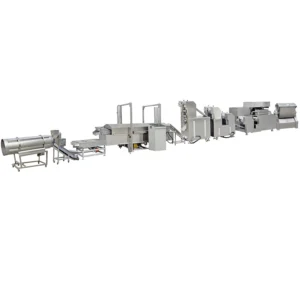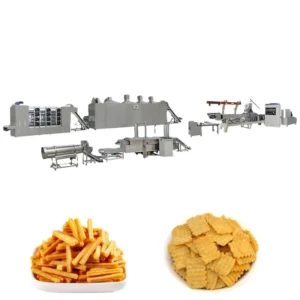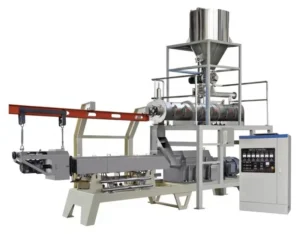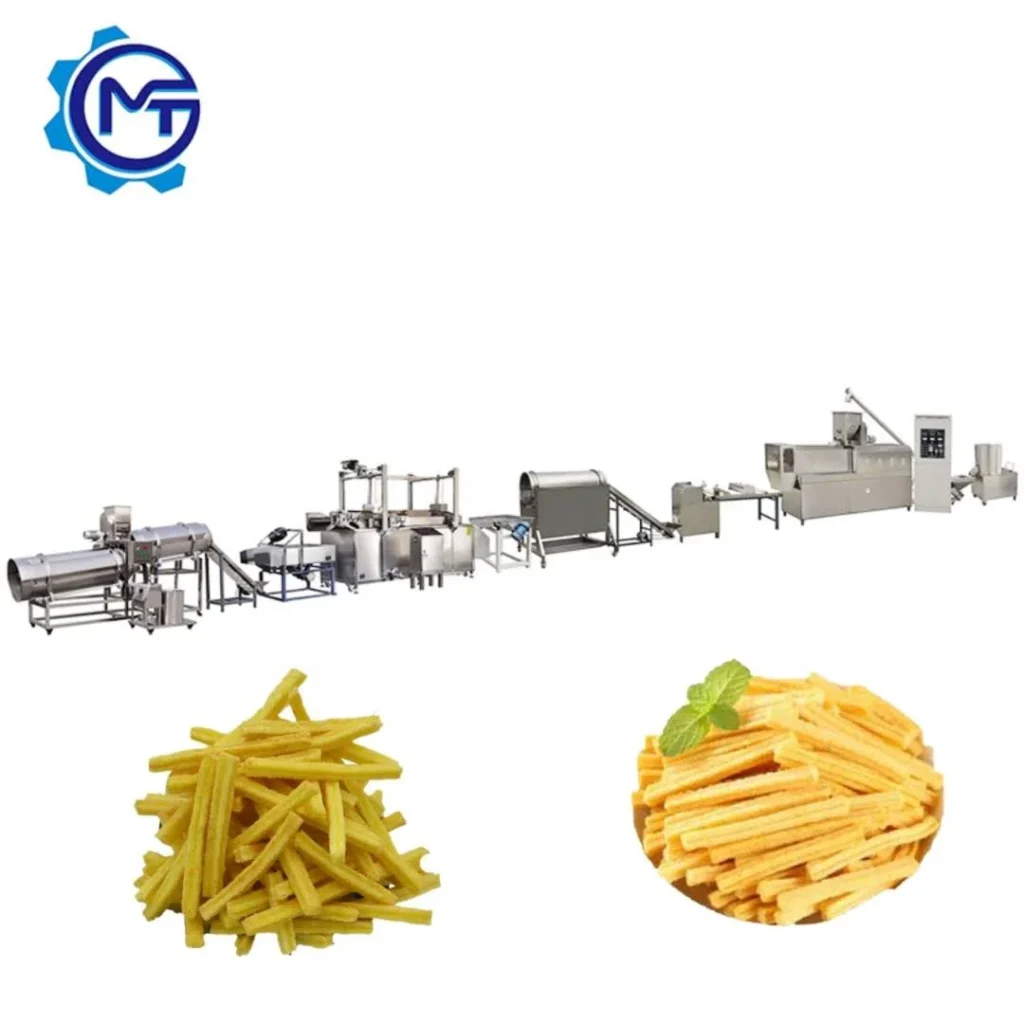
Throughput-Matched Stations — Every fryer, extruder and flavouring drum in this line is sized against the others so no single machine dictates the ceiling.
Technical Specifications
| Parameter | Value |
|---|---|
| Product Type | Fried Snack Food Processing Line (Rice Crust / Bugles / Pillow Snacks) |
| Line Sequence | Mixer → Twin-Screw Extruder → Cutting Machine → Fryer → Flavoring Drum |
| Extruder Type | Twin-screw |
| Fryer Rated Power | 60 kW |
| Flavoring Drum Rated Power | 0.37 kW |
| Voltage Options | Three-phase 380V/50Hz; Single-phase 220V/50Hz (configurable to local standard) |
| Assembly State | Multi-station continuous line |
| Certification | CE |
| Output Capacity | (basis to be confirmed — depends on raw material, moisture and product format) |
Application Suitability
| Application | Material or Output |
|---|---|
| Rice crust chip production | Rice flour, corn flour, water-based dough formulations |
| Bugles and horn-shaped snacks | Corn flour blends with controlled moisture addition |
| Pillow-format fried snacks | Wheat flour or mixed grain flour formulations |
| Corn-based extruded fried pellets | Corn grits or corn flour with seasoning post-fry |
What "Rated Capacity" Means When Your Flour Blend Changes
A line is only as fast as its slowest matched station on your actual raw material.
I remember configuring a fried snack line for a buyer in the Middle East who specified wheat flour on the inquiry. We quoted accordingly. Two weeks before shipment, they switched to a mixed grain blend with higher fibre content, and the extruder output dropped noticeably while the fryer sat half-empty. [NEED_CITE: raw material moisture and composition effects on extrusion throughput] When a fried snack food processing line is built around a single flour type and the buyer changes the recipe, every downstream station reveals the mismatch. The fryer does not know the extruder slowed down; it just runs with gaps on the belt.
Station Sizing That Follows the Material, Not the Brochure
The mixer feeds the twin-screw extruder at a rate governed by screw speed and barrel fill. From there, the cutting machine portions the extruded dough into uniform pieces before they enter the fryer. A fried snack food processing line only holds its rhythm when each station’s cycle time overlaps the next without accumulation or starvation. The 60 kW fryer in this configuration has a belt length and layer arrangement selected around the expected dwell time for rice crust and bugle formats.
How Voltage Confirmation Prevents Commissioning Delays
Export markets run on different electrical standards, and a motor wound for 380V/50Hz will not start cleanly on a 440V/60Hz supply without rewinding or a transformer. [NEED_CITE: voltage and frequency standards by export market] This line supports three-phase 380V/50Hz and single-phase 220V/50Hz as baseline options, with further configuration available before production begins. Confirming the buyer’s local supply at the quotation stage avoids rewiring on the factory floor after delivery.
Reading the Specs That Actually Matter
The twin-screw extruder provides higher shear and more residence time control than a single-screw equivalent, which matters when working with mixed grain flours that gelatinise at different rates. The screw configuration and die geometry together determine whether a rice crust chip exits dense and flat or light and blistered. Fryer power at 60 kW indicates the thermal headroom available to maintain oil temperature as cold product enters continuously; undersized fryers lose recovery speed and produce uneven colour. The flavouring drum at 0.37 kW turns at a speed that tumbles fried pieces gently enough to avoid breakage while distributing seasoning across all surfaces.
The Cost of Skipping the Fryer Calculation
Buyers sometimes specify an extruder first and add a fryer later based on a catalogue number. [NEED_CITE: extrusion line bottleneck caused by undersized downstream equipment] The result is a fryer that cannot recover oil temperature fast enough when the extruder runs at full rate, producing under-coloured chips on one end of the belt and over-fried pieces on the other. The flavouring drum then receives product at inconsistent surface oil levels, so seasoning sticks unevenly. These problems surface only during production, not during the factory acceptance test where the line runs briefly on a standard recipe.
Why Sourcing the Full Range Here Reduces Integration Risk
Every station in this fried snack food processing line comes from one equipment catalogue, meaning belt widths, transfer heights and control signals are designed to align. Screw and die configurations are documented against the buyer’s stated raw material rather than copied from a generic build. An in-house testing workshop allows trial runs on the buyer’s actual flour blend before the line ships, revealing throughput and texture issues while adjustments are still inexpensive. Electrical schematics and voltage confirmation happen before production starts, not after the machines arrive on site. The CE declaration covers the assembled line, not just individual stations.
Documentation & Verification
- Line layout drawing showing throughput calculation at each station from mixer to flavouring drum
- Screw and die configuration record matched to your rice crust or bugle recipe
- Electrical schematic with voltage and frequency confirmed against your local supply
- Factory trial run report on your actual flour blend before shipment
- CE declaration of conformity covering the integrated line assembly
Installation, Commissioning & Support
- Foundation plan accounting for fryer weight when filled with oil and product load
- Dedicated electrical circuit sized for the 60 kW fryer plus extruder motor starting current
- Multi-station assembly sequence from mixer through flavouring drum with belt alignment checks
- First-run parameter logging covering barrel temperatures, screw speed and fryer oil recovery time
- Operator training on die changes for switching between rice crust and bugle formats
- Wear parts list covering screws, dies and cutting blades with reorder part numbers
Before You Request a Quote
Send the flour type or blend you plan to run, including any minor ingredients like salt or sugar that affect gelatinisation. Confirm your facility’s available voltage, phase and frequency so the motors and controls are wound correctly from the start. If you have existing upstream mixing or downstream packing equipment, share the interface dimensions so the line transfer points align.
Frequently Asked Questions
Q: How is the output rate determined for different snack formats?
A: Output depends on the raw material formulation, moisture content at the extruder inlet, and the target piece weight after cutting. Rice crust chips and bugles have different dough densities and fryer dwell times, so the same line runs at different rates for each. We calculate capacity after reviewing your specific recipe and confirm it with a trial run before shipment.
Q: What electrical configurations are available for export markets?
A: The baseline options include three-phase 380V/50Hz and single-phase 220V/50Hz. Other voltage and frequency combinations are configurable before production. We request your local supply specification at the quotation stage so motors, heaters and control panels are built to match, avoiding transformers or rewinding on site.
Q: How is the fryer sized for different chip formats?
A: Fryer belt length and layer count are selected based on the required oil immersion time for each snack shape. Thicker rice crust pieces need longer dwell than thin bugles. The 60 kW rating provides thermal recovery headroom for continuous loading at the extruder’s confirmed output rate.
Q: Which spare wear parts should I plan for in the first year?
A: Screws, dies and cutting blades are the primary wear items on an extrusion and cutting line. We supply a wear parts list with part numbers at delivery. Screw life depends on the abrasiveness of your flour blend, and die wear relates to the dough formulation and operating pressure.
Q: Can additional stations be added to the line later?
A: The line sequence supports adding cooling conveyors between the fryer and flavouring drum, or an extra seasoning station for dual-coat applications. Belt heights and transfer points are designed with standardised interfaces so later additions integrate without rebuilding existing stations.