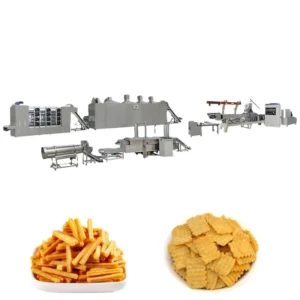
Matched Throughput Across Every Station — Every unit in this fried snack food processing line equipment is sized to your confirmed raw material and target output so the fryer, de-oiling belt, and seasoning drum never choke on extruder volume.
Technical Specifications
| Parameter | Value |
|---|---|
| Product Type | Fried Snack Food Processing Line with Continuous Frying Machine |
| Place of Origin | Shandong Province, China |
| Power Source | Electric or Gas heating (options available) |
| Voltage & Frequency | 380V / 50Hz (configurable for target market) |
| Heating Tube Power | 60 kW |
| Drive Power | 2.6 kW |
| Oil Capacity | 320 L |
| Net Weight | 2000 kg |
| Overall Dimensions (L×W×H) | 6700 × 2200 × 1200 mm |
| Output Capacity | 100–1000 kg/h (basis to be confirmed with product type, moisture, and frying time) |
| Control System | PLC |
| Mesh Belt Type | Upper and lower double-layer mesh belt |
| Oil Filtration | Continuous oil circulation filtration system |
| Slag Discharge | Bottom slag discharge system |
| Lifting System | Automatic lifting for upper hood and mesh belt |
| Material | Food-grade 304 stainless steel |
| Belt Transmission | Frequency conversion stepless speed regulation |
| Warranty | 1 Year |
Application Suitability
| Application | Material or Output |
|---|---|
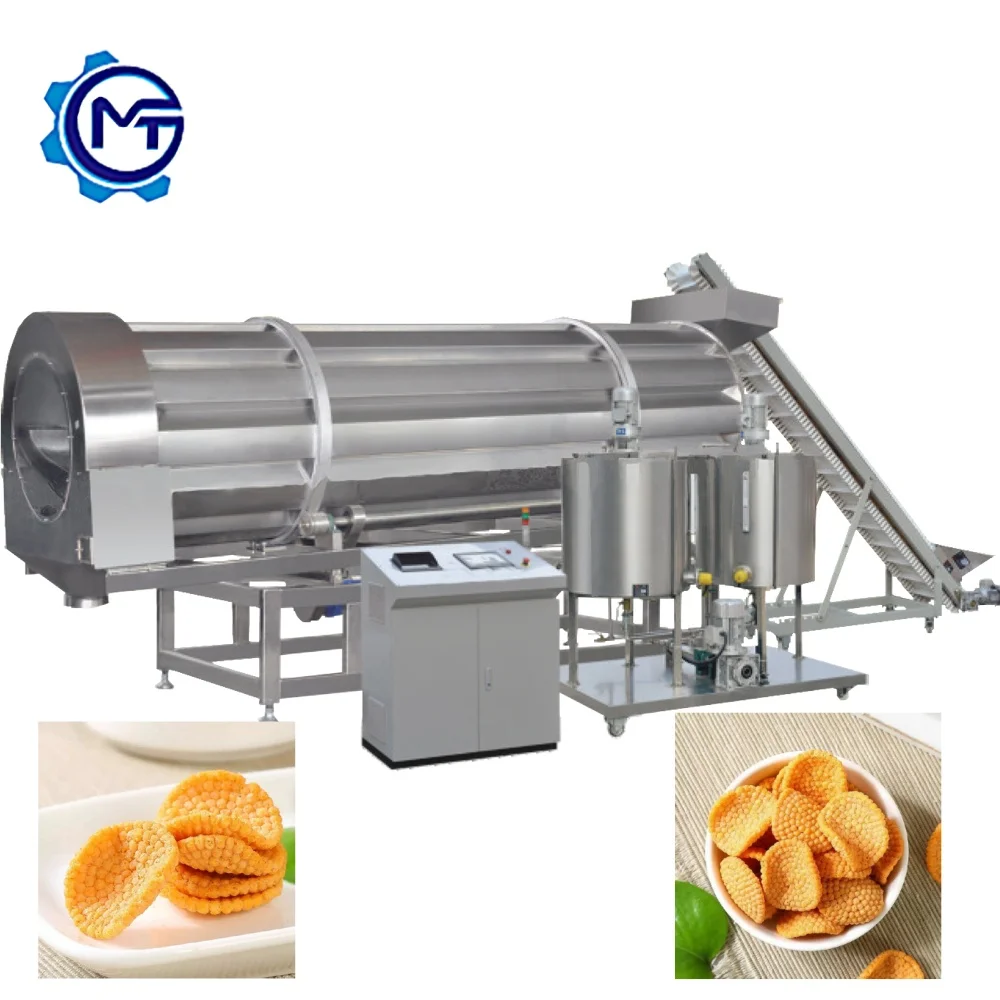
| Rice crust chips production | Rice flour, starch, and grain blends |
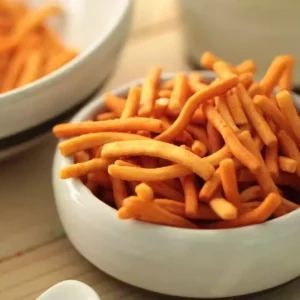
| Bugles and pizza rolls | Corn meal, wheat flour, and cheese or seasoning fillings |
| Puffed-and-fried pellet snacks | 2D/3D pellets from potato starch or tapioca base |
| Snack food factory line expansion | Existing extruded products requiring frying, de-oiling, and seasoning stations |
Why "100–1000 kg/h" Means Nothing Without the Rest of the Line
A fryer rated at a nominal number on clean oil tells you nothing until the extruder, dryer, and seasoning drum are all matched to that same throughput.
I have seen buyers fixate on a fryer spec sheet without asking how long the product actually sits in the oil, what the moisture level is when it enters the hot zone, or whether the upstream dryer can keep the belt full. The extruder pushes out product, but if the frying station cannot hold that volume at the correct temperature, you get uneven colour, soggy centres, or oil that breaks down twice as fast. Sourcing fried snack food processing line equipment as isolated machines from different vendors almost guarantees that one station becomes the bottleneck the moment you switch to your own recipe [NEED_CITE: industrial frying line throughput matching].
Double-Layer Mesh Belt and Controlled Submersion
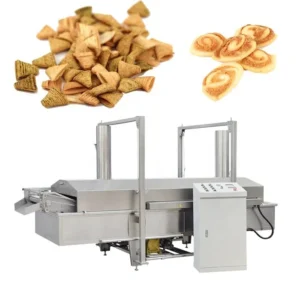
When lightweight snacks like rice crust chips or pellets hit hot oil, they float. Floating means the top surface fries in air while the bottom fries in oil, giving you an uneven crunch and inconsistent colour batch to batch. The double-layer mesh belt in this continuous fryer clamps the product between upper and lower belts, holding every piece at the same depth throughout the full fry cycle. That is what keeps bugles and pizza rolls uniform when you are running the full output of the fried snack food processing line equipment catalogue.
Oil Life and the Filtration Loop
Frying snack foods generates fine carbon particles and free fatty acids that darken oil and transfer off-flavours to the product. The continuous oil circulation filtration system on this unit pulls oil through a filter bed while the line runs, removing sediment and slowing the rise of acid value. Combined with the bottom slag discharge system that collects heavier debris before it burns, the result is longer intervals between full oil changes. Buyers running corn-based or cheese-filled products see the difference fastest because those recipes foul oil quicker than plain starch pellets [NEED_CITE: frying oil degradation in snack production].
What the Spec Sheet Numbers Actually Mean on the Floor
The 320-litre oil capacity sets how much thermal mass the fryer carries. A larger bath recovers temperature faster when cold product drops in, reducing the dip that causes oil absorption spikes. The 60 kW heating tube bank must bring that volume to target temperature from a cold start and hold it under continuous load — confirm with your supplier whether that rating covers peak draw or steady state. The 6700 mm overall length defines the fry zone; longer belts allow slower travel at higher oil temperatures for a lighter crunch, or faster travel for heavier browning. Frequency conversion stepless speed regulation on the belt drive lets you dial in exact fry time per product format without changing sprockets or pulleys, which matters when you switch between rice crust chips and pizza rolls on the same line. The 380V / 50Hz electrical supply is standard for many markets but must be verified against your facility before the fried snack food processing line equipment ships.
When Stations Are Not Matched
A line assembled from separate vendors often arrives with an extruder that produces faster than the dryer can handle, or a seasoning drum that cannot keep up with the fryer output. The result is not just a slower line — it is product sitting too long between stations, absorbing moisture back from the air, and seasoning that clumps instead of coating evenly. I have walked into factories where the operator had to manually throttle the extruder down to match the fryer, defeating the purpose of buying automated equipment in the first place [NEED_CITE: snack line bottleneck from mismatched stations].
Why Source the Full Catalogue Here
Every station in this fried snack food processing line equipment range is documented with throughput calculations matched to your target product, not pulled from a generic brochure. Screw and die configuration for the extrusion station is specified to your raw material before the line ships, and the testing workshop runs trial batches on your actual flour blend. Electrical schematics and PLC language are confirmed against your market’s voltage and operator requirements. Food-grade 304 stainless steel is used on all contact surfaces across every station, not just the fryer. Pre-sales layout drawings show utility drops, clearance for the automatic lifting hood, and mesh belt access for cleaning so installation does not stall over an unmeasured column.
Documentation & Verification
- Line layout drawing with throughput calculation across extrusion, frying, and seasoning stations
- Screw and die configuration record matched to your raw material blend
- Electrical schematic with confirmed voltage, frequency, and PLC language
- Factory test record from trial run on your product recipe before dispatch
- Machinery test report and video inspection provided before shipment
- Operation and maintenance manual with wear parts list for mesh belts and heating tubes
Installation, Commissioning & Support
- Floor plan confirmation for 6700 × 2200 mm footprint with clearance for hood lifting
- Dedicated electrical circuit sized for 60 kW heating load plus 2.6 kW drive
- Assembly of upper hood lifting mechanism and mesh belt tensioning on site
- First-run parameter setting for oil temperature, belt speed, and filtration cycle
- Operator training on PLC interface, oil change procedure, and daily slag discharge
- Wear parts stock including spare mesh belt sections and replacement heating tubes
Before You Send the Inquiry
To size the line correctly, share your target product format, raw material recipe with moisture percentage, desired daily output, and available workshop floor area. Specify the voltage and frequency at your facility, the preferred PLC display language, and whether you need gas or electric heating. If you are adding frying to an existing extrusion line, provide the current extruder output rate so the fryer and seasoning stations are matched from the start.
Frequently Asked Questions
Q: How is the output capacity range determined for this fried snack food processing line equipment?
A: The stated range is based on variables including product type, dough moisture entering the fryer, oil temperature, and belt speed. Actual throughput is confirmed during line configuration using your raw material recipe and target product density. A trial run in the testing workshop validates the number before the line ships.
Q: Which heating options are available and how do they affect my facility?
A: Electric and gas heating are both available. Electric requires a dedicated circuit sized for the full heating tube load, while gas requires appropriate ventilation and a certified gas supply line. Your local utility capacity and energy cost structure determine which option suits the installation site.
Q: How are fryer, seasoning drum, and cooling conveyor capacities matched?
A: Each station is sized during the line layout phase based on the confirmed extruder output. Throughput calculations ensure the continuous fryer, de-oiling belt, seasoning drum, and cooling conveyor all handle the same hourly volume without any single machine creating a bottleneck.
Q: What voltage and control language options are confirmed before shipment?
A: Voltage and frequency are confirmed against your facility supply during the specification stage, and the PLC interface language is set to match your operators. Electrical schematics are provided in the documentation package so local electricians can verify before connection.
Q: What spare wear parts are included and when is the first replacement expected?
A: A wear parts list covering mesh belt sections, heating tubes, and oil filter elements is included with every line. The operation manual notes inspection intervals based on running hours, and replacement scheduling depends on your daily production volume and product type.