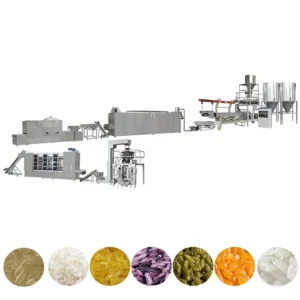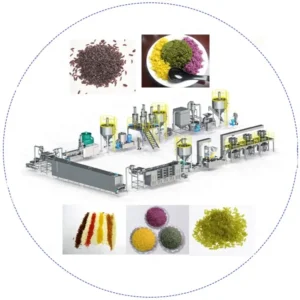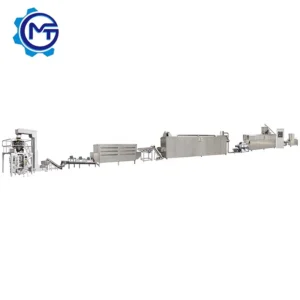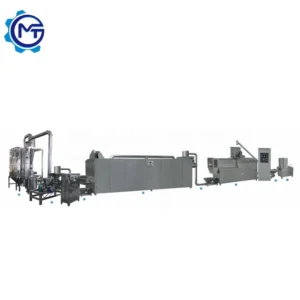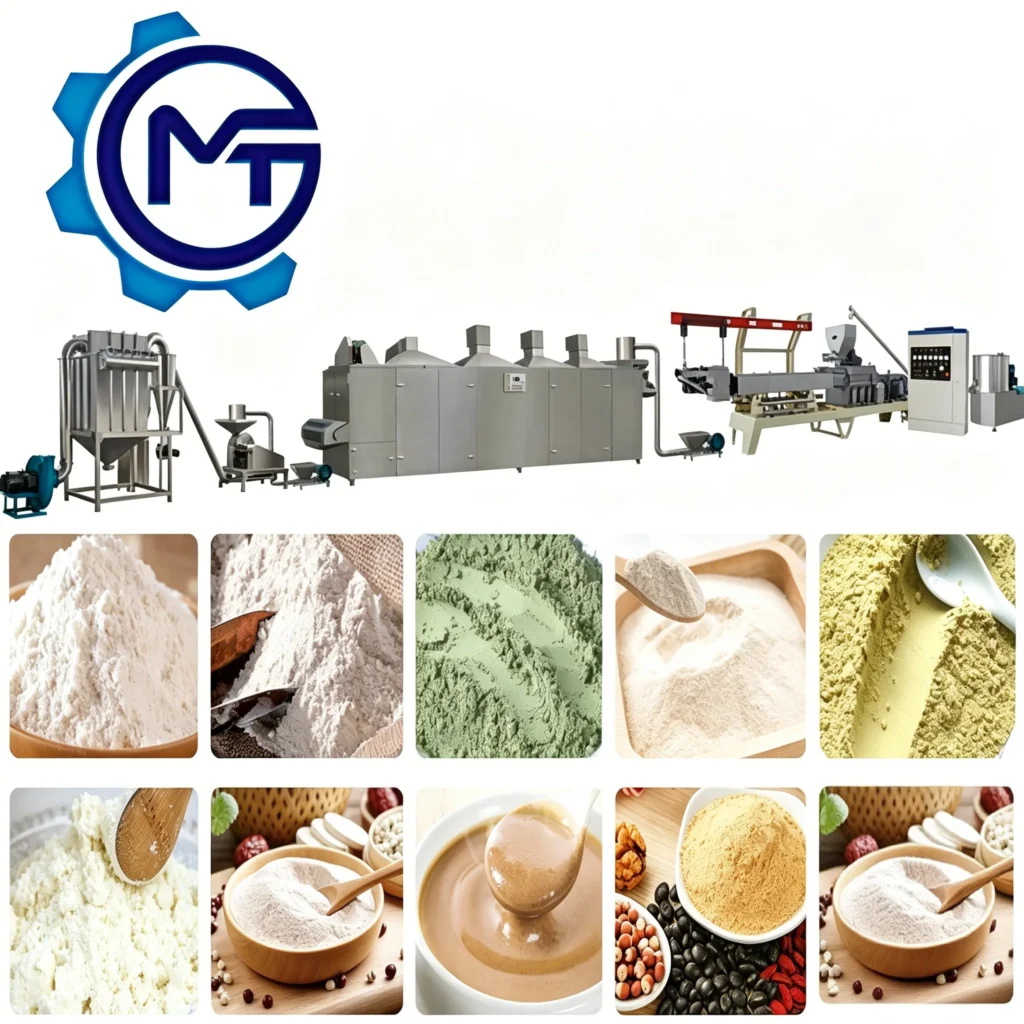
Throughput-Matched Processing — every station from mixing to packing is configured around your actual grain formulation and moisture profile, not assembled from generic catalog machines.
Technical Specifications
| Parameter | Value |
|---|---|
| Product Type | Nutrition Powder Processing Line |
| Processing Capacity | 200–500 kg/h (basis not stated in source — confirm raw material type, moisture content, and formulation) |
| Construction Material | Food-grade 304 stainless steel |
| Control System | Touch control panel with digital system |
| Heat Source Options | Electric, gas, or steam |
| Key Machines Included | Baking ovens, mixers |
| Assembly State | Complete line configuration |
| Warranty | 1 year |
| After-Sales Service | Overseas engineer service available |
Application Suitability
| Application | Material or Output |
|---|---|
| Infant nutrition powder production | Rice, corn, and grain blends for baby food formulations |
| Fortified porridge manufacturing | Beans, cereals, and multi-grain blends requiring uniform gelatinisation |
| Instant breakfast powder processing | Corn and rice substrates with nutritional fortification additives |
| Specialty dietary powder lines | Custom grain and legume combinations for targeted nutritional profiles |
Why "500 kg/h" Means Nothing Without Your Raw Material Data
Capacity claims on a nutritional powder processing line full equipment range are only valid against a defined formulation and moisture baseline.
I once saw a buyer receive a line rated for a specific throughput on paper, only to find the actual output dropped noticeably once their local corn variety — slightly higher in fibre and lower in starch — entered the extruder barrel. The extruder motor was not undersized; the problem was that the screw configuration and barrel temperature profile had been selected for a reference material that did not match the buyer’s supply chain. When the formulation shifts, residence time, shear intensity, and die pressure all shift with it, and every downstream station — dryer, cooler, packing scale — ends up running at a rhythm the line was never balanced for. [NEED_CITE: raw material variability impact on extrusion throughput]
Every Station Sized to the Same Throughput Reality
A nutrition powder line is only as reliable as its slowest station. The mixing batch size must feed the extruder continuously without starvation surges. The dryer belt length and airflow must handle the moisture load exiting the die at peak output. When any single machine in a nutritional powder processing line full equipment range is undersized relative to the others, the entire line throttles down to match, and the operator spends the shift compensating instead of producing.
How Heat Source Selection Affects Line Layout and Utility Planning
The choice between electric, gas, and steam heating on the baking ovens and dryer sections changes the utility infrastructure the factory must prepare before the line arrives. Electric heating demands dedicated high-amperage circuits and may require transformer upgrades. Gas heating needs properly rated piping and combustion ventilation. Steam integration assumes an existing boiler with adequate pressure and flow capacity. Selecting the heat source early prevents last-minute utility conflicts during commissioning — a problem I have watched delay more than one installation when the factory electrical panel was already at capacity. [NEED_CITE: industrial heat source planning for food processing facilities]
Reading the Specification Sheet Beyond the Headline Numbers
Food-grade 304 stainless steel across all product contact surfaces is standard for hygiene compliance and withstands the wash-down cycles that nutrition powder environments demand. The touch control panel with digital system allows operators to store and recall formulations, which matters when a factory runs different grain blends on the same line across shifts. The 200–500 kg/h processing capacity range covers small-to-medium production scales, though the actual achievable output depends on the raw material density, moisture content entering the extruder, and the degree of expansion required by the target product specification. Confirming these variables during the consultation phase ensures the screw configuration and die selection match your formulation rather than a generic default.
The Hidden Cost of Skipping a Factory Trial Run
Lines shipped without a trial run on the buyer’s actual raw material carry a hidden commissioning cost. The first production runs become the trial — except now they happen on the factory floor with installation crews still on site, raw material being consumed, and a market launch deadline approaching. Screw adjustments, barrel temperature tuning, and dryer airflow calibration that could have been resolved in the supplier’s testing workshop instead consume weeks of production time. [NEED_CITE: pre-shipment trial run benefits for extrusion equipment]
What Makes This Line Configuration Different
The complete line from batching to packing is configured under one supplier, so throughput matching across mixing, extrusion, drying, and packing is calculated before the first machine is built rather than negotiated between separate vendors after delivery. Screw configuration and die design are specified to the buyer’s raw material and target product density. An in-house testing workshop allows trial runs on customer-supplied grain blends before shipment, resolving formulation issues at the factory rather than at the installation site. CE and ISO certifications are documented for the line. Pre-sales consultation covers line layout, utility planning, and operator training scheduling so that commissioning follows a known sequence.
Documentation & Verification
- Line layout and capacity calculation confirming throughput match across mixing, extrusion, drying, and packing stations
- Machine specification sheet with voltage, frequency, and control language confirmed to your market requirements
- Trial run report documenting results on your actual grain blend before shipment
- Wear parts list covering screws, dies, and dryer belt consumables with replacement intervals
- Electrical schematic and utility requirement document for factory preparation before equipment arrival
Installation, Commissioning & Support
- Floor plan and utility connection diagram specifying electrical load for the touch control panel and heating system
- Heat source configuration — electric, gas, or steam — confirmed and installed to match factory utility availability
- Complete line delivered in assembly-ready configuration with station-by-station alignment verified at factory
- Commissioning includes extruder barrel temperature profiling and dryer airflow calibration on your raw material
- Operator training covers formulation recall on the digital control panel and wash-down procedures for 304 stainless surfaces
- Spare wear parts package including screws, dies, and seals shipped with the line to cover initial production months
What We Need to Size Your Line Correctly
To build an accurate line layout and throughput calculation, share your primary raw materials — rice, corn, beans, or a specific blend — along with the moisture content you typically receive from your supplier. Confirm your factory’s available voltage and frequency, and whether your existing utility infrastructure supports electric, gas, or steam heating. Provide the workshop floor dimensions and ceiling height so that dryer and oven placement accounts for ventilation and maintenance access clearance.
Frequently Asked Questions
Q: How is the 200–500 kg/h capacity verified against my specific grain formulation?
A: We run your raw material — rice, corn, beans, or a custom blend — in our testing workshop using the screw configuration and die selected for your target powder density. The trial run report documents the actual throughput, moisture reduction across the dryer, and product specification achieved, so the capacity figure in your quotation reflects your formulation rather than a generic reference material.
Q: Which supporting stations are included and how is throughput matched between them?
A: The nutritional powder processing line full equipment range covers mixing, extrusion, baking, drying, cooling, and packing. Each station is sized so that batch cycle times, belt speeds, and packing rates align at the confirmed output. The capacity calculation document shows the throughput at every station, eliminating the bottleneck risk that occurs when equipment is sourced from separate vendors.
Q: What voltage, frequency, and control language options can I specify?
A: These parameters are confirmed during the specification phase before production begins. The touch control panel and digital system are configured to your local electrical standard and preferred operator language, so the line is ready for immediate commissioning upon arrival without adapter transformers or translation delays on the interface.
Q: Can I send my raw material for a trial run before the line ships?
A: Yes. The in-house testing workshop accepts customer-supplied grain samples for trial extrusion. We document the screw configuration, barrel temperature profile, die selection, and resulting product density and moisture content. This report travels with the shipment and becomes the baseline reference for on-site commissioning.
Q: What spare wear parts ship with the line and what is the replacement lead time?
A: The wear parts list included with your line identifies screws, dies, seals, and dryer belt consumables along with their expected service intervals. A starter spare parts package ships with the line to cover initial production months, and ongoing supply is arranged through the after-sales service channel with typical multi-week lead times for replenishment orders.