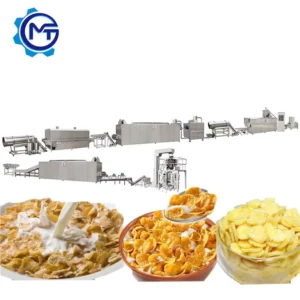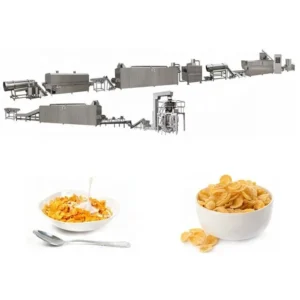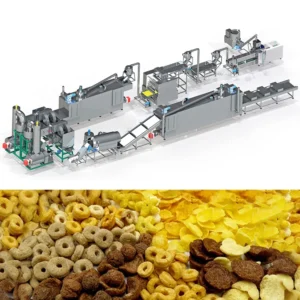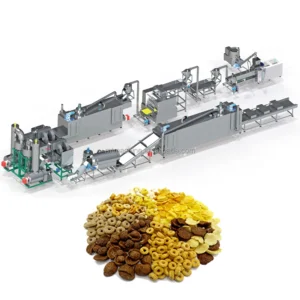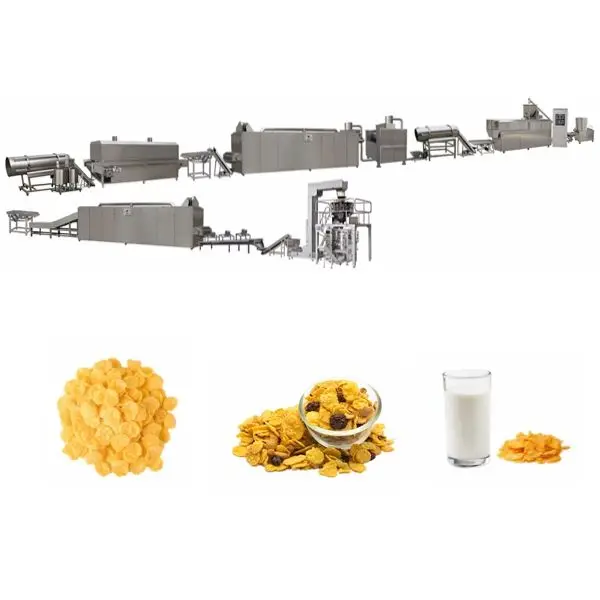
Matched Equipment Stations — Every station from mixing to packing is sized to the extruder model so throughput holds steady across the line instead of bottlenecking at the dryer or flaker.
Technical Specifications
| Parameter | Value |
|---|---|
| Product Type | Corn Flake Production Line / Breakfast Cereal Extruder |
| Extruder Type | Twin Screw |
| Models Available | MT70, MT85, MT75 |
| MT70 Installed Power | 160 kW |
| MT70 Power Consumption | 120 kW |
| MT70 Output Capacity | 150–200 kg/h (basis not stated in source — confirm raw material and moisture content) |
| MT70 Overall Dimensions | 41 × 1.5 × 2.2 m |
| MT85 Installed Power | 190 kW |
| MT85 Power Consumption | 140 kW |
| MT85 Output Capacity | 300–400 kg/h (basis not stated in source — confirm raw material and moisture content) |
| MT85 Overall Dimensions | 43 × 1.5 × 3.2 m |
| MT75 Installed Power | 210 kW |
| MT75 Power Consumption | 150 kW |
| MT75 Output Capacity | 300–500 kg/h (basis not stated in source — confirm raw material and moisture content) |
| MT75 Overall Dimensions | 45 × 1.5 × 3.5 m |
| Flaking Machine Capacity | 200–300 kg/h (basis not stated in source — confirm raw material and moisture) |
| Flaking Machine Control | PLC with hydraulic double rollers and infrared sensor temperature control |
| Dryer Heating Source | Gas or Electric |
| Roasting Oven | Hot air with vibrating pan, cyclone dust removal, two circulating fans |
| Coating System | Double tumble sugar melter, elevator, coating drum, spraying nozzle |
| Control System | PLC and MCC |
| Standards | CE, ISO |
Application Suitability
| Application | Material or Output |
|---|---|
| Natural corn flake production | Corn powder through mixing, extruding, flaking, drying, roasting, cooling, and packing |
| Sugar-coated corn flakes | Corn base with sugar melting, coating drum, and secondary drying |
| Multi-grain breakfast cereals | Rice, wheat, oat, and barley powders on the same extrusion platform |
| Shaped cereal formats | Ball, tube, stick, ring, fruit loop, star, wheel, flower, and heart shapes via die adjustment |
What "300 kg/h" Actually Means When You Run Oat-Blend Corn Flakes
A capacity figure only matters when it is tied to a specific raw material, moisture level, and flake density target.
I once helped a buyer commission a breakfast cereal corn flakes machine full equipment range that was rated for corn grits at a given moisture. When they switched to a blend containing oat and wheat bran, expansion collapsed. Flakes came out uneven in thickness, and the roasting oven turned them into fragments rather than crisp sheets. The extruder was not at fault — the screw configuration and die had simply never been matched to that particular grain mix [NEED_CITE: grain blend behaviour under twin-screw extrusion shear profiles]. Asking for a trial run on your actual raw material before shipment eliminates this class of surprise entirely.
How the Twin-Screw Extruder Handles Grain Variability
The twin-screw design on the MT series gives operators independent control over feeding, extruding, cutting, heating, gearing, and the controlling system. That separation matters when a buyer shifts from pure corn to an oat-barley blend, because starch gelatinisation temperature and shear tolerance differ between grains. The screw configuration and die design are specified to the buyer’s raw material, so the extrusion profile can be adjusted without replacing hardware. Moisture content at the barrel inlet directly influences expansion ratio and flake blister formation downstream.
Flaking and Roasting: Where Consistency Is Won or Lost
The flaking station uses PLC control with hydraulic pressure on double rollers and infrared sensors to regulate roller surface temperature. Uniform flake thickness depends on both roller gap precision and consistent dough temperature entering the nip. Downstream, the hot air roasting oven relies on a vibrating pan with high-temperature spraying tubes, two independent circulating fans, and a cyclone dust removal device to produce the blistered, crisp surface that buyers expect in packaged corn flakes [NEED_CITE: hot air roasting parameters for breakfast cereal texture]. Any mismatch between flaker output rate and roaster dwell time shows up immediately as either under-toasted or scorched product.
Reading the Specification Sheet Against Your Production Reality
Installed power on the MT75 reaches 210 kW while power consumption sits at 150 kW — that gap reflects peak motor draw versus steady-state running load, and it affects how you size electrical panels and cable runs. The flaking machine capacity is listed separately from extruder output, which is intentional: throughput matching between stations is what prevents material pile-up or starvation. Dryer heating source options of gas or electric determine your utility planning and operating cost structure. Voltage adaptation and control language confirmation must happen before production starts, not during commissioning [NEED_CITE: industrial voltage and frequency standards by export market].
The Hidden Cost of Undersized Supporting Stations
An extruder producing at its rated output will stall the entire breakfast cereal corn flakes machine full equipment range if the dryer cannot handle that volume. Wet flakes pile up, stick together, and feed unevenly into the roaster. The coating drum faces the same problem — if sugar application rate cannot keep pace, some batches get over-coated while others pass through bare. These mismatches are invisible on a quotation that lists each machine independently. The consequence is a line that never reaches its nameplate capacity and produces inconsistent flake quality shift after shift [NEED_CITE: production line throughput matching across extrusion and drying stations].
Why Sourcing the Complete Line from One Supplier Matters
Every station in this corn flake line — mixing, extruding, flaking, drying, roasting, coating, cooling, and packing — is sized as a matched set rather than assembled from separate vendors, so throughput stays consistent at each transfer point. Screw configuration and die design are specified to your raw material and target flake density, not copied from a generic build. An in-house testing workshop runs your actual grain blend before shipment, so parameters are established before the line arrives at your facility. Twin-screw expertise covers corn, rice, wheat, oat, and barley bases across breakfast cereal formats. Pre-sales engineering through on-site commissioning and operator training keeps responsibility under one supplier.
Documentation & Verification
- Line layout and capacity calculation showing throughput at every station
- Machine specification sheet with screw and die configuration matched to your grain blend
- Trial run report produced on your raw material before dispatch
- Electrical schematic with voltage and frequency confirmed to your facility standard
- Operation and maintenance manual with wear parts list and replacement intervals
- CE declaration of conformity and ISO certificate included with shipment
Installation, Commissioning & Support
- Foundation plan sized to the MT75 footprint of 45 × 1.5 × 3.5 m with utility routing
- Electrical panel configuration matched to your local voltage and the 150 kW running load
- Extruder, flaker, and roaster delivered in modular sections for assembly inside existing facilities
- First-run parameter setting covering screw speed, barrel temperature, and roller gap on your grain mix
- Operator training on PLC interface and MCC panel for daily production control
- Wear parts list covering screws, dies, and roller surfaces with recommended replacement schedule
Before You Request a Quotation
To size the line correctly, share your grain formulation including any oat, barley, or wheat proportions, along with the moisture content you plan to run. Provide your workshop dimensions and ceiling height so the layout can be drafted around existing columns and doorways. Confirm your local voltage, frequency, and preferred control language so the electrical package is built to match.
Frequently Asked Questions
Q: How is the output capacity of each extruder model verified?
A: Stated capacity figures are based on specific raw materials and moisture levels. We run your actual grain blend in our testing workshop and document the real throughput, flake density, and expansion behaviour. The trial run report becomes part of your documentation, so you know exactly what the line produces before it ships.
Q: What supporting equipment prevents bottlenecks at each extruder size?
A: The dryer, roaster, and coating drum are each selected to match the extruder model’s output. A flaker rated at 200–300 kg/h pairs with the MT70, while higher-capacity extruders require proportionally larger downstream stations. Throughput matching is confirmed in the line layout before quotation.
Q: How do screw configuration and die design affect flake texture?
A: Different grain powders require distinct screw element arrangements and die geometries to achieve proper starch gelatinisation and expansion. Corn behaves differently from oat or barley under shear. We configure screws and dies to your specific formulation and validate the result during the pre-shipment trial run.
Q: What utility requirements should be planned before installation?
A: The full line requires electrical supply matching the combined installed power of all stations, gas or electric supply for the dryer and roaster, and compressed air for pneumatic controls. Voltage, frequency, and phase must be confirmed before production so panels and motors are built to your facility standard.
Q: What spare wear parts come with the line and when should they be replaced?
A: A wear parts list covers screws, dies, flaker roller surfaces, and spraying nozzles. The recommended first replacement interval depends on your raw material abrasiveness and daily running hours. We include this schedule in the maintenance manual and can supply replacements on short lead times.