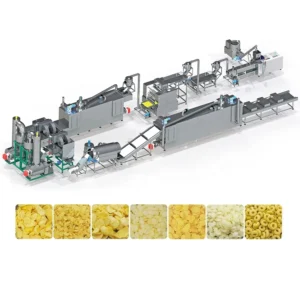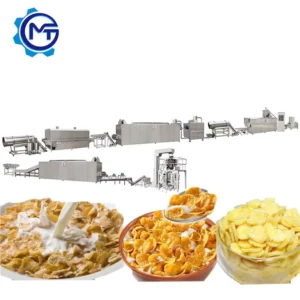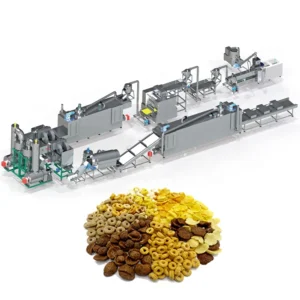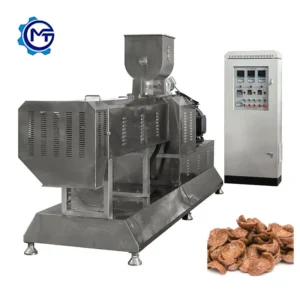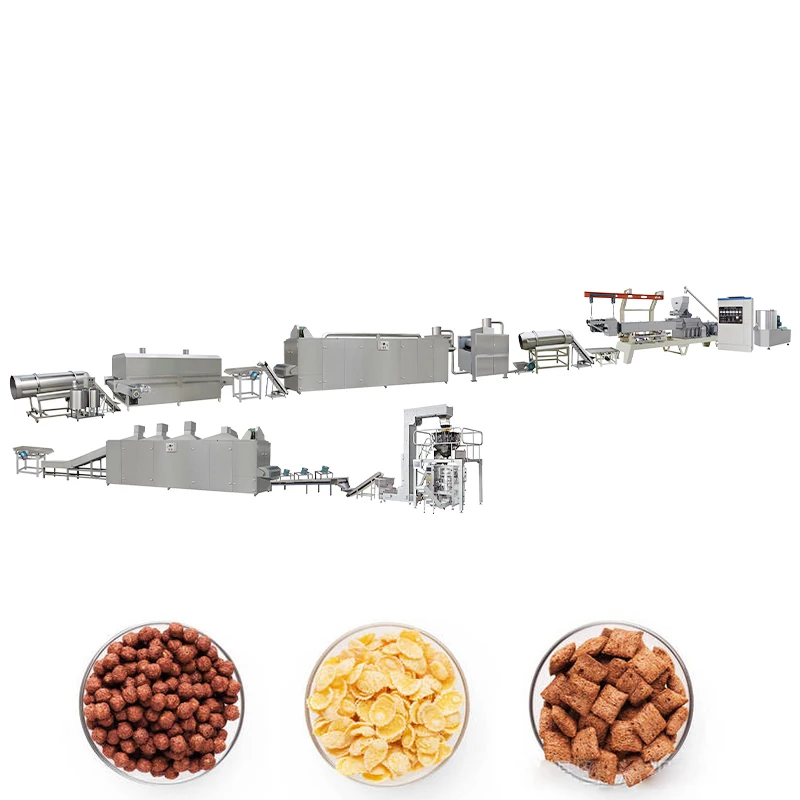
Throughput-Matched Stations — Every mixer, extruder, flaker, dryer and packer in this corn flakes line is sized against the others so no single unit chokes output when running real grain formulations.
Technical Specifications
| Parameter | Value |
|---|---|
| Product Type | Corn Flakes Breakfast Cereal Production Line |
| Models Available | MT-65 / MT-70 / MT-85 / MT-75 |
| Screw Type | Twin screw |
| Line Stations | Mixer → screw conveyor → twin screw extruder → air conveyor → dryer → hoister → flavoring drum and oil sprayer → cooling machine → packing machine |
| Extruder Design Method | 3D software design with analogue simulation |
| Extruder Control Features | Button start, real-time data storage, real-time monitoring, alarm and reminder functions |
| Flaking Machine Roller Material | Cast iron |
| Flaking Machine Shaft Material | 45# steel |
| Flaking Machine Frame Material | Carbon steel |
| Flaking Machine Gap | Adjustable for flake thickness control |
| Flaking Machine Cooling | Water cooling system |
| Hot Air Roaster Max Temperature | 400°C |
| Hot Air Roaster Heating Source | Electric or gas (configurable) |
| Hot Air Roaster Air Delivery | High pressure blower |
| Dryer Heating Method | Electric or gas (configurable) |
| Dryer Layers | Three, five, and seven available |
| Dryer Mesh Belt Speed | Adjustable |
| Dryer Function | Drying and cooling combined |
| Sugar Spraying System Total Power | 28.75 kW |
| Sugar Spraying System Dimension | 4000×1900×1880 mm |
| Sugar Spraying System Roller Size | Ø600 × 2700 mm |
| Packing Machine Type | Combination head weigher vertical automatic packing machine |
| Packing Machine Models Available | 420, 520, 620, 720 |
| Control System | PLC with centralised automation |
| Standards | CE |
MT-65 Processing Line
| Parameter | Value |
|---|---|
| Installed Power | 84 kW |
| Real Power | 59 kW |
| Output Capacity | 120–150 kg/h (basis to be confirmed) |
| Overall Dimensions | 21000×1200×2200 mm |
MT-70 Processing Line
| Parameter | Value |
|---|---|
| Installed Power | 132 kW |
| Real Power | 92 kW |
| Output Capacity | 200–250 kg/h (basis to be confirmed) |
| Overall Dimensions | 23000×1500×2200 mm |
MT-85 Processing Line
| Parameter | Value |
|---|---|
| Installed Power | 239 kW |
| Real Power | 167 kW |
| Output Capacity | 300–400 kg/h (basis to be confirmed) |
| Overall Dimensions | 28000×3500×4300 mm |
MT-75 Processing Line
| Parameter | Value |
|---|---|
| Installed Power | 186 kW |
| Real Power | 140 kW |
| Output Capacity | 400–500 kg/h (basis to be confirmed) |
| Overall Dimensions | 24000×1500×2800 mm |
Application Suitability
| Application | Material or Output |
|---|---|
| Corn flakes breakfast cereal | Corn powder, corn grits |
| Maize flakes and mixed grain flakes | Rice, millets, wheat, oat, barley in flour or grits form |
| Sugar-coated corn flakes | Extruded flakes with sugar syrup or honey glaze |
| Plain and toasted flakes | Untreated flakes for health-oriented cereal blends |
| Vegan breakfast cereal production | Plant-based grain formulations without animal-derived coatings |
Why "Rated Capacity" Means Nothing Without the Rest of the Line
A corn flakes machine full equipment range only delivers its stated output when the dryer, flaker and coater are each sized to keep pace with the extruder.
I have watched buyers receive a twin-screw extruder rated for a certain throughput, only to discover the dryer downstream cannot handle the moisture load, or the flaking rolls cannot press fast enough. The extruder runs fine in isolation, but the line stalls at half speed. With breakfast cereal production line equipment, every station has to be calculated against the actual raw material moisture, starch content and target flake density — not just a catalogue number. [NEED_CITE: throughput balancing methodology for extruded cereal lines]
How Screw Profile and Die Geometry Shape the Flake
The twin-screw extruder at the heart of this line uses 3D-modelled screw elements configured to the buyer’s specific grain blend. Starch gelatinisation inside the barrel determines whether the extrudate will hold its structure through the flaking rolls or collapse into powder. The die opening controls the rope diameter that feeds the flaker, and even a small mismatch between die size and roller gap produces uneven flakes that shatter during roasting. A corn flakes machine full equipment range built around a correctly profiled screw set avoids these texture failures before they reach the production floor.
The Flaking and Roasting Sequence That Decides Crunch
After extrusion, the cooked ropes pass through the cast-iron flaking machine where adjustable roller gap and water cooling together control flake thickness and surface finish. The water cooling system prevents the rolls from overheating and sticking to the starch-heavy material. From there, flakes enter the hot air roaster where a high-pressure blower pushes air up to 400°C across the product bed. This rapid heat shock creates the characteristic micro-bubbles on the flake surface that give breakfast cereals their crunch. Without sufficient blower pressure, the flakes toast unevenly and develop hard spots instead of a consistent crisp bite. [NEED_CITE: hot air roasting dynamics in flaked cereal processing]
Reading the Specs That Actually Matter for Cereal Output
The distinction between installed power and real power across the MT-65, MT-70, MT-85 and MT-75 lines tells you how much energy the motors draw under continuous load versus peak startup draw — a critical figure for sizing your workshop transformer and circuit breakers. The dryer is available in three, five, or seven layers; more layers give longer residence time at lower belt speed, which matters when drying high-moisture sugar-coated flakes that scorch easily. The sugar spraying system runs at 28.75 kW with a Ø600 × 2700 mm roller, meaning the drum volume and syrup contact time are matched to the throughput of the larger extruder models. PLC control with real-time data storage lets operators log temperature and screw speed for every batch, so when a shift produces flakes that are slightly too thick or too pale, the exact parameter set can be traced and corrected.
What Happens When the Dryer and Coater Are Undersized
When the dryer cannot remove moisture fast enough, flakes reach the packing station with residual water that causes sogginess within weeks on the shelf. An undersized sugar spraying drum leaves patches of uncoated surface that consumers notice immediately. These are not extruder problems — they are line-balancing failures that show up only after installation, when reconfiguring the layout means unplumbing conveyors and rewiring control cabinets. The cost of correcting a mismatched breakfast cereal production line equipment setup after commissioning far exceeds the time spent verifying capacity calculations before the order is placed. [NEED_CITE: post-installation line rebalancing costs in food processing]
Why Buyers Source the Full Range From One Supplier
Every station in this corn flakes machine full equipment range is specified together, so the air conveyor capacity matches the extruder output, the hoister feeds the flavouring drum at the correct rate, and the combination weigher packer keeps up with the cooling conveyor discharge. Screw configuration and die design are set against the buyer’s own raw material sample, not copied from a generic template. The in-house testing workshop runs the actual grain formulation before shipment, producing a trial run report that confirms flake thickness, expansion behaviour and roasting response. Electrical schematics confirm voltage and control language before fabrication begins, preventing the commissioning delays that arise when a 50 Hz machine arrives at a 60 Hz facility. CE certification covers the complete line assembly rather than individual machines bolted together from different vendors.
Documentation & Verification
- Line layout drawing with station-by-station throughput calculation for your grain formulation
- Screw and die configuration record matched to your raw material sample
- Electrical schematic with voltage, frequency and PLC language confirmation
- Trial run report from in-house testing workshop on your supplied corn or grain blend
- CE declaration of conformity covering the full line assembly
- Operation and maintenance manual with wear parts list for screws, dies and mesh belts
Installation, Commissioning & Support
- Floor plan marking for the MT-85 line at 28 m length requires level concrete with drainage near the flaker water cooling circuit
- Dedicated power circuit sized to the MT-75 real power draw of 140 kW with isolator at the main control panel
- Extruder barrel and screw elements shipped separately and assembled on site to avoid transport damage
- First-run parameter logging via the PLC real-time data storage to establish baseline recipes for each grain type
- Operator training covers flaking gap adjustment, roaster temperature ramp and dryer belt speed coordination
- Wear parts list provided at handover includes spare screw sections, die inserts and cast iron flaker roller sleeves
What We Need to Configure Your Line
To specify the right breakfast cereal production line equipment configuration, share the grain types you plan to run, whether in flour or grits form, along with your target hourly output and the finished flake thickness you need. Tell us the voltage and frequency at your facility, the PLC language your operators prefer, and whether your workshop uses electric or gas heating so we can match the dryer and roaster accordingly. If you can send a sample of your actual raw material, we will run it in our testing workshop and include the results with the line proposal.
Frequently Asked Questions
Q: What machines are included in the corn flakes line and what does each station do?
A: The line starts with a mixer and screw conveyor feeding the twin-screw extruder. Extruded ropes pass through an air conveyor into the dryer, then a hoister lifts them to the flavouring drum and oil sprayer. A cooling machine brings flakes to packing temperature before the vertical combination weigher packer bags the finished product. Each station is matched to the extruder model you select.
Q: How do I choose between the MT-65, MT-70, MT-85 and MT-75 lines?
A: Selection depends on your target output and the raw material you plan to process. The MT-65 suits smaller operations, while the MT-85 and MT-75 handle higher volumes. We confirm the right model after reviewing your grain type, moisture content and desired flake specification, then validate it with a trial run in our testing workshop.
Q: Can I buy the flaking machine or hot air roaster separately to upgrade an existing line?
A: Yes. Individual stations such as the cast iron flaking machine with adjustable gap and water cooling, or the hot air roaster reaching 400°C with a high-pressure blower, are available as standalone units. We will need your current line throughput data and raw material details to size the machine correctly for your existing setup.
Q: What utility connections does the line require?
A: The dryer and roaster are configurable for electric or gas heating based on your facility. The flaking machine requires a water supply for its cooling system. Power circuits must match the real power draw of your selected line model, confirmed on the electrical schematic before production. We verify voltage, frequency and phase during the specification stage.
Q: Do you test the line before it ships?
A: We run your actual raw material through the complete line in our testing workshop and produce a trial run report documenting extrusion behaviour, flake thickness after the flaking machine, and roasting results. This lets us adjust screw configuration and die design before shipment rather than after installation at your facility.