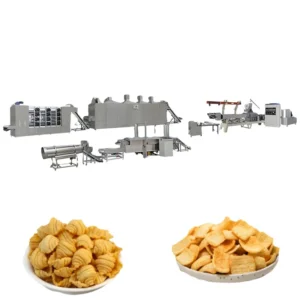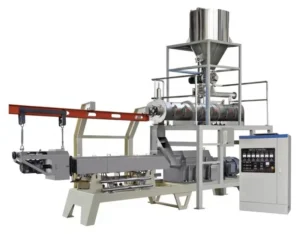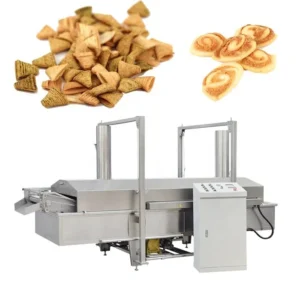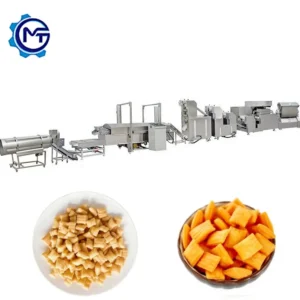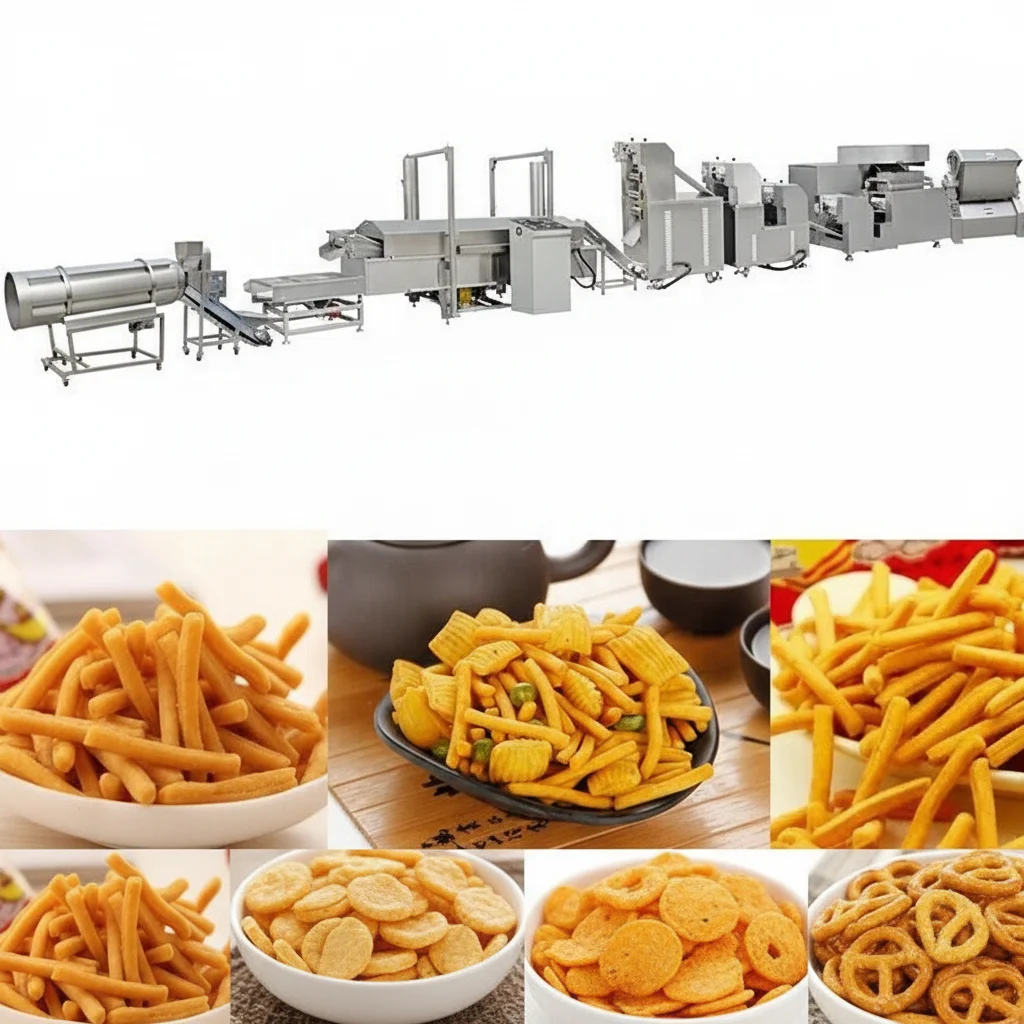
Matched Throughput Across Stations — Every mixer, extruder, fryer and flavoring drum is sized to the line’s real output so no single unit bottlenecks the frying chips making machine full equipment range.
Technical Specifications
| Parameter | Value |
|---|---|
| Product Type | Twin-Screw Puffing Deep Frying Production Line |
| Model | MT100/MT120 |
| Screw Type | Single screw (source states single screw extruder; title mentions twin-screw — verify against manufacturer catalog) |
| Output Capacity | 120 kg/h (basis not stated in source — confirm raw material / moisture / product shape) |
| Rated Power | 50–70 kW (electricity); 50–60 kW (gas or diesel) |
| Voltage & Frequency | Three phases 380V/50Hz, Single phase 220V/50Hz (customizable to local voltage) |
| Control System | PLC controlled |
| Overall Dimensions (L×W×H) | 12,000–26,000 × 1,200 × 2,200 mm |
| Material | Food grade stainless steel 201/304 |
| Energy Options | Electricity / Gas / Diesel / Steam |
| Motor & Electrical | Siemens (China-made) or China top brand motor; Delixi or Delta inverter |
| Line Stations | Mixer → Screw conveyor → Single screw extruder → Pulling and cutting machine → Automatic fryer → Automatic flavoring line → Cooling |
| Die Configuration | Adjustable dies for multiple shapes (screw shell, round tube, square tube, ring, cartoon shapes) |
| Raw Materials | Wheat flour, corn starch, potato starch |
| Assembly State | Complete production line (multiple stations) |
| Standards | CE, ISO 9001 |
Application Suitability
| Application | Material or Output |
|---|---|
| Bugles and horn-shaped fried snacks | Wheat flour and corn starch blends |
| Rice crust and golgappa / pani puri | Rice flour, potato starch, wheat flour |
| Secondary puffing snack formats | Corn starch and mixed grain dough |
| Cartoon and novelty shaped chips | Wheat flour with adjustable die plates |
What a "120 kg/h" Label Hides from the Buyer
Capacity only matters when the raw material, moisture content, and die shape are all locked in before you sign the purchase order.
I have stood in workshops in West Africa where a snack frying production line for sale was rated at a certain throughput on the brochure, yet the buyer’s locally sourced wheat flour carried moisture well above the test standard. The extruder could not gelatinise the starch fast enough, and the actual output dropped dramatically. This is why the frying chips making machine full equipment range must always be quoted against the buyer’s own raw material, not a laboratory-grade reference sample. [NEED_CITE: starch gelatinisation behaviour at varying moisture levels in extrusion]
Every Station Catalogued, Not Assembled from Separate Vendors
A common mistake when sourcing a snack frying line is treating the extruder as the headline purchase and sourcing the fryer, flavoring drum and cooler from different suppliers. When the automatic fryer cannot keep pace with the extruder’s peak output, product backs up on the conveyor, cools unevenly, and enters the oil at inconsistent temperatures. The MT100/MT120 line lists every station — mixer, screw conveyor, single screw extruder, pulling and cutting machine, automatic fryer, automatic flavoring line and cooling — so throughput matching is visible on the layout drawing before production begins.
Die Flexibility Without Re-Engineering the Line
Snack brands in South Asia frequently rotate seasonal shapes — rings for one festival, cartoon figures for another — and they need a frying chips making machine full equipment range that handles die changes without a full line shutdown. The adjustable die set on this extruder station covers screw shell, round tube, square tube, ring and cartoon shapes. The operator swaps the die plate and adjusts the cutting speed; no new screw profile or barrel section is required for shape changes within the same dough family. [NEED_CITE: die design and snack shape changeover practices in extrusion]
Reading the Specs That Actually Govern Product Quality
The single screw extruder is the station where starch gelatinisation and dough expansion are decided. A single screw design suits wheat flour and corn starch blends that do not require the intensive mixing shear of a twin-screw, keeping power draw within 50–70 kW on electricity. The PLC control panel with Delixi or Delta inverter allows operators to store barrel temperature profiles for each die shape, so a batch of bugles and a batch of rice crust do not require the crew to relearn settings from scratch. Stainless steel 201/304 contact surfaces resist the acidic seasoning powders used in golgappa and pani puri production, and the food-grade finish simplifies wash-down between flavor changes. Dimensions ranging from 12 to 26 metres in length mean the buyer must confirm workshop floor length and utility drop points before the line ships.
The Hidden Cost of a Mismatched Fryer Station
I once visited a plant where the extruder produced consistent shapes, but the fryer was undersized for the line speed. Half-cut snacks sat on the belt losing moisture unevenly, and by the time they reached the oil, some pieces absorbed more oil than others. The result was a batch with uneven crunch and colour. When the fryer capacity is not matched to the extruder output on a snack frying production line for sale, the defect shows up in the bag, not on the factory floor. Buyers who skip the throughput calculation between these two stations inherit a quality problem that no amount of operator adjustment can fix. [NEED_CITE: oil absorption variance caused by inconsistent feed rate in continuous fryers]
Why Source the Full Range From One Equipment Catalogue
The line is supplied as a single package where the mixer batch size, screw conveyor rate, extruder output, fryer belt speed and flavoring drum cycle are all calculated together. Screw and die configuration is documented against the buyer’s raw material, not copied from a generic build. An in-house testing workshop runs the buyer’s actual flour and starch blend before the line ships, producing a trial run report. Electrical schematics and voltage confirmation are prepared per destination market, reducing on-site commissioning delays. Ongoing maintenance support covers wear parts such as replacement dies and screw elements matched to the original configuration.
Documentation & Verification
- Line layout drawing showing station throughput and utility drop points
- Screw and die configuration record matched to your raw material blend
- Electrical schematic with voltage and frequency confirmed for your market
- Trial run report produced on your actual flour or starch sample
- Wear parts list with first replacement cycle items identified
- CE declaration of conformity and ISO 9001 certificate copies
Installation, Commissioning & Support
- Floor plan review for 12–26 m line length and 2,200 mm headroom clearance
- Dedicated circuit planning for 50–70 kW electrical or gas/diesel supply routing
- Station-by-station assembly and alignment on your prepared foundation
- PLC parameter setup with barrel temperature profiles stored per die shape
- Operator training on die changeover, cutting speed adjustment and wash-down
- Spare die plates and screw conveyor wear parts staged for first replacement
What to Include in Your First Inquiry
To configure the right station sizing, please share the raw material types and moisture content you plan to run, the target snack shapes from the die catalogue, and your local three-phase voltage and frequency. If your workshop has length or height restrictions, include the available floor dimensions so the layout can be adapted before quotation. Mention whether your existing upstream mixing or downstream packing equipment needs to interface with the new line.
Frequently Asked Questions
Q: What is the complete station list in this frying chips making line, and how is throughput matched?
A: The line includes a mixer, screw conveyor, single screw extruder, pulling and cutting machine, automatic fryer, automatic flavoring line and cooling section. Throughput is calculated across all stations during the layout phase so that no single unit limits the others, and the capacity document shows each station’s rated rate.
Q: Which energy source options are available for the fryer and how do I choose?
A: The fryer station supports electricity, gas, diesel and steam heating. The choice depends on your local utility cost and availability. Gas or diesel is common where electricity tariffs are high, while steam suits facilities that already operate a boiler for other processes.
Q: How do I confirm voltage, frequency and control language before ordering?
A: During the specification review stage, you provide your site voltage and frequency along with the preferred PLC interface language. The electrical schematic is then prepared and confirmed before production begins, preventing commissioning delays caused by mismatched electrical standards.
Q: What snack shapes and raw materials are compatible with this extruder and die set?
A: The adjustable die configuration produces screw shell, round tube, square tube, ring and cartoon shapes. Compatible raw materials include wheat flour, corn starch and potato starch blends. Each shape may require specific moisture and barrel temperature settings, which are documented during the trial run.
Q: How does the equipment catalogue on this page relate to the turnkey line project service?
A: This page covers the full equipment range so buyers can survey every station before committing. The turnkey project service builds on this catalogue by adding phased installation scheduling, utility planning, commissioning management and operator training as a single project package. [NEED_CITE: scope differences between equipment supply and turnkey project delivery in food processing lines]