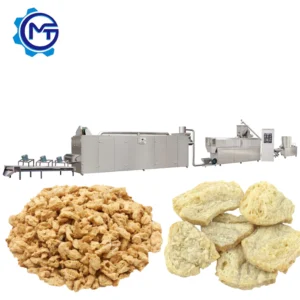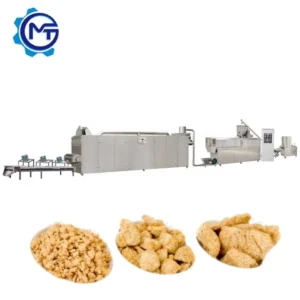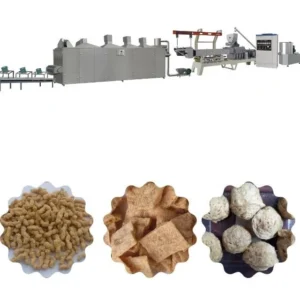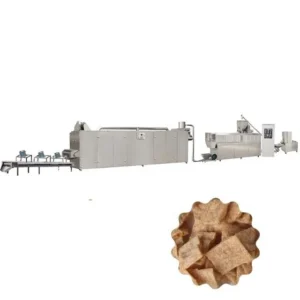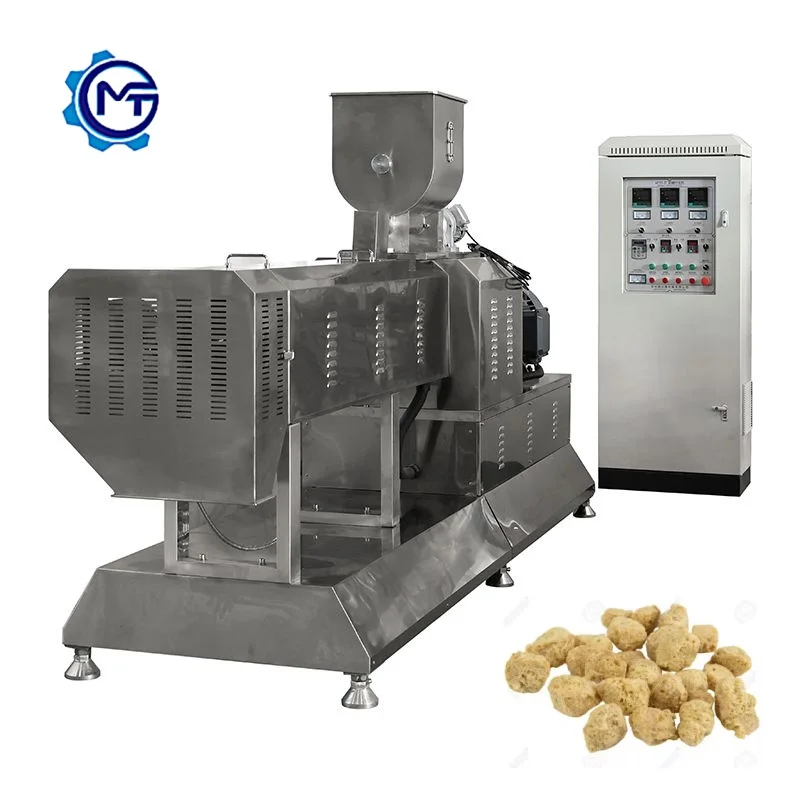
Every Station Matched for Output — From the vertical mixer feeding defatted soya flour through the twin screw extruder to the multi-layer dryer, throughput is calculated across the entire plant based meat processing line equipment so no single machine bottlenecks your daily run.
Technical Specifications
| Parameter | Value |
|---|---|
| Product Type | Twin Screw Extruder Production Line for Texturized Soy Protein |
| Extruder Models | MT65 / MT70 / MT75 / MT85 |
| Screw Type | Twin Screw |
| Installed Power | 84 kW (MT65) / 160 kW (MT70) / 190 kW (MT75) / 210 kW (MT85) |
| Power Consumption | 59 kW (MT65) / 120 kW (MT70) / 140 kW (MT75) / 140 kW (MT85) |
| Output Capacity | 100–150 kg/h (MT65) / 150–200 kg/h (MT70 & MT75) / 250–300 kg/h (MT85) (basis not stated in source) |
| Overall Dimensions (L×W×H) | 40,000×1,200×2,200 mm to 45,000×1,500×3,500 mm depending on model |
| Main Motor Power | 22 kW / 30 kW / 45 kW (model mapping to be confirmed) |
| Mixer Type | Vertical mixer with stainless steel 304 mixing ruler, carbon steel shelf |
| Mixer Capacity Options | 20–30 kg / 70–80 kg / 170–180 kg |
| Dryer Type | Multi-layer oven, double pitch roller chain drive, round-trip drying |
| Dryer Heating Options | Fuel / gas / electricity (buyer selectable) |
| Line Stations | Mixer → Screw Conveyor → Twin Screw Extruder → Air Conveyor → Multi-layer Dryer → Cooling Machine |
| Control System | PLC / MCC availability to be confirmed before ordering |
| Standards | CE (since 2014), ISO certified |
Application Suitability
| Application | Material or Output |
|---|---|
| Texturized vegetable protein (TVP/TSP) ingredient production | Defatted soya flour, low-temperature soya flakes |
| Soy nuggets and soya chunks for meat analogue formulation | Soybean dregs, peanut dregs blended with soya protein concentrate |
| Plant-based meat substitute for fast food and frozen food supply | High-protein soy formulations requiring specific fibre alignment |
| Fortified maigre snack base material | Mixed grain and soy blends requiring adjustable die profiles |
What "Nominal Capacity" Hides in Soy Protein Extrusion
A capacity figure only matters when tied to your exact raw material formulation, moisture content, and target product density.
When I was running trials in Southeast Asia, a buyer showed up with spec sheets promising a steady tonnage, only to find the line choked within the first hour because the supplier had quoted on high-protein isolate while the factory was actually feeding low-protein defatted meal. The screw combination had to be entirely rebuilt over four days of lost production. That plant based meat processing line equipment never reached its brochure number on that material [NEED_CITE: raw material variability in extrusion throughput]. Before any capacity commitment is made, the specific protein content, particle size, and moisture of your soya flour or flakes must drive the screw configuration and die selection, not the other way around.
Matching Every Station to Your Formulation
A complete plant based meat processing line equipment setup involves more than just the extruder. The vertical mixer must turn over your specific batch size within the cycle time the extruder demands, and the multi-layer dryer must remove moisture at a rate that matches the output without creating a backlog on the cooling conveyor. When each station is selected independently, one machine invariably runs faster than the next can handle, forcing operators to throttle the entire line down to the slowest link.
Why Screw Geometry Decides Fibre Structure
The twin screw configuration creates the shear and residence time needed to align soy protein molecules into the fibrous texture buyers expect in meat analogues. Changing the screw element sequence, barrel temperature profile, and die geometry allows the same extruder platform to shift between fine TVP strands and dense soya chunks. This flexibility means a processor can respond to different customer specifications without investing in separate extrusion lines [NEED_CITE: twin screw extrusion principles for texturized protein].
Reading the Spec Sheet for Real-World Impact
The installed power across the MT65 to MT85 range reflects the mechanical energy available to drive material through the barrel and generate the internal friction required for protein texturization. Main motor options at 22 kW, 30 kW, or 45 kW determine how much torque is available when processing higher-viscosity doughs from low-temperature soya flakes. The multi-layer dryer offers fuel, gas, or electric heating, which directly affects operating cost and temperature control precision in regions where one energy source is significantly cheaper or more stable than another. Adjustable temperature and drying time settings let operators dial in the exact final moisture content required for shelf stability or downstream rehydration performance.
The Cost of a Mismatched Dryer
An extruder running at full output means nothing if the dryer cannot remove moisture fast enough. I have seen lines where the extruder produced dense soya chunks that required longer residence time in the oven, but the dryer was sized for lighter TVP strands. The result was product stacking up on the cooling belt, uneven moisture content in the final bag, and operators manually reducing extruder feed rate to keep the dryer from flooding [NEED_CITE: throughput bottleneck in food processing lines]. The multi-layer oven on this line must be specified against your heaviest product format, not your lightest.
Why Source the Full Line from One Builder
Every station from the vertical mixer through the screw conveyor, twin screw extruder, air conveyor, multi-layer dryer, and cooling machine is configured as one system, so throughput calculations account for the actual transfer rate between each piece of plant based meat processing line equipment. Screw configuration and die design are specified to your raw material and target product, not copied from a generic template. The in-house testing workshop runs your actual soya flour or flakes before the line ships, producing a trial run report that confirms texture, density, and output on your material. Pre-sales engineering covers line layout and utility planning, and the same team handles on-site installation, commissioning, and operator training. Documentation includes electrical schematics with voltage and frequency confirmed for your market, along with a wear parts list so replacement screws and dies are available when first needed.
Documentation & Verification
- Line layout drawing showing station placement and utility connection points for your workshop dimensions
- Screw and die configuration record matched to your soya flour protein content and target chunk size
- Electrical schematic confirming voltage, frequency, and control language for your local market
- Trial run report produced on your actual raw material in the testing workshop before shipment
- CE declaration of conformity and ISO certificate for customs clearance and regulatory compliance
Installation, Commissioning & Support
- Foundation and floor space planning based on the selected model footprint up to 45,000×1,500×3,500 mm
- Dedicated power circuit sized for installed load up to 210 kW with voltage and frequency confirmed pre-build
- Complete line arrives in matched modules for sequential assembly from mixer through cooling machine
- First-run parameter setting including barrel temperature profile, screw speed, and dryer residence time
- Operator training covering screw element changes, die swaps, and daily cleaning of stainless steel 304 contact surfaces
- Wear parts list covering screws, dies, and mixer blades with reorder lead times documented
Before You Send an Inquiry
To get a configuration that actually runs your material, share the type and protein content of your soya flour or flakes, your target daily output in kilograms, and the specific product formats you need such as TVP strands, nuggets, or chunks. Include your workshop dimensions, local voltage and frequency, and preferred control language so the electrical package matches your site from day one. If you are unsure whether your current formulation will texturize properly, send a sample batch for a trial run in the testing workshop before any purchase commitment is made.
Frequently Asked Questions
Q: How is output capacity verified against my specific soya flour or flake raw material?
A: Capacity figures on the spec sheet are reference points that must be validated against your actual material. A trial run in the testing workshop uses your soya flour or flakes to confirm throughput, texture, and density before the line configuration is finalized. The resulting report documents the screw speed, barrel temperature, and die setup that achieved acceptable output on your specific formulation.
Q: Can the screw and die configuration be customized for different TVP textures and chunk sizes?
A: Yes. The twin screw extruder accepts different screw element sequences and adjustable die plates to shift between fine TVP strands, soy nuggets, and larger soya chunks. The configuration is selected based on your target product specification and confirmed during the pre-shipment trial run on your raw material.
Q: How do I ensure every station is throughput-matched so no single unit bottlenecks the line?
A: The line is configured as one system where the mixer batch cycle, extruder feed rate, dryer residence time, and cooling conveyor speed are all calculated against each other. The layout proposal includes a capacity calculation showing the transfer rate between every station so no machine runs faster than the next can handle.
Q: What voltage, frequency, and control language options are available for my market?
A: Electrical specifications are confirmed during the pre-order consultation based on your local supply. The electrical schematic documents the exact voltage, frequency, and control panel language before production begins, ensuring the plant based meat processing line equipment connects to your power supply without modification on arrival.
Q: What does the pre-shipment trial run on my raw material cover?
A: The trial run processes your actual soya flour or flakes through the configured extruder and dryer to verify product texture, density, moisture content, and achievable output rate. You receive a written report documenting the parameters used and the product samples produced, so you know the line will perform on your material before it leaves the factory.