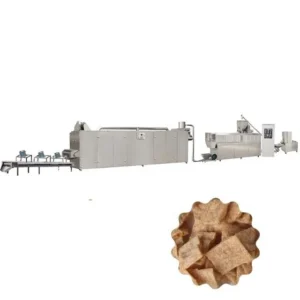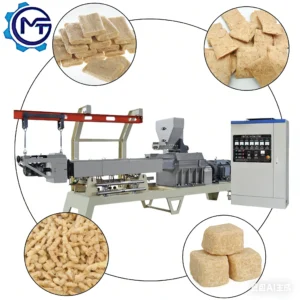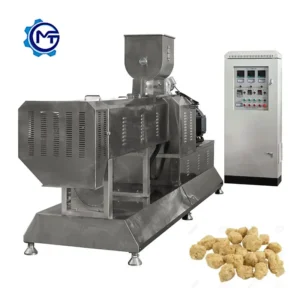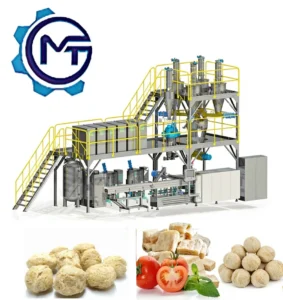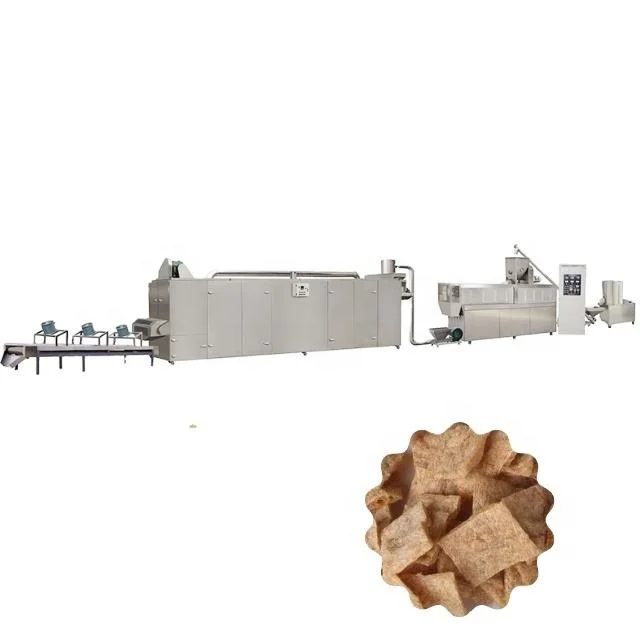
Screw Configuration Matched to Formulation — MT65 twin-screw extrusion platform configured with die profiles and barrel zones specified to the buyer’s soy or peanut meal blend and target fiber structure.
Technical Specifications
| Parameter | Value |
|---|---|
| Model | MT65 |
| Product Type | Textured Vegetable Protein Production Line |
| Screw Type | Twin-screw |
| Installed Power | 85 kW |
| Real Power | 65 kW |
| Output Capacity | 150–200 kg/h (basis not stated in source) |
| Overall Dimensions | 18000 × 1300 × 2300 mm |
| Material of Construction | 304 Stainless Steel |
| Extruder Main Motor Power | 30 kW |
| Extruder Dimensions | 2800 × 830 × 1875 mm |
| Powder Mixer Tank Volume | 150 kg |
| Powder Mixer Output | 300–600 kg/h |
| Powder Mixer Rotary Speed | 385 rpm |
| Roaster Belt Effective Length | 3.5 m |
| Roaster Far Infrared Heater Power | 3.9 kW × 24 |
| Certification | CE |
Application Suitability
| Application | Material or Output |
|---|---|
| Soy-based meat analogues | Low-temperature soybean meal formulations |
| Vegetarian ham and sausage ingredients | Textured protein chunks and strips for further processing |
| Canned and quick-frozen food inclusions | Rehydratable TVP pieces matching meat fiber density |
| Peanut meal protein extenders | Blended plant protein for fast food and ready meal sectors |
What Throughput Claims Leave Out When Stations Are Mismatched
A line is only as fast as its slowest station, and separate-vendor builds almost always hide a bottleneck.
I have walked into workshops where a textured vegetable protein production line equipment manufacturer quoted an extruder at a certain capacity, but the dryer belt was too short to handle that volume. The result was operators manually throttling the extruder feed to prevent product backing up on the conveyor. The entire line ran well below its paid-for output. When sourcing a textured vegetable protein production line, the mixer batch cycle, extruder throughput, roaster residence time, and cooler capacity must be calculated against each other, not assembled from standalone catalog pages [NEED_CITE: line throughput balancing principles for extrusion systems].
Barrel Zone Profiling for Protein Alignment
The twin-screw extruder on the MT65 platform processes soy and peanut meal through multiple heated barrel zones. Temperature profiling across these zones controls how the protein molecules denature and realign under shear. The screw configuration and die design are specified to the buyer’s raw material blend, determining whether the output emerges as dense, rehydratable chunks or lighter, ready-to-season strips. This is the core of the textured vegetable protein production line equipment manufacturer process where fiber structure is formed.
Drying Dynamics and Fiber Integrity
After extrusion, the high-temperature roaster carries the product on a 3.5-meter effective belt length with far infrared heating elements. Moisture removal must be gradual enough to preserve the internal fiber matrix that the extruder created. If the surface dries too quickly while the core remains wet, the protein structure collapses during cooling and the product loses its meat-like chew. The roaster on this line is sized to the extruder output so residence time remains consistent across production runs [NEED_CITE: drying rate effects on extruded protein fiber retention].
How Motor Load and Screw Speed Shape the Output
The extruder main motor at 30 kW and actual running power of 30–35 kW indicate the mechanical energy available for shear inside the barrel. Higher shear forces produce finer, more uniform fiber striations, which matters when the TVP is destined for sliced deli-style analogues rather than coarse ground-meat extenders. The powder mixer at 385 rpm with a 10-minute batch cycle ensures the soy meal, additives, and moisture are evenly distributed before entering the extruder feed hopper, preventing density variation across a production shift.
Line-Wide Stainless Steel Contact Surfaces
All food-contact surfaces use 304 stainless steel, which is standard for food-grade extrusion but worth confirming because some suppliers mix carbon steel in conveyor frames or mixer internals. Consistent material across the mixer, extruder, roaster, and cooler simplifies sanitation validation and prevents corrosion at weld joints where dissimilar metals meet.
The Cost of Unconfirmed Electrical and Control Specifications
Voltage, frequency, and control language are frequently left until the machine is on the water. I have seen commissioning delayed by weeks because the motor contactors were rated for 380V/50Hz while the buyer’s facility runs on 440V/60Hz, requiring a full panel rebuild on-site. For a textured vegetable protein production line, this oversight stalls not just the extruder but every downstream station. Always obtain the electrical schematic and voltage confirmation document before production begins, not after [NEED_CITE: industrial voltage and frequency standards by region].
Why Sourcing Under One Supplier Changes the Outcome
Every station on the MT65 line — mixer, extruder, roaster, cooler, and conveyors — is sized to a common throughput target, eliminating the guesswork of matching capacities across separate vendors. The screw configuration and die design are recorded against the buyer’s specific raw material blend, so replacement parts arrive pre-matched rather than generic. An in-house testing workshop allows trial runs on the buyer’s actual soy or peanut meal before shipment, catching fiber structure issues at the factory rather than after installation. The complete line documentation set includes layout calculations and capacity matching records so nothing is left to assumption. Pre-sales consultation carries through to on-site installation, commissioning, and operator training on the specific product being run.
Documentation & Verification
- Line layout drawing showing throughput calculations matched across mixer, extruder, roaster, and cooler
- Screw and die configuration record specific to your soy or peanut meal formulation
- Trial run report on your raw material conducted in the testing workshop before dispatch
- Electrical schematic with voltage, frequency, and control language confirmed for your facility
- CE declaration of conformity and ISO certificate for the complete line
- Operation and maintenance manual with wear parts list for screws, dies, and heater bands
Installation, Commissioning & Support
- Foundation plan accommodating the 18,000 mm overall line length with utility connection points marked
- Dedicated electrical circuit sized for the 85 kW installed power with voltage verified before panel build
- Extruder barrel and screw assembly alignment checked during on-site commissioning against your formulation
- Roaster far infrared heater zones individually calibrated to your product moisture target during first run
- Operator training covering screw speed, barrel temperature, and mixer batch timing for consistent fiber output
- Wear parts inventory including spare screw elements and die plates matched to your configuration record
What to Include With Your Inquiry
Provide your raw material specification including soy meal grade, particle size, and any additive ratios so the screw and die configuration can be matched before quotation. Confirm your facility voltage, frequency, and preferred control language to avoid panel modifications after delivery. Share your target product format — chunk, strip, or flake — along with daily volume requirements so every station on the line is calculated to the same throughput.
Frequently Asked Questions
Q: How is output capacity verified, and what raw material blend is it based on?
A: Stated capacity figures are tied to specific raw material blends and moisture levels. We confirm output based on your actual soy or peanut meal formulation through a trial run in our testing workshop before shipment, documenting the result in a test report so you know what to expect at commissioning.
Q: How is screw configuration matched to my specific formulation?
A: The screw elements and die profile are selected based on your raw material composition, target fiber density, and end-product format. A configuration record is generated for your line, and this same specification is used for all future replacement parts orders to maintain consistency.
Q: Is the dryer and cooler capacity matched to extruder output?
A: Every station on the line is calculated to a common throughput target. The roaster belt length, heater capacity, and cooler airflow are all sized so no single station restricts the extruder, which is confirmed in the line layout and capacity calculation document.
Q: Can I send raw material for a trial run before shipment?
A: Yes. Our in-house testing workshop runs your actual soy or peanut meal through the configured extruder and dryer, producing sample product that is evaluated for fiber structure and density before the line is approved for dispatch.
Q: What voltage and control options are confirmed before production?
A: Voltage, frequency, and control language are confirmed during the specification stage before production begins. The electrical schematic is reviewed with your team to ensure compatibility with your facility power supply and operator requirements.