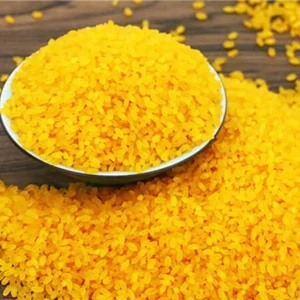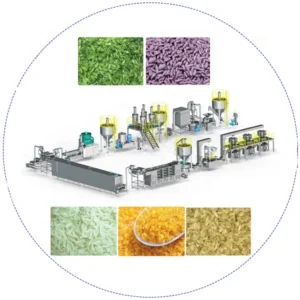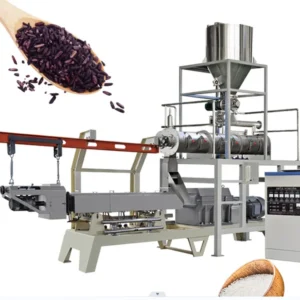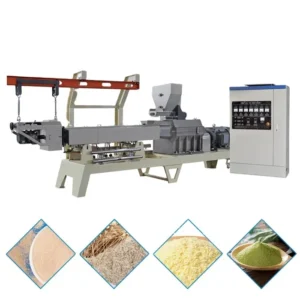
Line-Wide Equipment Matching — Every station from mixing to packing is specified against your rice flour formulation, so no single machine bottlenecks the fortified nutritional rice production line.
Technical Specifications
| Parameter | Value |
|---|---|
| Product Type | Fortified Nutritional Rice Production Line |
| Output Capacity | 70–300 kg/h (basis not stated in source — confirm raw material type, moisture content, and grain formulation) |
| Voltage & Frequency | 380V / 50Hz |
| Control System | Automatic control (PLC / MCC not specified in source) |
| Construction Material | Food-grade stainless steel |
| Screw Type | Twin-screw or single-screw (confirm based on formulation) |
| Raw Material Compatibility | Rice flour and other grain-based raw materials |
| Customization | Minor, drawing-based, and full customization supported |
| Color | Silver (stainless steel body) |
| Line Stations | Mixer, fryer, extrusion system (downstream dryer, cooler, packing to be confirmed) |
| Standards | CE, ISO (product-level certification to be confirmed) |
Application Suitability
| Application | Material or Output |
|---|---|
| Fortified rice production | Rice flour blended with micronutrient premix |
| Artificial rice manufacturing | Grain-based flour blends shaped into rice kernels |
| Infant formula rice processing | Pregelatinised starch and rice flour combinations |
| Nutrition programme supply | Fortified grain kernels with consistent micronutrient distribution |
| Breakfast cereal variants | Extruded and formed grain-based rice formats |
What "70–300 kg/h" Leaves Out About Fortified Nutritional Rice Production Line Full Equipment Range
Capacity only holds when every station — mixer, extruder, dryer, fryer — is matched to your actual grain formulation and moisture profile.
I spent years on assembly floors before moving into line planning, and the most common failure I have seen on grain-based extrusion lines is not the extruder itself. It is the station after it. A buyer specifies a fortified nutritional rice production line full equipment range based on a single machine’s rated throughput, only to find the downstream dryer cannot keep pace with the extruder’s actual output on their specific rice flour blend. The extruder pushes product forward; the dryer falls behind; moisture stays too high in the formed kernels; and the entire line stalls at a fraction of its nameplate capacity [NEED_CITE: throughput matching principles in continuous food extrusion lines].
Station-by-Station Equipment Survey
The fortified nutritional rice production line full equipment range begins at the batching and mixing stage, where rice flour and micronutrient premix are blended to a uniform moisture level before entering the extruder barrel. Each station — mixer, extrusion system, fryer — is individually specifiable, meaning you can review the throughput rating of every machine before committing to a line configuration. This approach prevents the common mismatch where one station operates well below the capacity of the others.
How Extrusion Parameters Shape the Final Kernel
Twin-screw or single-screw selection depends directly on your rice flour formulation, particularly the protein content and starch gelatinisation behaviour of your grain blend. Screw configuration and die design determine the expansion ratio, surface texture, and dimensional consistency of the formed rice kernels. Barrel temperature profiles and moisture conditioning at the feed point influence whether the output holds its shape through the downstream frying and drying stages or collapses under thermal stress [NEED_CITE: starch gelatinisation behaviour in twin-screw extrusion of rice flour].
Reading the Specs That Actually Matter for Grain Extrusion
The voltage and frequency specification — 380V / 50Hz — must match your facility’s electrical supply before the line ships, because reconfiguring motor drives and heater circuits on-site adds weeks to commissioning. The control system designation as automatic control leaves room for either PLC or MCC architecture; the choice affects how operators adjust barrel zone temperatures and screw speed during production changeovers. Food-grade stainless steel construction across contact surfaces addresses both hygiene compliance and the corrosive environment created by high-moisture grain processing. The output range of 70–300 kg/h is broad, and where your line actually lands within that range depends on the raw material moisture content and the degree of fortification in your formulation. Screw type selection between twin-screw and single-screw should be confirmed through trial runs on your specific rice flour blend rather than assumed from general capacity tables.
The Hidden Cost of Skipping the Station Audit
Buyers who select an extruder without verifying that the downstream fryer and any dryer can handle the same volumetric throughput end up with a line that produces well-formed rice kernels at one station and queues them at the next. Moisture content drifts upward when kernels sit too long before frying, altering texture and shelf stability. Wear parts such as screws and dies degrade on a schedule that assumes continuous operation; intermittent running caused by downstream bottlenecks accelerates uneven wear [NEED_CITE: wear patterns in extrusion screws under intermittent load].
Why Source the Full Equipment Range Here
Every station in the fortified nutritional rice production line full equipment range is specified against your raw material and target kernel shape, rather than pulled from a generic catalogue. Screw configuration and die design are documented for your rice flour formulation before the extruder leaves the factory. An in-house testing workshop allows trial runs on your actual grain blend, so output consistency is verified before shipment rather than after installation. The line integrates mixing, extrusion, frying, and supporting stations under one supplier, which means throughput calculations are matched across every connection point. Electrical schematics and voltage confirmation are completed during the order stage, reducing commissioning delays on-site.
Documentation & Verification
- Line layout and capacity calculation matched to your rice flour throughput target
- Screw and die configuration record specific to your grain kernel shape
- Electrical schematic and voltage confirmation for your facility supply
- Trial run report on your actual rice flour blend from the testing workshop
- Factory test record documenting output before dispatch
- Operation and maintenance manual covering every station in the line
Installation, Commissioning & Support
- Foundation and floor space planning based on the full line station layout
- Dedicated electrical circuit sizing for 380V / 50Hz extruder and fryer loads
- Pre-assembled station modules arriving for final connection and alignment
- First-run parameter setting for barrel temperature and screw speed on your grain blend
- Operator training covering control system interface and production changeover procedures
- Wear parts list for screws, dies, and fryer components with replacement intervals
Before You Request a Quote
To size the fortified nutritional rice production line full equipment range accurately, share your rice flour formulation including protein content and any micronutrient premix ratios, your target daily output in kilograms, and your facility’s voltage and frequency supply. If you have existing upstream milling or downstream packing equipment, note the connection points so the line layout accounts for them. Sending a sample of your raw material for a trial run in the testing workshop allows capacity and kernel quality to be confirmed before you review the final quotation.
Frequently Asked Questions
Q: What supporting stations are included beyond the mixer, extruder, and fryer?
A: The line configuration depends on your target kernel specification. Downstream stations such as dryers, coolers, and packing systems are integrated based on throughput matching with the extruder output. Each station is individually specifiable, so you can confirm the equipment list before the order is placed.
Q: How do I verify that output capacity holds on my specific rice flour blend?
A: Request a trial run using your actual raw material in the in-house testing workshop. The trial run report documents throughput, kernel shape consistency, and moisture levels at each station, giving you verified data rather than a nominal capacity figure.
Q: Can individual machines be ordered separately?
A: Yes. Each station in the full equipment range can be specified and ordered on its own, which is useful when replacing a single machine in an existing line or expanding capacity at one stage of production.
Q: What voltage and frequency options are available?
A: The baseline specification is 380V / 50Hz, but voltage and frequency must be confirmed against your facility supply before production. Motor drives, heater circuits, and control panel components are configured to match your local electrical standard.
Q: What customization range is available for the line?
A: Customization spans minor specification adjustments, drawing-based modifications to station dimensions, and full line redesigns to fit your factory floor layout and production target. Screw and die configurations are always matched to your specific rice flour formulation.