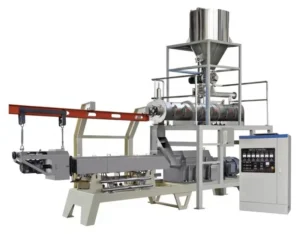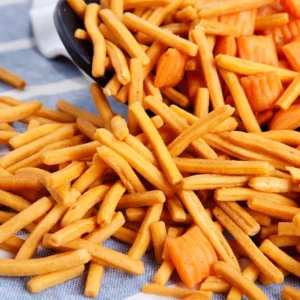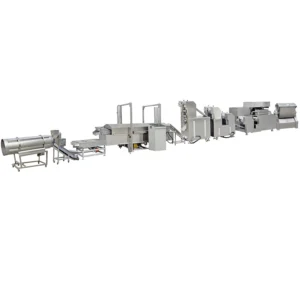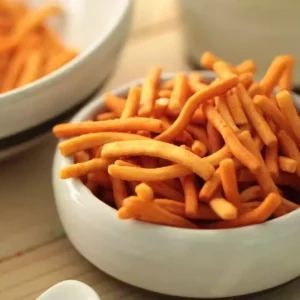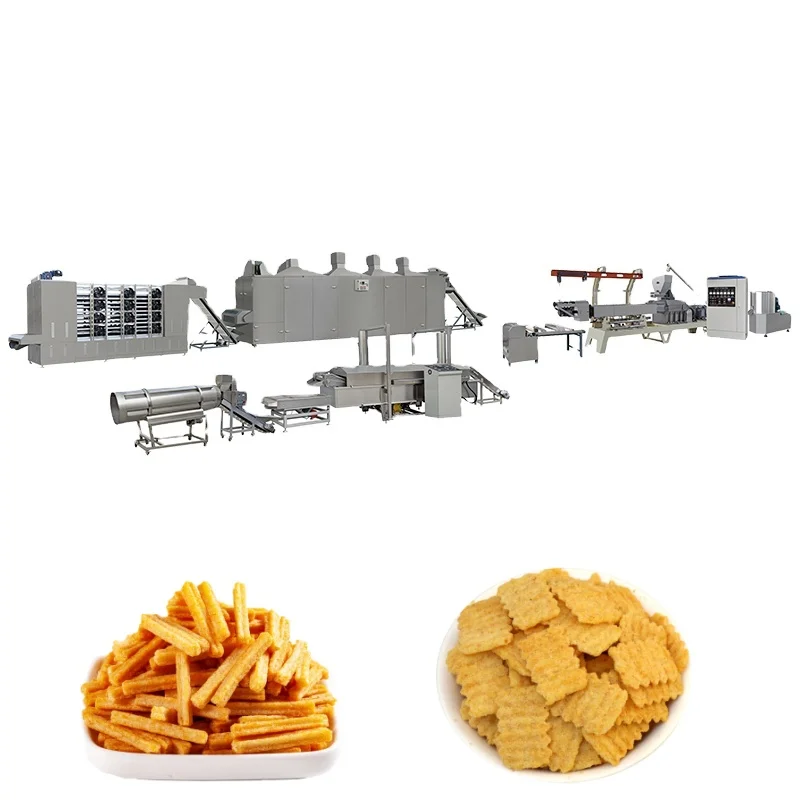
Throughput-Matched Line Design — Every station from mixer through fryer is calculated against your actual raw material before we quote, so the extruder never waits on a bottlenecked dryer or an undersized fryer belt.
Technical Specifications
| Parameter | Value |
|---|---|
| Product Type | Fried Pellet Snack Food Production Line |
| Available Models | MT-65 / MT-70 / MT-85 / MT-75 / MT-95 |
| Extruder Type | Co-rotating twin-screw with sectional modules |
| Main Motor (MT-65 / MT-70 / MT-85) | 100 kW / 130 kW / 180 kW |
| Main Motor (MT-75 / MT-95) | 185 kW / 280 kW |
| Output Capacity (MT-65) | 120–150 kg/h (basis not stated in source — confirm raw material formulation / moisture content) |
| Output Capacity (MT-70) | 200–250 kg/h (basis not stated in source — confirm raw material formulation / moisture content) |
| Output Capacity (MT-85) | 300–500 kg/h (basis not stated in source — confirm raw material formulation / moisture content) |
| Output Capacity (MT-75) | 400–500 kg/h (basis not stated in source — confirm raw material formulation / moisture content) |
| Output Capacity (MT-95) | 800–1000 kg/h (basis not stated in source — confirm raw material formulation / moisture content) |
| Contact Material | Stainless steel (food-grade, all parts touching raw material or product) |
| Frame Material | Painted steel (non-contact structure) |
| Drying Method | Gas / Electric / Diesel heating |
| Fryer Belt Width | 600 mm stainless steel belt |
| Fryer Energy Options | Electricity / Fuel gas |
| Mixer Power Options | 4 kW / 7.5 kW / 15 kW (matched to line model) |
| Cutting Machine Power | 1.47 kW |
| Voltage & Frequency | Customizable (e.g., 3ph 380V 50Hz, 3ph 415V 60Hz, 3ph 220V 60Hz) |
| Standards | CE certified (since 2014); ISO certified |
Application Suitability
| Application | Material or Output |
|---|---|
| Bugles and cone-shaped fried snacks | Corn powder, corn starch, potato starch blends |
| Tortilla chips and Doritos-style triangles | Wheat flour and corn flour mixtures |
| Ribbed and wavy fried chips | Potato powder and rice flour formulations |
| Pillow and shell-shaped pellet snacks | Multi-grain starch bases with varying moisture |
| Tube and stick-format fried pellets | High-amylose corn starch and wheat blends |
Why "Nominal Capacity" Can Sink Your Fried Snack Line Before It Runs
A fried snack food production line equipment quote means nothing if the dryer cannot keep pace with the extruder on your specific flour blend.
I remember a South American buyer who signed for a fried corn chip line based on sample output. Their local corn flour had higher protein content than the test sample we used. The extruded pellet did not expand enough, and after frying, the chips came out hard and dense. The entire screw configuration had to be reworked on site. Since then, I never trust a capacity number until the buyer’s actual raw material has run through the testing workshop. When stations are sourced from different vendors, the extruder might push product faster than the dryer can handle moisture removal, or the fryer belt may not move volume fast enough to maintain oil temperature. [NEED_CITE: impact of raw material protein content on extrusion expansion and final fried texture]
How the Full Equipment Range Fits Together on One Floor
This fried pellet chips making machine setup covers every station from raw material batching through final frying under a single equipment supply. The mixer feeds the twin-screw extruder, which cooks and shapes the dough through interchangeable dies. Cut pellets move into the dryer where moisture is reduced to the target range before the fryer. The 600 mm stainless steel fryer belt accepts product via roller feed, maintaining even spacing so oil temperature stays stable. When you source the entire fried snack food production line equipment package from one supplier, the conveyor heights, belt speeds, and transfer chutes are designed to align rather than adapted after delivery.
Shape Changeover Without Rebuilding the Line
The co-rotating twin-screw extruder accepts sectional screw modules and interchangeable dies or cutting rollers. This means the same extrusion platform can produce bugles, sticks, rib chips, diamond chips, wavy chips, pillow shapes, shells, screws, square tubes, and round tubes. A snack producer entering multiple market segments does not need a separate extruder for each format. The die swap and screw reconfiguration happen on the same barrel, and the downstream dryer and fryer handle the varied pellet geometries without modification. [NEED_CITE: twin-screw extrusion die changeover procedures in snack pellet production]
Reading the Specs That Actually Matter for Frying Quality
The main motor rating — ranging from 100 kW on the MT-65 to 280 kW on the MT-95 — tells you how much shear energy the screws can deliver to the dough. Higher motor capacity allows the extruder to handle viscous, high-starch formulations that require intense mixing and cooking within the barrel. The co-rotating sectional screw design lets the process engineer arrange forward-transport, mixing, de-gassing, and cooking zones in sequence along the barrel length. This is critical because different raw materials — corn powder behaves very differently from potato starch — need different residence times and shear profiles. The stainless steel contact surfaces throughout the line prevent corrosion from the acidic and salty environments typical in snack seasoning and frying operations. Voltage and frequency customization ensures the motors and heating elements receive correct power at the installation site, avoiding the underperformance or burnout that occurs when a 50 Hz motor runs on a 60 Hz supply without recalculation.
The Hidden Cost of Mismatched Stations
When the fryer belt is too narrow or the oil volume too small for the extruder output, the oil temperature drops every time a new batch of pellets enters. The result is uneven frying — some chips absorb excess oil while others remain undercooked. Similarly, if the dryer is undersized, pellets enter the fryer with too much residual moisture, causing violent oil splattering and inconsistent texture. These problems do not show up in the factory test because the test runs at reduced throughput. They appear on the buyer’s floor during the first full-speed production shift, when downtime and product waste start accumulating. [NEED_CITE: consequences of throughput mismatch between extruder and fryer in snack pellet lines]
What This Equipment Range Covers That Separate Purchases Miss
Complete line supply from mixer through fryer means every conveyor, transfer chute, and control panel is specified together. The screw configuration and die design are matched to your raw material and target shape before the extruder ships, not guessed from a generic build. The in-house testing workshop runs your actual formulation before dispatch, so expansion, density, and frying behavior are verified in advance. Voltage, frequency, and control language are confirmed against your facility specifications during the design phase. CE and ISO documentation travels with the shipment, clearing customs and meeting local safety inspection requirements without last-minute scrambles.
Documentation & Verification
- Line layout drawing showing station-by-station throughput matched to your target output
- Screw configuration record specifying module arrangement for your raw material formulation
- Electrical schematic with voltage and frequency confirmed against your facility supply
- Trial run report on your actual corn or potato starch blend before dispatch
- CE declaration of conformity and ISO certificate included with shipping documents
- Wear parts list identifying screws, dies, and fryer belt sections for reorder planning
Installation, Commissioning & Support
- Foundation planning accounts for the full line length, up to 24 meters on the MT-70 configuration
- Dedicated electrical circuits sized for the main motor rating, up to 280 kW on the MT-95
- Stations arrive separately and are aligned on-site using the supplied layout drawing
- First-run parameter setting covers barrel temperature zones, screw speed, and fryer belt speed
- Operator training includes die changeover, screw module replacement, and fryer oil management
- Free wearing parts supplied at delivery, with additional spares recommended for two to three years of operation
What We Need to Configure Your Line
Send us the raw material you plan to use — corn flour, wheat flour, potato starch, or a custom blend — along with the target chip shape and your daily production volume. Let us know your facility voltage and frequency, and whether your workshop has gas supply for the dryer or requires electric heating. If you have existing upstream mixing or downstream packing equipment, share the interface dimensions so we match conveyor heights. For buyers who want to see their product before ordering, we can arrange a trial run using your shipped raw material in our testing workshop.
Frequently Asked Questions
Q: How is output capacity determined for a specific raw material?
A: Output capacity depends on the formulation, moisture content, and target pellet density. We run your actual raw material in the testing workshop and measure throughput at the extruder, dryer, and fryer. The quoted capacity reflects the slowest station in the matched line, not just the extruder nameplate rating.
Q: Can voltage and frequency be configured for my facility?
A: Yes. The line motors, heating elements, and control panels are built to your confirmed voltage and frequency — for example, 3-phase 380V 50Hz or 415V 60Hz. We verify this against your electrical schematic before production starts to avoid commissioning delays.
Q: How many shapes can one line produce, and is changeover quick?
A: The interchangeable dies and cutting rollers support formats including bugles, sticks, rib chips, diamonds, waves, pillows, shells, and tubes. Changeover involves swapping the die plate and adjusting the cutter, which trained operators complete within a standard shift without specialized tools.
Q: Is the fryer capacity matched to the extruder, or must I verify?
A: On this full equipment range, the fryer belt width, oil volume, and heating capacity are calculated to handle the extruder output at your confirmed throughput. You receive a line layout document showing matched station capacities rather than assembling from separate vendors.
Q: What spare wearing parts come with the line?
A: Free wearing parts are included at shipment. We recommend ordering two to three years of additional spares — screws, die plates, and fryer belt sections — based on the wear parts list provided with your documentation package.