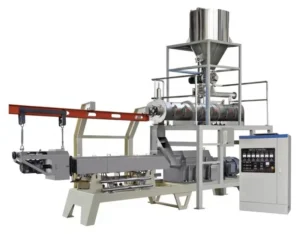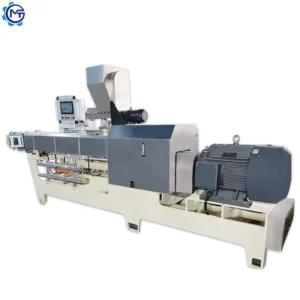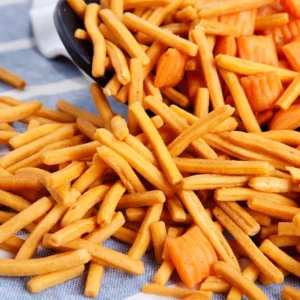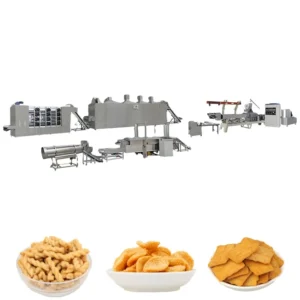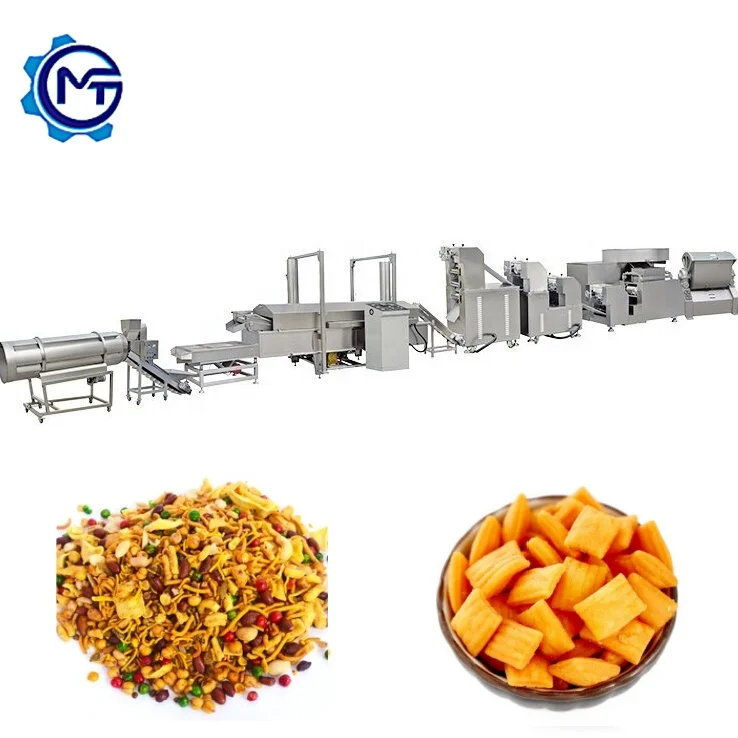
Matching Fryer Throughput to Extruder Output — every station in the line is capacity-balanced so the frying step never dictates the bottleneck or forces upstream equipment to idle.
Technical Specifications
| Parameter | Value |
|---|---|
| Product Type | Continuous Deep Frying Machine |
| Rated Power | 60 kW (heating tube); 2.6 kW (drive/auxiliary) |
| Voltage & Frequency | 380V / 50HZ |
| Control System | PLC |
| Overall Dimensions (L×W×H) | 6700 × 2200 × 1200 mm |
| Net Weight | 2000 KG |
| Oil Capacity | 320 L |
| Output Capacity | 100–1000 kg/h (basis to be confirmed) |
| Heating Method | Electric heating / Gas heating (configurable) |
| Construction Material | Food-grade 304 stainless steel |
| Conveyor Type | Upper and lower double-layer mesh belt with frequency conversion stepless speed regulation |
| Oil Filtration | Automatic oil circulation filtration system |
| Slag Discharge | Bottom slag discharge system |
| Lifting System | Automatic lifting for upper hood and mesh belt |
| Key Features | PLC temperature control, CE certified, ISO certified |
Application Suitability
| Application | Material or Output |
|---|---|
| Fried extruded snack production | Corn curls, cheese balls, and similar pelled snacks exiting a twin-screw extruder and dryer |
| Fried stick and noodle-style snacks | Soba, Spix, and Mie Sedap style fried sticks from extruded dough |
| Pellet snack finishing | 2D and 3D puffed pellets fried to target crunch and colour |
| Integrated snack line station | Positioned between dryer output and de-oiling / flavouring drums |
Why "1000 kg/h" Means Nothing Without the Rest of the Story
A fryer rated at nominal throughput only holds that figure when product moisture, frying time, and oil temperature are all within the assumed range.
I once watched a fried corn curl line drop to half its expected output because the upstream dryer left the pellets two points higher in moisture than the fryer was set for. The oil temperature fell every time a new batch entered, recovery lagged, and the finished product came out oily and pale — an entire shift sent back for rework [NEED_CITE: moisture content impact on continuous frying throughput]. Sizing a Continuous Frying Machine for sale without confirming the exact product format and upstream moisture level is how lines end up bottlenecked at the station that was supposed to be the simplest.
Belt Speed and Frying Time Alignment
The double-layer mesh belt runs on frequency-controlled stepless speed regulation, which means the residence time inside the oil bath is adjustable across a wide range without mechanical changeover. For a light corn curl that needs only seconds of contact with hot oil, the belt moves quickly; for a denser pellet snack requiring a longer fry to reach the correct colour and crunch, the belt slows down. This flexibility is what lets one Continuous Frying Machine for sale handle multiple product formats across different production runs on the same line.
Oil Filtration and Production Continuity
The automatic oil circulation filtration system continuously pulls residue and fine particulate out of the oil bath during operation. Without this, carbonised crumbs accumulate on heating surfaces, degrading heat transfer and darkening the oil faster than the scheduled replacement cycle [NEED_CITE: oil degradation rates in continuous industrial frying]. For a snack line running multiple shifts, the difference between filtered and unfiltered oil shows up in both product colour consistency and the frequency of full oil changeovers.
Power, Heating Method, and Recovery Rate
The 60 kW heating tube rating determines how quickly the oil recovers its set temperature after each batch of product enters. Electric heating suits facilities with stable three-phase supply and lower gas infrastructure costs, while gas heating is preferable where electricity tariffs are high or where rapid recovery on heavy product loads is needed [NEED_CITE: industrial heating method selection for food processing]. The 320 L oil capacity works alongside the heating power to buffer temperature swings — a larger volume means a slower drop when cold product hits the bath, but also a longer initial heat-up time at the start of a shift.
What the 6700 mm Footprint Means for Line Layout
At 6700 × 2200 × 1200 mm and 2000 KG, this unit occupies a fixed position in the line between the dryer discharge conveyor and the de-oiling station. The overall length includes the oil bath, the loading and discharge zones, and the filtration loop. Planning the upstream and downstream conveyor heights to match the fryer’s belt entry and exit points avoids product jams and spillage that would otherwise require manual intervention every few hours.
The Cost of Skipping the Capacity Calculation
When a fryer is ordered on nominal capacity alone, the most common failure mode is oil temperature collapse under actual product load. The PLC maintains the set point, but the heating elements cannot recover fast enough if the product entering the bath carries more moisture or mass than the thermal design anticipated [NEED_CITE: thermal recovery limits in continuous deep fryers]. The result is product that absorbs excess oil without reaching the target surface colour — a quality deviation that may not be caught until the packing station.
Why Buyers Source the Frying Station Here
Every piece of equipment from the extruder through to the packing end is specified under one supplier, which means the fryer throughput is calculated against the actual extruder output rather than an independent nameplate figure. Screw configuration and die design on the upstream extruder determine product density and moisture, both of which directly affect frying behaviour. An in-house testing workshop runs trial production on the buyer’s raw material before the line ships, so frying parameters are documented rather than guessed. Food-grade 304 stainless steel contact surfaces are standard across all stations, simplifying washdown and meeting export market hygiene requirements. Electrical schematics and PLC language are confirmed before production begins, avoiding commissioning delays caused by mismatched voltage or untranslated interfaces.
Documentation & Verification
- Line layout drawing showing fryer positioned between dryer and de-oiling stations with matched throughput
- Machine specification sheet confirming heating method, voltage, and oil capacity for the target market
- Electrical schematic with PLC I/O list and control language confirmed before build
- Factory test record documenting oil temperature recovery and belt speed settings on test product
- CE declaration of conformity covering the frying machine and its electrical enclosure
Installation, Commissioning & Support
- Foundation must support 2000 KG static load plus dynamic vibration from the circulation pump
- Dedicated 380V three-phase circuit required for the 60 kW heating load with appropriate breaker rating
- Fully assembled delivery; upper hood lifted into operating position via the built-in automatic system
- First-run commissioning includes oil temperature profiling and belt speed calibration on buyer’s product
- Wear parts list covers mesh belt sections, heating elements, and filtration media with recommended spares
What to Include in Your Inquiry
To size the frying station correctly within your line, share the product format and target moisture after frying, the upstream extruder or dryer output rate, your local voltage and frequency, and whether electric or gas heating suits your facility. If you are integrating into an existing line, provide the conveyor discharge height and the distance available between the dryer and de-oiling stations.
Frequently Asked Questions
Q: How is fryer capacity matched to upstream extruder output and what product parameters affect actual throughput?
A: Throughput depends on product moisture entering the bath, required frying time for the target colour, and oil temperature recovery rate. We calculate the fryer’s effective capacity against your extruder’s confirmed output and the specific product format, rather than relying on a standalone nameplate figure.
Q: Which heating method suits my production line and local utility conditions?
A: Electric heating at 60 kW suits facilities with stable three-phase power and lower gas infrastructure costs. Gas heating is preferable where electricity tariffs are high or rapid thermal recovery on heavy product loads is needed. We confirm the method during the specification stage based on your utility data.
Q: What voltage, frequency, and PLC language options are confirmed before shipment?
A: Standard configuration is 380V / 50HZ, but we confirm your site’s actual supply before production. The PLC interface language is specified during the electrical review so operators can navigate the control panel in their working language from day one of commissioning.
Q: How does the oil filtration system integrate with production schedules and oil replacement cycles?
A: The automatic circulation filter removes particulate continuously during operation, extending oil service life between full changeovers. The filtration media replacement interval and oil drain schedule are documented in the operation manual based on the product type and production hours per shift.
Q: What supporting equipment is available to complete the frying station?
A: De-oiling conveyors, flavouring drums, cooling conveyors, and packing systems are all available within the same equipment range. Each station is throughput-matched to the fryer so product moves continuously without accumulation or starvation between stages.