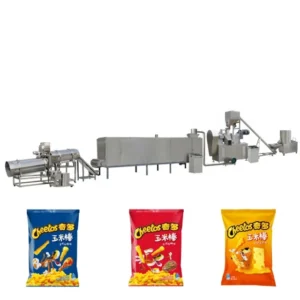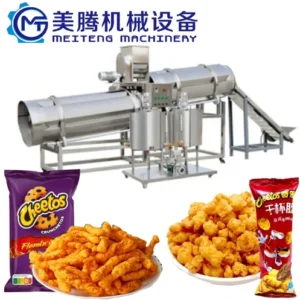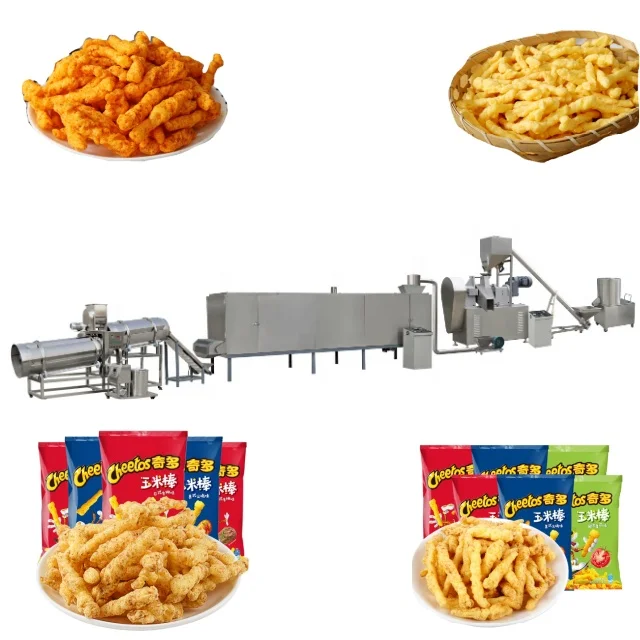
Line-Balanced Throughput — every station from mixer to packing is sized so the extruder never waits on the fryer or the flavouring drum.
Technical Specifications
| Parameter | Value |
|---|---|
| Product Type | Fried Snack Extrusion Production Line |
| Output Capacity | 200 kg/h (basis not stated in source — confirm raw material, moisture, product format) |
| Alternative Capacity Claim | up to 250 kg/h (source value — verify against manufacturer catalog, conflicts with 200 kg/h title claim) |
| Voltage Options | 220V / 380V (frequency to be confirmed: 50 Hz or 60 Hz) |
| Construction Material | Food-contact parts in 304 stainless steel; structural frame in carbon steel |
| Product Formats | Cheetos, Kurkure, Niknak and similar fried extruded snack shapes |
| Screw Type | To be confirmed (single or twin screw) |
| Control System | To be confirmed (PLC / MCC / manual) |
| Line Stations | To be confirmed (mixer, extruder, fryer, de-oiling, flavouring, cooling, packing) |
Application Suitability
| Application | Material or Output |
|---|---|
| Spiral and ring-shaped fried snacks | Corn grits, maize flour, or blended cereal bases |
| Cheetos-style puffed curls | Corn meal with controlled moisture for extrusion expansion |
| Kurkure-type extruded nibs | Grits and starch blends formulated for high-temperature frying |
| Niknak-format crunchy sticks | Grain-based doughs requiring die cutting and deep frying |
What "200 kg per Hour" Leaves Out When Sourcing a Fried Snack Extrusion Machine
Capacity only holds when the extruder, fryer, and flavouring drum share the same validated throughput on your actual corn blend.
I once watched a buyer lose an entire commissioning week because the extruder pushed dough faster than the fryer could crisp it, leaving a backlog of soggy半成品 that had to be scrapped. That fried snack extrusion machine for sale had impressive nameplate numbers, but the line was assembled from mismatched stations [NEED_CITE: line balancing principles in snack food processing]. When the raw material moisture drifted even slightly from the supplier’s trial batch, expansion dropped and the fryer oil temperature could not compensate. Before signing any purchase order, ask for a capacity calculation that shows each station’s throughput side by side, based on the exact corn grits and moisture level you will run in your own plant.
Matching Every Station to the Same Real-World Output
A fried snack extrusion machine for sale is only as reliable as its weakest link between the mixer and the packing table. If the extruder produces at a rate the fryer cannot absorb, oil temperature drops with every cold batch of dough entering the vat, resulting in uneven colour and excess oil uptake. Conversely, an oversized fryer running half-empty burns fuel and degrades oil life faster. Our approach sizes each piece of equipment — conveyor, fryer, de-oiling shaker, seasoning drum, cooling belt — against the extruder’s validated output on your specific formula, so no single station throttles the rest.
Die Geometry and Dough Rheology Define the Final Crunch
The shape and internal cell structure of a Kurkure or Cheetos curl are locked in the moment dough passes through the die plate. Die hole diameter, land length, and face angle determine how much shear the dough experiences, which in turn controls starch gelatinisation and expansion ratio. A die designed for fine corn flour will choke on coarser grits, causing pressure spikes that wear the screw tip prematurely [NEED_CITE: extrusion die design and starch gelatinisation]. Confirming screw profile and die configuration against your actual particle size distribution prevents unplanned downtime and keeps product density within market specification.
Reading Between the Specification Rows
Voltage options of 220 V or 380 V appear straightforward, yet frequency — 50 Hz versus 60 Hz — dictates motor speed and therefore screw RPM, directly affecting residence time inside the barrel. A line configured for 50 Hz will run the screw noticeably faster on a 60 Hz supply, altering shear rate and expansion behaviour before the operator even touches the HMI. Construction in 304 stainless steel on food-contact surfaces meets hygiene expectations for export markets, while carbon steel on the structural frame keeps weight and cost contained. What remains unlisted in many quotations is the control architecture: whether PLC with recipe memory or manual push-button panels are supplied shapes how consistently your night shift replicates day-shift settings.
The Cost of Skipping a Pre-Shipment Trial Run
Skipping a trial on your own corn blend means the first time the extruder meets your raw material is inside your factory, with your packaging film already printed and your launch date already promised to distributors. I have seen lines sit idle for weeks while technicians adjusted screw elements one combination at a time, burning through raw material and frying oil in volumes that wiped out the project’s contingency budget [NEED_CITE: cost of unplanned downtime in food manufacturing]. A pre-shipment trial locks in screw configuration, die selection, barrel temperature profile, and fryer settings before the crate leaves the workshop, reducing on-site commissioning to verification rather than experimentation.
Why Buyers Route Their Snack Line Inquiries Here
Complete line supply under one purchase order means throughput is calculated across every station rather than guessed between separate vendors. Screw and die combinations are specified after reviewing your corn grits sieve analysis and target bulk density, not copied from a generic template. An in-house testing workshop allows trial runs on customer-supplied raw material before the line ships, so expansion and crunch are confirmed in advance. Twin-screw and single-screw expertise spans pet food, aquatic feed, breakfast cereals, and fried snack formats, ensuring cross-category knowledge informs your die design. Engineering support extends from initial layout drawing through on-site installation and operator training.
Documentation & Verification
- Line layout drawing showing each station’s footprint and utility drop points
- Capacity calculation sheet matching extruder output to fryer and flavouring drum rates
- Screw and die configuration record locked to your corn grits specification
- Electrical schematic confirming voltage, frequency, and control language
- Factory trial run report on customer-supplied raw material before dispatch
- CE and ISO conformity documents applicable to the complete line
Installation, Commissioning & Support
- Foundation plan accounts for fryer oil load and extruder vibration isolation
- Dedicated electrical circuit sized for combined extruder motor and fryer heating load
- Modular assembly allows station-by-station uncrating in low-clearance workshops
- Commissioning includes barrel temperature mapping on your actual corn blend
- Operator training covers screw element swap and die cleaning procedures
- Wear parts list identifies screw tips, die plates, and fryer mesh belt as first-order spares
What We Need to Finalise Your Line Proposal
Share your corn grits or flour specification including particle size distribution and typical moisture content, along with the target hourly output you need to sustain. Let us know your plant’s available floor length, ceiling height, and local voltage and frequency so we can size motors and heating elements correctly. If you have existing upstream mixers or downstream packing machines you intend to keep, provide their throughput ratings so we can match the new extrusion and frying section accordingly.
Frequently Asked Questions
Q: How do you confirm whether the line delivers 200 kg/h or 250 kg/h?
A: Both figures depend on the raw material’s moisture content, particle size, and the final product’s target density. We run your actual corn grits through our testing workshop, measure real output at the packing station, and document the result in a trial report before the quotation is finalised.
Q: Can the voltage and frequency be set for markets running 60 Hz?
A: Yes. Motors, heating elements, and control transformers are specified after you confirm local supply. Running a 50 Hz-rated extruder on 60 Hz without reconfiguration changes screw RPM and residence time, so we adjust the drive ratio and PLC parameters before shipment.
Q: Is PLC control with recipe storage available instead of manual panels?
A: PLC with MCC is an available option. The HMI language, alarm text, and recipe naming convention are configured to your operator requirements during factory assembly, and the programme is backed up on a USB drive included in the documentation package.
Q: How do you prevent the fryer from becoming a bottleneck?
A: We calculate fryer belt length and oil volume so that residence time at your target frying temperature matches the extruder’s validated output. If the extruder produces faster than the fryer can crisp, we resize the fryer rather than throttle the extruder.
Q: Can we visit the workshop to see a trial run before paying the balance?
A: Yes. Once your raw material arrives at our testing workshop, we schedule a trial run and invite you or your representative to witness it. The trial report, including product samples, is shared before the shipment inspection is booked.