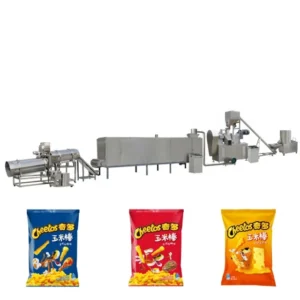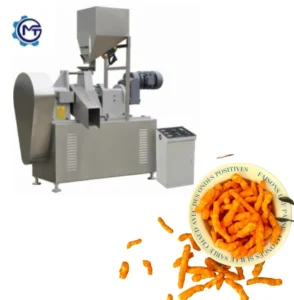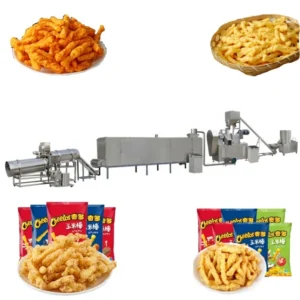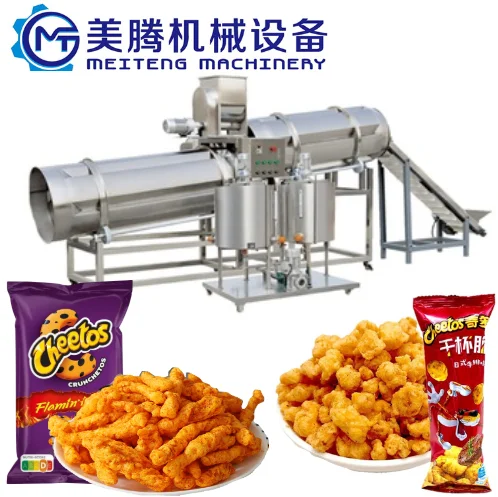
Matched Station Capacity — Every mixer, extruder, dryer and flavouring drum in the MT 120 line is sized to the same throughput target, preventing mid-line bottlenecks.
Technical Specifications
| Parameter | Value |
|---|---|
| Model | MT 120 |
| Product Type | Kurkure Cheetos Extrusion Processing Line |
| Output Capacity | 120-350 kg/h (basis not stated in source — confirm raw material type, moisture content and product format) |
| Heat Source | Electric |
| Construction Material | 304 Stainless Steel (food-contact stations) |
| Automation Level | Fully Automatic |
| Screw Type | Twin-screw extrusion |
| Line Stations | Mixing, extrusion, shaping, drying, flavouring/coating |
| Control System | Available with PLC and MCC control |
| Voltage & Frequency | Configurable to target market supply (basis to be confirmed) |
| Assembly State | Complete processing line |
| Certification | CE |
Application Suitability
| Application | Material or Output |
|---|---|
| Twisted corn snack production (Kurkure format) | Corn grits, corn flour, water, seasoning oil |
| Extruded cheese snack production (Cheetos format) | Corn meal, cheese powder blend, vegetable oil |
| Spiral and ring-shaped puffed snacks | Corn-based dough with varying moisture levels |
| Co-expressed filled snack variants | Corn base with cream or paste filling |
What the Kurkure Cheetos Making Machine Full Equipment Range Actually Covers
A complete line only works when every station is rated for the same throughput — not just the extruder.
When buyers survey extrusion lines, the quoted capacity often reflects the extruder alone. The dryer may be undersized, the flavouring drum too short for even coating coverage, or the cooling conveyor unable to keep pace. I have walked onto factory floors where a twin-screw extruder was pushing product into a dryer that simply could not handle the volume, creating a backlog that forced operators to throttle the extruder down. [NEED_CITE: throughput matching across extrusion line stations] The Kurkure Cheetos making machine full equipment range addresses this by specifying each station — from batching through packing — against a single production target rather than assembling off-the-shelf units from separate vendors.
Sizing Every Station to One Production Target
A Kurkure or Cheetos line moves product through distinct thermal and mechanical stages, and each one has its own residence time requirement. The mixer must batch fast enough to feed the extruder continuously. The extruder itself needs a screw configuration matched to the corn base and desired expansion. Downstream, the dryer must hold product long enough to reach the target moisture without scorching, and the flavouring drum must tumble pieces gently enough to avoid breakage while ensuring even oil and powder distribution. The Kurkure Cheetos making machine full equipment range lists every station so buyers can verify that capacities align before a single machine is built.
How the Equipment Catalogue Informs Line Layout
Buyers reviewing the full equipment range can see where each machine fits and what footprint it demands. This matters for factory planning — the dryer alone may require a significant length of floor space depending on the belt configuration and drying temperature profile. Knowing the complete station list upfront lets a technical buyer or equipment specifier plan utility drops, drainage for the mixer area, and exhaust routing for the dryer before the line arrives on site. [NEED_CITE: industrial food line layout planning standards]
Screw Geometry and Die Selection for Corn-Based Snacks
Twin-screw extrusion gives processors control over shear, residence time and pressure at the die face — all of which determine whether a corn-based snack expands into a light, open structure or a dense, crunchy one. The screw elements can be rearranged to increase or decrease mechanical shear, and the die opening shapes the product cross-section before it exits into ambient pressure. For Kurkure-style twisted snacks, the die geometry and post-die shaping mechanism work together to create the characteristic spiral form. The specification sheet records the exact screw configuration and die design so that repeat orders produce consistent texture batch after batch.
The Cost of Undersized Downstream Stations
An extruder running at full output is only productive if the dryer can remove moisture at the same rate. When the dryer falls behind, product piles up, surface moisture remains too high, and shelf life suffers. Similarly, a flavouring drum that is too small for the line throughput leaves uneven seasoning coverage — a defect that customers notice immediately. [NEED_CITE: snack food quality defects from line imbalance] These problems are not solved by adjusting extruder settings; they require correctly sized downstream equipment from the start, which is why surveying the full station list matters before committing to a purchase.
Why Source the Complete Range from One Supplier
Every station in the MT 120 Kurkure Cheetos line is specified under a single line layout and capacity calculation, so throughput is matched across mixing, extrusion, drying and coating. Screw configuration and die design are recorded against the buyer’s actual raw material rather than a generic build. The in-house testing workshop allows trial runs on customer-supplied corn grits or flour before shipment, confirming expansion and texture. Food-grade 304 stainless steel is used across all product-contact surfaces. PLC and MCC control options provide consistent batch-to-batch operation with recipe storage for different snack formats.
Documentation & Verification
- Line layout and capacity calculation showing matched throughput for every station
- Machine specification sheet with screw configuration and die design record
- Electrical schematic with voltage and frequency matched to buyer’s facility
- Trial run report produced on buyer’s actual corn-based raw material before dispatch
- CE declaration of conformity for the complete processing line
- Operation and maintenance manual covering each station in the range
Installation, Commissioning & Support
- Floor space and utility planning based on the confirmed station list and dryer length
- Dedicated electrical circuit sized for the total connected electric heating and motor load
- Machines shipped in sectional assemblies for staged installation on site
- First-run commissioning with screw speed, barrel temperature and dryer settings optimised
- Operator training on PLC recipe management across all line stations
- Wear parts list covering screws, dies and dryer belt sections with reorder intervals
Before You Send an Inquiry
To specify the right Kurkure Cheetos making machine full equipment range configuration, share your target corn-based raw material and its moisture content, the daily or hourly production volume you need, and your local voltage and frequency standard. Let us know whether you are building a new line from scratch or replacing individual stations in an existing setup. If you can provide a sample of your raw material, we can run a trial in the testing workshop before finalising the screw and die specification.
Frequently Asked Questions
Q: What stations are included in the full Kurkure and Cheetos equipment range?
A: The range covers batching and mixing, twin-screw extrusion, shaping, drying, flavouring or coating, cooling and packing support. Each station is sized to the same throughput target so that no single machine bottlenecks the line. Buyers can review the complete station list to verify capacity alignment before ordering.
Q: How do I confirm voltage and control language for my facility?
A: Provide your local supply voltage, frequency and phase specification along with your preferred control interface language. The electrical schematic is then prepared to match, and the PLC programme labels are set accordingly before the line ships, avoiding delays during on-site commissioning.
Q: Can I order a single station like a dryer or flavouring drum for an existing line?
A: Individual stations can be specified to match an existing extruder’s output. Share your current extruder capacity, product format and available floor space so the replacement or upgrade unit is sized correctly for throughput and physical layout.
Q: What screw and die setup is needed for different corn snack textures?
A: Screw element arrangement, barrel temperature profile and die opening geometry together determine expansion, density and surface texture. The configuration is selected after a trial run on your specific corn material, and the exact setup is recorded in the specification sheet for future reference.
Q: Is a trial run on my raw material done before the line ships?
A: Yes. The in-house testing workshop runs your supplied corn grits or flour through the extruder with the proposed screw and die configuration. A trial run report documenting expansion rate, product density and texture is provided before shipment so product development begins with confirmed parameters.