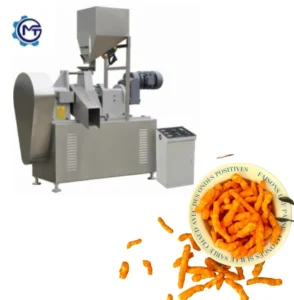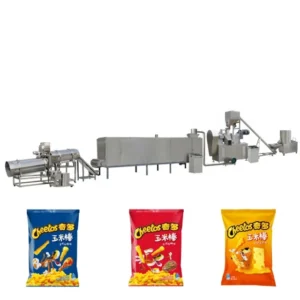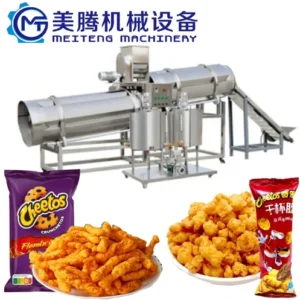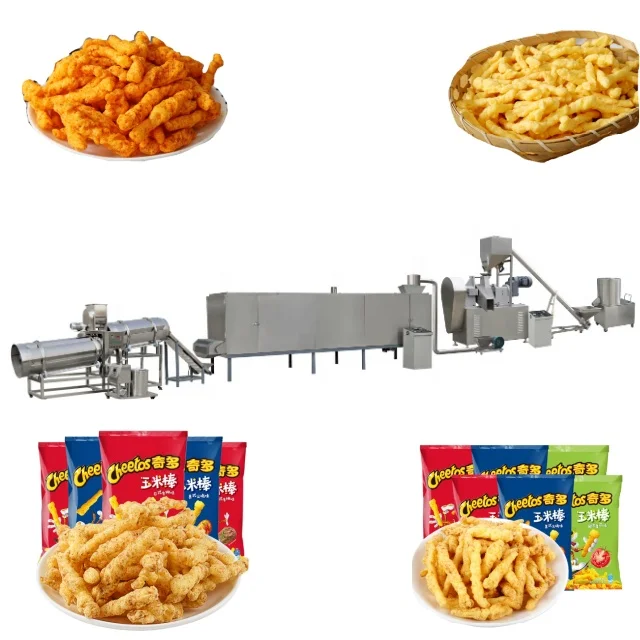
Integrated Station Sizing — Every mixing, extruding, frying and flavouring unit in this range is throughput-matched to prevent mid-line bottlenecks on fried snack lines.
Technical Specifications
| Parameter | Value |
|---|---|
| Product Type | Fried Snack Cheetos Kurkure Making Machine |
| Output Capacity | up to 250 kg/h (basis not stated in source — confirm raw material type, moisture content, and product format) |
| Title Claimed Capacity | 200 kg/h (basis to be confirmed) |
| Voltage Options | 220V / 380V (frequency to be confirmed) |
| Contact Material | 304 Stainless Steel |
| Structural Frame | Carbon Steel |
| Cooking Rack | Adjustable to accommodate different pot sizes |
| Suitable Formats | Cheetos, Kurkure, Niknak |
| Control Options | MCC or PLC available |
Application Suitability
| Application | Material or Output |
|---|---|
| Fried extruded snack production | Corn grits, corn flour based Kurkure and Cheetos formats |
| Puffed coil and ring snacks | Grain-based doughs requiring rotary die extrusion |
| Niknak-style tube snacks | Maize and rice flour blends with controlled moisture |
| Snack line station upgrades | Individual extruder, fryer, or flavouring drum replacement |
Why a Rated Capacity Figure Can Mislead Your Fried Snack Investment
A capacity number without raw material context is a guess, not a guarantee.
When a Fried Snack Cheetos Kurkure Making Machine for sale is quoted at a flat throughput, buyers often assume that figure will hold once their own corn grits arrive at the factory floor. In my early years on the assembly line in the Pearl River Delta, I saw extruders rated at full capacity on standard fine corn flour fail to reach half that output when the buyer shipped in a coarser local grind. The screw geometry and barrel moisture profile had never been adjusted for the actual feed stock, so expansion dropped and the downstream fryer sat idle waiting for product. That mismatch is why confirming raw material particle size, moisture percentage, and fat content before locking a line specification matters more than comparing headline numbers. [NEED_CITE: effect of corn grit particle size on extrusion expansion rate]
How Extruder and Fryer Throughput Must Align
Sizing the extruder alone is not enough; the fryer, flavouring drum, and cooling conveyor each have to handle the same volume without queueing or starving. A fryer with insufficient belt area will leave product sitting in oil too long, altering colour and oil absorption. A flavouring drum that cannot complete its coating cycle within the extruder output interval creates a pile-up that cools the snack below seasoning adhesion temperature. Matching every station to one verified throughput keeps the line continuous and the product uniform.
Material Contact Surfaces and Food-Grade Compliance
All product-contact parts across this Fried Snack Cheetos Kurkure Making Machine range use 304 stainless steel, meeting the hygiene expectations of snack food regulators in most export markets. The structural frame is carbon steel, keeping machine weight and footprint manageable while the contact zones stay corrosion-resistant during the wash-down cycles that fried snack lines require. [NEED_CITE: food-contact material requirements for extruded snack machinery]
What the Voltage and Frequency Choice Actually Affects
Selecting between 220V and 380V is not just about plugging in — it determines motor winding specification, heater element rating, and control panel transformer sizing. A line shipped with 380V / 50 Hz motors to a market running 60 Hz will spin extruder screws faster than designed, changing shear rate and dough temperature inside the barrel. Confirming local utility standards before the order avoids rewiring costs and commissioning delays on site.
Reading the Core Specs for Production Impact
The adjustable cooking rack lets operators swap fryer pots to handle different snack cross-sections, from thin Niknak tubes to thicker Kurkure coils, without replacing the entire frying module. Voltage configurability between 220V and 380V means the same extruder platform can serve markets from Southeast Asia to the Middle East without custom motor orders. The 304 stainless steel contact surfaces tolerate the hot oil mist and seasoning dust that accumulate during fried snack runs, reducing unplanned downtime for deep cleaning.
The Cost of Skipping Downstream Station Checks
Buyers who focus only on the extruder price often discover later that an undersized flavouring drum cannot coat product fast enough, forcing the entire line to slow down. Frying oil degrades faster when product dwell time exceeds design limits because the fryer is overloaded, raising oil replacement frequency and operating cost. Cooling conveyors that are too short deliver warm snacks to the packing station, where moisture condensation inside the bag shortens shelf life. Each of these mismatches traces back to specifying stations in isolation rather than as a matched set. [NEED_CITE: impact of downstream bottleneck on extruded snack line efficiency]
Why Buyers Source This Range Here
The full equipment catalogue covers every station from batching through packing, so throughput calculations are done against one consistent output target rather than pieced together from separate vendor quotes. Screw configuration and die geometry are specified to the buyer’s actual corn grits and target Kurkure or Cheetos format, not copied from a generic template. An in-house testing workshop runs the buyer’s raw material before shipment, confirming expansion, texture, and density so product development does not start from zero at installation. Electrical schematics are prepared with confirmed voltage, frequency, and control language for the destination market, cutting commissioning time. Pre-sales consultation continues through on-site installation, operator training, and ongoing wear-part supply.
Documentation & Verification
- Line layout with capacity calculation matched to your corn grit moisture level
- Screw and die configuration record for your specific Kurkure or Cheetos format
- Electrical schematic confirming voltage, frequency, and PLC language before build
- Trial run report on your raw material verifying expansion and texture
- Wear parts list covering screws, dies, and frying mesh screens
Installation, Commissioning & Support
- Floor plan and utility load sheet provided for 220V or 380V supply circuits
- Extruder barrel and fryer module shipped partially assembled to ease site rigging
- First-run parameter setting covering barrel temperature zones and fryer oil temperature
- Operator training on screw speed adjustment and cooking rack changeover procedure
- Spare screw and die set recommended with the initial shipment for first replacement cycle
What to Prepare Before Requesting a Quote
Share the exact corn grits or flour specification you intend to run, including particle size distribution and moisture content. Confirm your local voltage, frequency, and preferred control language so the electrical package matches your facility. Indicate whether you need individual station replacements or a full line from mixing to packing, and whether a trial run on your raw material is required before dispatch.
Frequently Asked Questions
Q: How do I confirm the real output capacity for my raw material?
A: Provide your corn grits specification including particle size and moisture level. A trial run in the testing workshop validates throughput, expansion, and texture on your actual feed stock before the line ships, so the confirmed capacity reflects your material rather than a generic benchmark.
Q: Which supporting stations should I include to avoid bottlenecks?
A: Beyond the extruder, a correctly sized fryer, flavouring drum, cooling conveyor, and packing station must all match the same throughput target. Undersizing any one of them forces the entire line to slow down, regardless of extruder capability.
Q: What voltage and frequency options are available?
A: The range supports 220V and 380V configurations. Frequency and control language are confirmed during the specification stage to match the destination market utility grid and operator preference before production begins.
Q: Is a trial run performed before the machine ships?
A: Yes. The in-house testing workshop runs your supplied raw material through the configured extruder and fryer setup. The resulting trial report documents product expansion, density, and texture so you can verify the line meets your market specification before it leaves the factory.