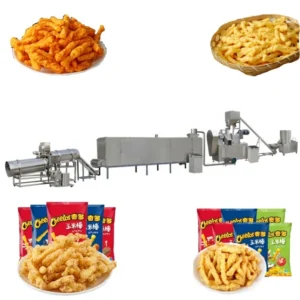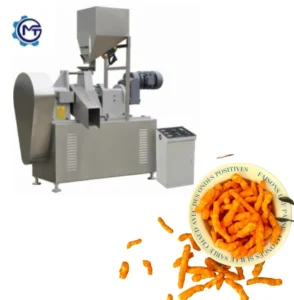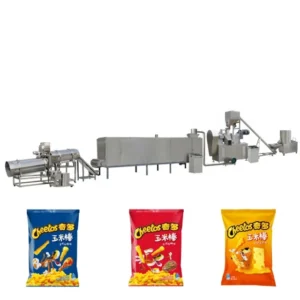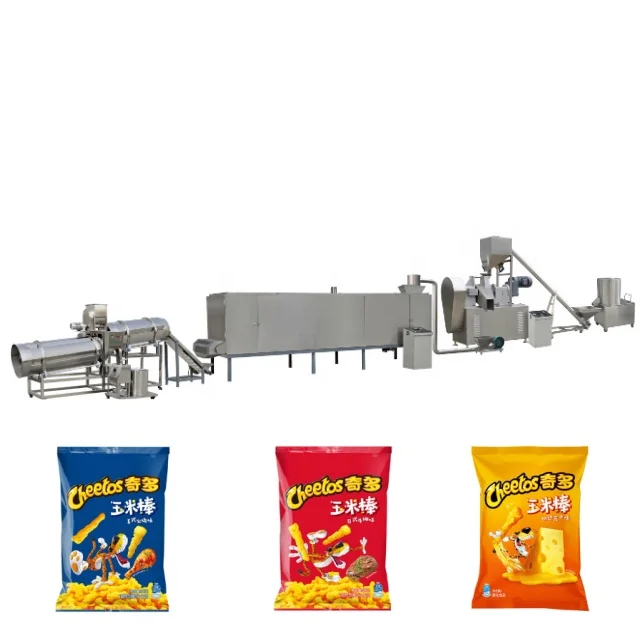
Matched Throughput Across Every Station — the kurkure cheetos making machine full equipment range is specified as one integrated line, so extruder output, dryer residence time, and coating drum speed are calculated together rather than sourced separately.
Technical Specifications
| Parameter | Value |
|---|---|
| Product Type | Kurkure Cheetos Making Machine |
| Output Capacity | 120–350 kg/h (basis not stated in source — confirm raw material, moisture, and product format) |
| Heat Source | Electric |
| Construction Material | 304 Stainless Steel (food-contact surfaces) |
| Automation Level | Fully Automatic |
| Control System | PLC with MCC integration |
| Product Application | Cheetos, Kurkure, and various extruded puffed snacks |
| Key Features | Integrated mixing, extrusion, drying, flavouring, cooling, and packing stations |
Application Suitability
| Application | Material or Output |
|---|---|
| Kurkure-style extruded snacks | Corn grits, corn flour at controlled moisture levels |
| Cheetos-type puffed curls | Maize-based formulations with seasoning post-coat |
| Small-batch puffed snack trials | Alternative grain blends for product development |
| Secondary snack line additions | Existing producers diversifying into rotary-head extruded formats |
Why "Nominal Capacity" Rarely Tells the Full Story on a Kurkure Line
A rated output only holds when the raw material, moisture content, and screw configuration are all confirmed against your actual supply chain.
I once watched a snack producer in the Yangtze River Delta lose an entire week of production because their locally sourced corn flour carried a moisture level several points higher than the standard test material. The extruder pushed out a sticky, shapeless mass instead of the curled pieces the market expected. The screw combination had been selected for a generic corn grit profile, and the dryer could not compensate for the extra water load entering the system [NEED_CITE: moisture variation effects on extruded snack density and texture]. When you evaluate any kurkure cheetos making machine full equipment range, the first question should never be about the headline output number — it should be about what raw material you will actually feed into the hopper on a Tuesday morning.
How the Full Equipment Range Eliminates Station Bottlenecks
A kurkure cheetos making machine is only as productive as its slowest station. The extruder may push product at a steady rate, but if the downstream dryer is undersized, moisture stays trapped in the snack pieces and the coating drum cannot achieve an even seasoning layer. Specifying every station — mixing, conveying, drying, flavouring, cooling, and packing — under one equipment package means the throughput at each point is calculated against the others, removing the guesswork that arises when a buyer assembles stations from separate vendors.
Matching Screw and Die Geometry to Your Exact Raw Material
The texture, curl diameter, and bulk density of a Kurkure or Cheetos snack depend heavily on how the screw profile and die opening interact with the starch composition of the feed stock. A rotary-head extruder designed for coarse corn grits will behave very differently when fed a finer, higher-moisture corn flour. Configuring the screw elements and die plate to the buyer’s specific raw material — and validating that configuration through a trial run before the line leaves the factory — prevents the costly on-site re-engineering that generic builds often require [NEED_CITE: screw configuration impact on extruded snack texture].
What the Specifications Actually Mean for Daily Production
The 304 stainless steel construction across food-contact surfaces matters because corn-based extrusion generates acidic residues during prolonged runs, and lower-grade metals corrode at contact points, contaminating product and accelerating wear. Electric heating gives operators direct control over barrel temperature zones, which governs starch gelatinisation and, in turn, the expansion ratio of the snack piece. Fully automatic operation through PLC and MCC control reduces the manual adjustments that introduce batch-to-batch variation — a factor that becomes critical when a producer is supplying retail packs with strict weight and piece-count targets. The capacity range of 120–350 kg/h should always be verified against the buyer’s own corn source, because moisture, particle size, and fat content all shift the achievable throughput in either direction.
The Hidden Cost of Choosing Stations Separately
When a buyer sources the extruder from one supplier and the dryer, flavouring drum, and cooler from others, the responsibility for throughput matching falls entirely on the buyer’s engineering team. An undersized dryer forces the line to slow down to allow adequate residence time, cutting actual output below the extruder’s rated capacity [NEED_CITE: dryer sizing and throughput mismatch in snack extrusion lines]. An oversized coating drum wastes seasoning powder and creates uneven coverage because the tumble speed does not correspond to the product flow rate. These mismatches do not appear in any single vendor’s quotation — they surface only after installation, when the line is running and the numbers do not add up.
Why This Equipment Source Fits the Kurkure Format
Every station in the kurkure cheetos making machine full equipment range is specified under one supplier, so the mixing batch size, extruder throughput, dryer belt length, and coating drum diameter are calculated as a single system. Screw and die configurations are selected based on the buyer’s raw material sample, not copied from a generic template. An in-house testing workshop allows trial runs on the buyer’s actual corn supply before the line ships, catching moisture and particle-size issues at the factory rather than on the production floor. Electrical schematics and voltage ratings are confirmed for the destination market ahead of build, avoiding commissioning delays caused by mismatched power supplies. Pre-sales consultation covers layout planning, utility requirements, and operator training so that the installation phase proceeds on schedule.
Documentation & Verification
- Line layout drawing showing station spacing and throughput balance for the kurkure cheetos making machine
- Screw and die configuration record matched to your specific corn grit or flour sample
- Electrical schematic with voltage and frequency confirmation for your destination market
- Trial run report produced on your raw material before dispatch
- Factory test record documenting output and product quality at each station
- Operation and maintenance manual with wear parts list and replacement intervals
Installation, Commissioning & Support
- Foundation plan aligned to the full line footprint including dryer and cooler stations
- Dedicated electrical circuit sizing based on the electric heating load and PLC panel requirements
- Assembly sequence for stainless steel conveyor and dryer modules on arrival
- First-run parameter setting for barrel temperature zones and screw speed on your raw material
- Operator training covering PLC interface navigation and emergency stop procedures
- Wear parts kit including replacement screw elements and die plates for initial production cycles
What to Share Before Requesting a Quotation
To configure the kurkure cheetos making machine full equipment range accurately, provide the specific corn variety and particle size you plan to extrude, your target daily output, and the finished snack format including piece shape and seasoning type. Share your facility’s voltage, frequency, and available floor space so the layout can be dimensioned correctly. If you have existing upstream mixers or downstream packing machines, note their capacities so the new line can be integrated without bottlenecks.
Frequently Asked Questions
Q: How is the 120–350 kg/h output capacity verified for my raw material?
A: The stated range assumes conditions that must be confirmed against your actual corn source. We run a trial in the testing workshop using your raw material sample, measuring throughput, moisture loss through the dryer, and final snack density. The verified output is then documented in a trial run report before the line ships.
Q: Which supporting stations are included and how is throughput matched?
A: The line covers mixing, extrusion, conveying, drying, flavouring, cooling, and packing. Each station’s capacity is calculated against the extruder’s verified output on your raw material, so the dryer belt speed, coating drum volume, and cooler length all align with the actual product flow rather than a nominal figure.
Q: Can the screw and die configuration be adjusted for a specific texture?
A: Yes. Screw element arrangement and die opening geometry are selected based on your target curl diameter, crunch level, and bulk density. The configuration is tested during the workshop trial run, and adjustments are made before the final build is locked in.
Q: What electrical options are available for different export markets?
A: Voltage, frequency, and control language are confirmed during the specification stage to match your local power supply. The electrical schematic is reviewed and approved before production begins, ensuring the PLC panel and electric heating elements arrive ready for immediate connection.