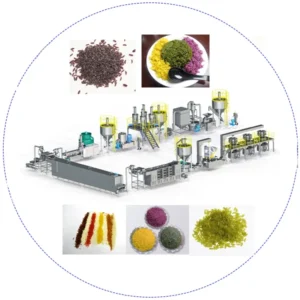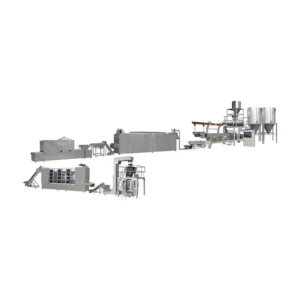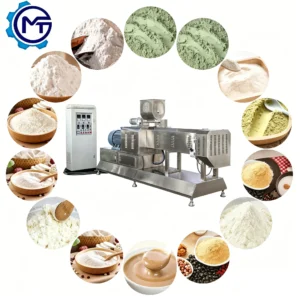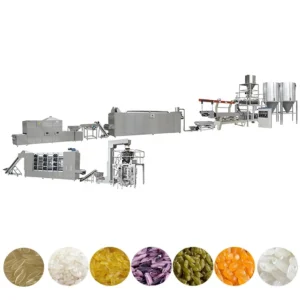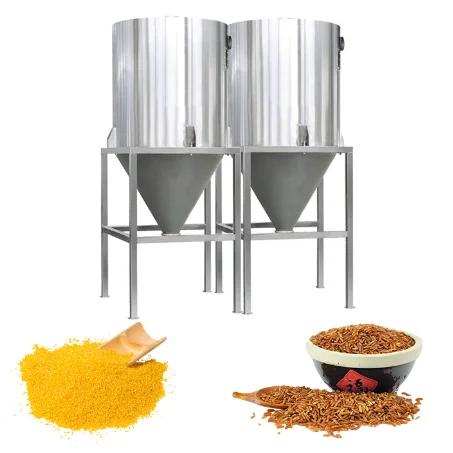
Balanced Throughput Across Every Station — Each extruder, dryer, and cooling unit in the line is capacity-matched to your raw material formulation, preventing bottlenecks that stall output before the packing station.
Technical Specifications
| Parameter | Value |
|---|---|
| Model | MT65 / MT70 / MT85 / MT75 / MT95 |
| Product Type | Fortified Rice Extruder Production Line |
| Screw Type | Twin Screw |
| Installed Power | 85 kW (MT65) / 120 kW (MT70) / 235 kW (MT85) / 180 kW (MT75) / 260 kW (MT95) |
| Power Consumption | 60 kW (MT65) / 85 kW (MT70) / 165 kW (MT85) / 135 kW (MT75) / 195 kW (MT95) |
| Output Capacity | 80–100 kg/h (MT65) / 100–120 kg/h (MT70) / 200–300 kg/h (MT85) / 300–500 kg/h (MT75) / 800–1000 kg/h (MT95) (basis not stated in source — confirm raw material formulation and moisture content) |
| Overall Dimensions (L×W×H) | 28×1.2×2.2 m (MT65) / 30×1.5×2.2 m (MT70) / 34×3.5×4.3 m (MT85) / 32×3.5×4.3 m (MT75) / 36×3.5×4.3 m (MT95) |
| Control System | PLC with frequency speed controlling |
| Line Stations | Mixing, Extruding, Vibrating, Low Temperature Drying, Cooling, High Temperature Roasting, Cooling, Packing |
| Heating Source (Dryer) | Electric or Gas |
| Screw Material | Wear-resistant alloy with special grinding treatment |
| Lubrication | Automatic lubricating and cooling system |
| Feeding System | Single or double screw feeding (matched to material characteristics) |
Application Suitability
| Application | Material or Output |
|---|---|
| Nutritional rice fortification programmes | Broken rice and rice bran blended with vitamin and mineral premix |
| Artificial rice kernel manufacturing | Corn, millet, wheat, oats, and buckwheat with micro-nutrient incorporation |
| Instant rice processing | Starch-based formulations with bean and cereal blends |
| Food aid and institutional supply | Fortified rice kernels meeting programme-specific nutritional specifications |
Why the Dryer Capacity Matters More Than the Extruder Rating
A fortified rice extruder production line rated only at the extruder will stall at the drying stage when actual moisture loads exceed the dryer’s design envelope.
I watched a nutrition programme line shut down twice daily because the dryer could not keep pace with the extruder output on a vitamin-enriched formulation. The extruder pushed product through at full rate, but the high-moisture premix required longer residence time in the drying chambers than the original specification allowed. The buyer ended up replacing the entire drying section within six months. That kind of mismatch rarely appears in brochure comparisons [NEED_CITE: throughput balancing methodology for extrusion lines]. The problem surfaces only when actual raw material — with its specific moisture content and additive load — runs through the complete sequence.
Extruder and Feeding System Selection by Formulation
The fortified rice extruder production line offers single or double screw feeding, and the choice depends on how uniformly your premix blends before entering the barrel. A double screw feeder handles formulations where vitamin and mineral particles tend to segregate from the base grain flour, maintaining a consistent feed rate that protects product density. The twin-screw extrusion section itself uses an automatic lubricating and cooling system to sustain stable barrel temperatures across long production runs, which is essential when heat-sensitive nutrients are part of the formulation.
How Drying and Roasting Stages Protect Kernel Integrity
Low temperature drying removes surface and internal moisture gradually so the fortified kernels do not crack or lose their shape before reaching the roasting stage. The high temperature roasting step that follows develops the final texture and colour that consumers associate with quality rice. Both stages use frequency-controlled drives, allowing operators to adjust belt speed and air flow in response to seasonal humidity changes or shifts in the raw material blend [NEED_CITE: cereal drying kinetics for fortified grain products]. This two-stage thermal sequence is where many lines lose product integrity, and it is where capacity matching between stations pays off most visibly.
Reading the Specification Sheet Beyond Installed Power
The installed power figures — ranging from 85 kW on the MT65 to 260 kW on the MT95 — indicate motor and heater capacity, but actual power consumption sits noticeably lower during steady-state operation. The gap between installed and consumed power reflects the thermal headroom available when a formulation demands higher barrel temperatures or longer drying cycles. The PLC control system with frequency speed governing lets operators fine-tune screw speed, feeder rate, and dryer belt speed from a single interface, keeping batch-to-batch variance within acceptable limits. Wear-resistant alloy screws with special grinding treatment extend service intervals, which matters when abrasive mineral premixes accelerate barrel wear compared to plain starch extrusion.
What Happens When Stations Are Sourced Separately
Buyers who assemble a line from separate vendors often discover that the dryer, cooler, and packing station each arrive with their own control logic, none of which communicates with the extruder PLC. The result is manual speed adjustment at every transfer point, with operators guessing at belt rates until product pile-ups or starvation force a correction. Throughput drops, and the rated capacity on paper never materialises on the floor [NEED_CITE: integration challenges in multi-vendor food processing lines]. Matching every station under one supplier eliminates that friction because the frequency drives and control language are configured as a single system before the line ships.
Why Buyers Specify This Range
Capacity matching across mixing, extrusion, drying, cooling, roasting, and packing stations means no single section constrains the others when running fortified formulations. Screw configuration and die design are specified to your raw material blend rather than copied from a generic build, protecting kernel density and shape. The in-house testing workshop runs your actual premix before the line leaves the factory, catching moisture and viscosity issues before they reach your floor. Twin-screw expertise across nutritional powder and grain-based applications means the engineering team has encountered the segregation and gelatinisation challenges specific to vitamin-enriched rice. Pre-sales layout planning covers utility routing, floor loading, and phased installation so commissioning starts from a known baseline.
Documentation & Verification
- Line layout and capacity calculation covering every station from mixer to packer
- Screw and die configuration record matched to your grain and premix blend
- Electrical schematic with voltage and frequency confirmed for your destination market
- Trial run report on your actual raw material before shipment approval
- Operation and maintenance manual with wear parts list and replacement intervals
- CE declaration of conformity and ISO certificate on file
Installation, Commissioning & Support
- Floor plan accounts for the longest configuration at 36 m length and 4.3 m height clearance
- Power supply sized to the selected model’s installed power with dedicated circuit breaker
- Line arrives in modular sections with labelled connections for on-site assembly
- PLC parameters pre-loaded with your trial run data, then verified during commissioning
- Operator training covers frequency drive adjustment for different grain and premix ratios
- Wear parts list identifies screw segments, dies, and feeder screws with reorder codes
Before You Request a Quote
Share your base grain type, the vitamin and mineral premix ratio, and the target moisture content of the finished kernel. Confirm your workshop voltage, frequency, and preferred control language so the electrical package is built correctly from the start. If you have existing upstream milling or downstream packing equipment, provide the interface specifications so the line integrates without modification.
Frequently Asked Questions
Q: How is output capacity verified, and what raw material formulation is it based on?
A: Published capacity figures for each model are reference ranges that must be confirmed against your specific grain blend, premix ratio, and moisture content. A trial run on your actual raw material in the testing workshop generates real throughput data before the quotation is finalised.
Q: How are the dryer and cooling stations matched to the extruder?
A: Each station’s belt width, air volume, and residence time are calculated from the extruder’s output rate and the moisture load of your formulation. Frequency-controlled drives on both dryer and cooler allow fine adjustment so no station becomes a bottleneck during production.
Q: What screw configuration is specified for fortified rice versus instant rice?
A: Fortified rice with mineral premixes typically requires a screw profile that manages higher abrasion and different gelatinisation behaviour compared to plain instant rice. The die design is also adjusted to produce the target kernel density and shape for each product type.
Q: Which supporting stations are included, and can individual stations be sourced?
A: The standard line includes mixing, extruding, vibrating, low temperature drying, cooling, high temperature roasting, a second cooling stage, and packing. Individual stations can be supplied separately when integrating with existing equipment, provided throughput and control compatibility are confirmed.
Q: How are voltage and control language confirmed before production?
A: The electrical schematic is reviewed with the buyer during the specification confirmation stage, covering voltage, frequency, plug type, and PLC language. This is locked in before production begins to avoid commissioning delays at the destination site.