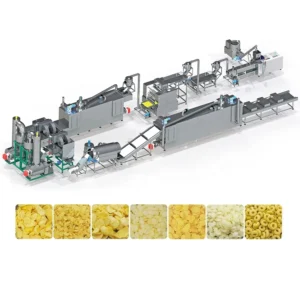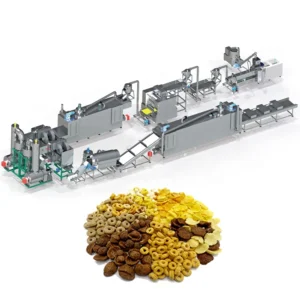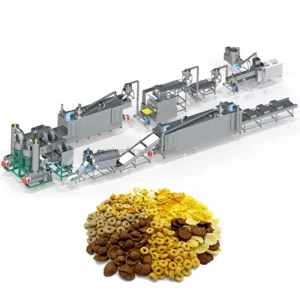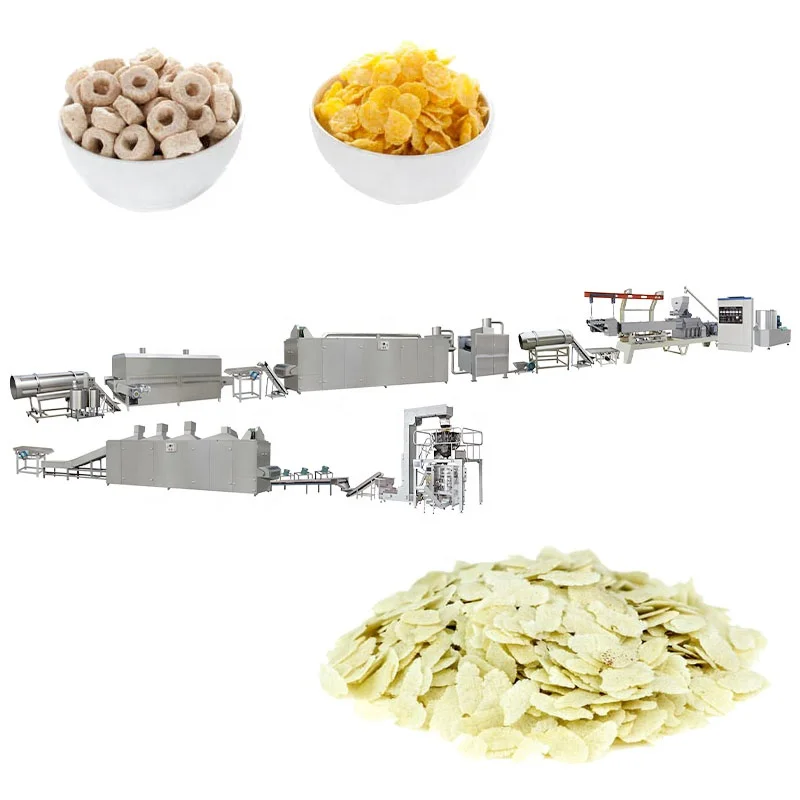
Single-Source Line Matching — every station from mixing to packing is engineered under one roof, so extruder output never outpaces the flaker or roaster downstream.
Technical Specifications
| Parameter | Value |
|---|---|
| Product Type | Corn Flakes Production Line |
| Models Available | MT70, MT85, MT75 |
| Extruder Type | Twin Screw |
| MT70 Installed Power | 160 kW |
| MT70 Power Consumption | 120 kW |
| MT70 Capacity | 150–200 kg/h (basis not stated in source — confirm raw material and moisture content) |
| MT70 Overall Dimensions | 41 × 1.5 × 2.2 m |
| MT85 Installed Power | 190 kW |
| MT85 Power Consumption | 140 kW |
| MT85 Capacity | 300–400 kg/h (basis not stated in source — confirm raw material and moisture content) |
| MT85 Overall Dimensions | 43 × 1.5 × 3.2 m |
| MT75 Installed Power | 210 kW |
| MT75 Power Consumption | 150 kW |
| MT75 Capacity | 300–500 kg/h (basis not stated in source — confirm raw material and moisture content) |
| MT75 Overall Dimensions | 45 × 1.5 × 3.5 m |
| Dryer Heating Source | Gas, Electric |
| Flaking Machinery Capacity | 200–300 kg/h (basis not stated in source — confirm raw material and moisture content) |
| Flaking Machinery Drive | Dual-motor separate roller drive with hydraulic system |
| Control System | PLC |
| Basic Materials | Corn, rice, wheat, oat, barley powder |
| Final Products | Natural corn flakes, coated corn flakes, various shapes (ball, tube, stick, ring, fruit loop, star, wheel, flower, heart) |
| Line Stations | Mixing → Extruding → Flaking → Drying → Hot Air Roasting → Sugar Coating → Drying → Cooling → Packing |
| Standards | CE, ISO |
Application Suitability
| Application | Material or Output |
|---|---|
| Natural breakfast corn flakes | Corn grits and corn flour |
| Sugar-coated cereal flakes | Corn, wheat, or oat base with sugar glaze |
| Multi-grain flaked cereals | Blends of rice, barley, oat, and wheat powder |
| Shaped breakfast cereal pieces | Corn or rice dough formed through interchangeable die plates (ring, star, heart, wheel) |
| Pilot-scale cereal product development | Small-batch trials on customer-supplied raw material before line commitment |
What a Corn Flakes Machine Full Equipment Range Should Actually Cover
A line is only as fast as its slowest station, and most bottlenecks are invisible until the machines are bolted to the floor.
I worked on a corn flakes line hand-assembled from three different vendors. The extruder pushed material faster than the flaker could press it, so half-cooked grits piled up on the conveyor and had to be scraped off by hand every twenty minutes. The roaster was undersized for the dryer’s output, meaning flakes sat in a holding bin losing crispness before they ever reached the oven. These mismatches are the reason a corn flakes machine full equipment range must be specified as a single throughput-matched system, not a shopping list of standalone units. When the mixing batch size, extruder screw speed, flaking roller gap, dryer belt length, and roaster residence time are all calculated against the same raw material and target moisture, the line runs continuously instead of cycling through start-stop interruptions [NEED_CITE: throughput matching principles in continuous food processing lines].
Every Station, One Throughput Calculation
A breakfast cereal line moves material through nine distinct stages: mixing, extruding, flaking, drying, hot air roasting, sugar spraying or coating, a second drying pass, cooling, and packing. Each stage has its own residence time and throughput ceiling. If the extruder delivers 400 kg/h but the flaking machinery is rated for a lower figure on the same dough consistency, material accumulates between stations. The corn flakes machine full equipment range presented here specifies each station against a shared capacity target so that no single machine forces the entire line to idle.
Why Twin-Screw Extrusion Matters for Flake Consistency
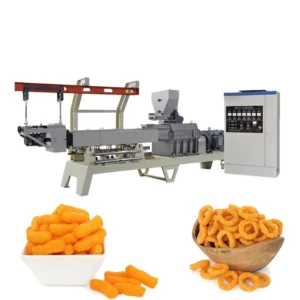
The MT-series extruders in this range use a twin-screw configuration with automatic lubrication and cooling circuits. Twin-screw geometry generates higher shear across a shorter barrel length compared to single-screw designs, which means starch gelatinisation happens more uniformly when processing corn, wheat, or oat blends. Uniform gelatinisation is critical because partially cooked dough flakes will crack during roasting instead of developing the surface blistering that consumers associate with quality corn flakes. The screw elements are manufactured with wear-resistant treatment to maintain tight clearance over extended production runs [NEED_CITE: twin-screw extrusion shear and gelatinisation behaviour in cereal processing].
How Roller Hydraulics and Infrared Sensing Control Flake Density
The flaking machinery uses a hydraulic system to set pressure across double rollers, with each roller driven by its own motor. Separate drives prevent speed differential tearing, which is a common cause of uneven flake thickness. An infrared sensor monitors roller surface temperature in real time, because if one roller runs hotter than the other, the dough sticks to the warmer side and produces ragged edges. Consistent flake thickness directly affects the downstream roasting stage — thicker flakes need longer oven residence, and a mixed batch means some flakes burn while others remain under-roasted. PLC control ties roller gap, pressure, and temperature into a single recipe that operators can recall for each product variant.
The Hot Air Roasting Oven Is Where Texture Is Made
Surface blistering — those small bubbles on a corn flake that give it a crisp bite — happens in the roasting oven, not in the extruder. The oven in this line uses a conciliation burner in the combustion chamber, two separate circulating fans, and a cyclone dust removal device. Dual fans create cross-flow air circulation that reaches flakes on every part of the vibrating pan, while the cyclone pulls fine particulate out of the air stream so it does not settle back onto the product. This matters for food safety and for visual consistency, because scorched dust deposits show up as dark specks on light-coloured flakes.
Specifying the Dryer to Match Extruder Moisture Drop
The extruder adds moisture through steam injection and liquid feed, and the dough exits the die at a moisture content far too high for flaking. The dryer must reduce that moisture to a narrow window before the dough reaches the rollers — too wet and it smears, too dry and it shatters. Available heating sources include gas and electric, and the choice affects both operating cost and temperature ramp-up speed. Gas-heated dryers recover temperature faster after a door opening or belt stop, which matters on lines that run multiple short batches per shift.
What Happens When Downstream Capacity Is Ignored
I visited a plant where the sugar coating drum was sized for half the extruder’s output. Every hour, coated flakes queued in an open bin while the drum caught up, absorbing ambient humidity and turning sticky. The packing station downstream then had to reject clumped product. This kind of mismatch is invisible on a quotation that lists each machine separately. The corn flakes machine full equipment range approach calculates coating drum volume, tumble speed, and spray nozzle flow rate against the same hourly throughput used to size the extruder and roaster [NEED_CITE: post-extrusion coating capacity alignment in cereal manufacturing].
Why the Equipment Range Is Sourced Under One Manufacturer
Sourcing every station from a single manufacturer means the line layout drawing accounts for conveyor heights, transfer chutes, and utility drop points between machines before any steel is cut. The extruder discharge height matches the flaker infeed. The dryer belt width matches the roaster pan width. Electrical schematics share a common PLC network so that a fault at any station pauses the entire line in sequence rather than dumping material onto a stopped conveyor. Pre-shipment testing in the factory’s machine testing workshop runs your actual raw material through the complete sequence, producing a trial run report that confirms flake density, blister formation, and coating adhesion before the line leaves the floor.
Documentation & Verification
- Line layout drawing with matched throughput for every station on your corn flakes line
- Machine specification sheet per station with electrical schematic and voltage confirmation
- Screw and die configuration record matched to your corn, wheat, or oat raw material
- Trial run report on customer-supplied raw material confirming flake density and blister quality
- CE declaration of conformity and ISO certificate for the complete line
- Wear parts list covering screws, dies, roller surfaces, and spray nozzles
Installation, Commissioning & Support
- Foundation plan showing load points for the 45 m maximum line length across MT75 configuration
- Dedicated electrical circuit planning for up to 210 kW installed power on the MT75 extruder
- PLC program loaded with your target language and local voltage and frequency parameters before shipment
- First-run commissioning with screw speed, roller gap, and oven temperature set to your raw material
- Operator training covering die changes for shape variants from ring to star to heart
- Scheduled spare parts supply for twin-screw elements, hydraulic roller seals, and infrared sensors
How to Scope Your Corn Flakes Line
Tell us the raw material you will run — corn, wheat, oat, or a blend — along with the moisture content your supplier typically delivers. Share your target daily output and the shift pattern you plan to operate. Confirm your facility’s voltage, frequency, and the control language your operators need. If you are adding coating or shape-change capability to an existing extrusion setup, specify which stations you need and the throughput of your current extruder so downstream equipment can be matched.
Frequently Asked Questions
Q: How is capacity verified across each station, and what premise applies to the stated kg/h figures?
A: The capacity figures for each model — MT70, MT85, and MT75 — are listed without a confirmed raw material or moisture basis in the source data. Before quotation, we run your actual corn, wheat, or oat material through the testing workshop and document the achievable throughput at your specific moisture content, so the final line specification carries a verified capacity tied to your raw material.
Q: Which extruder model matches my production target, and how do downstream stations align?
A: Model selection depends on your target hourly output and the raw material you process. Once the extruder is chosen, the flaker, dryer, roaster, and coating drum are each sized to match that throughput on your material. The line layout document shows the matched capacity at every station so no single machine creates a bottleneck.
Q: What voltage, frequency, and control language options are confirmed before shipment?
A: Electrical specifications are confirmed during the quotation stage and written into the machine specification sheet. The PLC is programmed with your local voltage, frequency, and operator language before the line leaves the factory. The trial run in the testing workshop validates that all control parameters function correctly under your confirmed electrical configuration.
Q: Can individual stations like the flaker or roaster be ordered separately?
A: Yes. Individual stations — flaking machinery, hot air roasting oven, coating drum, or dryer — can be supplied to integrate with existing extrusion equipment. We need the throughput and discharge height of your current extruder to ensure the new station matches mechanically and through the PLC control network.
Q: What does the complete equipment list include from mixing through packing?
A: The full line covers mixing, twin-screw extruding, flaking, drying, hot air roasting, sugar spraying or coating, a second drying stage, cooling, and packing. Each station is specified with its own power rating, dimensions, and capacity, and all stations share a unified PLC control architecture for coordinated start-up, fault response, and recipe management.