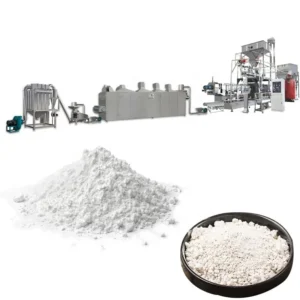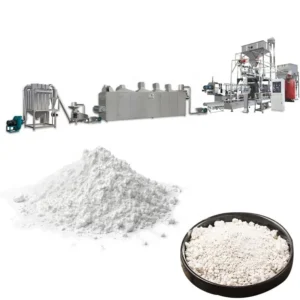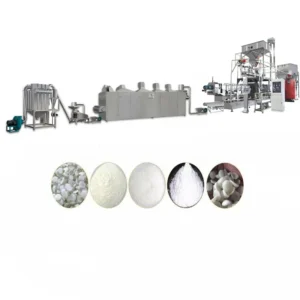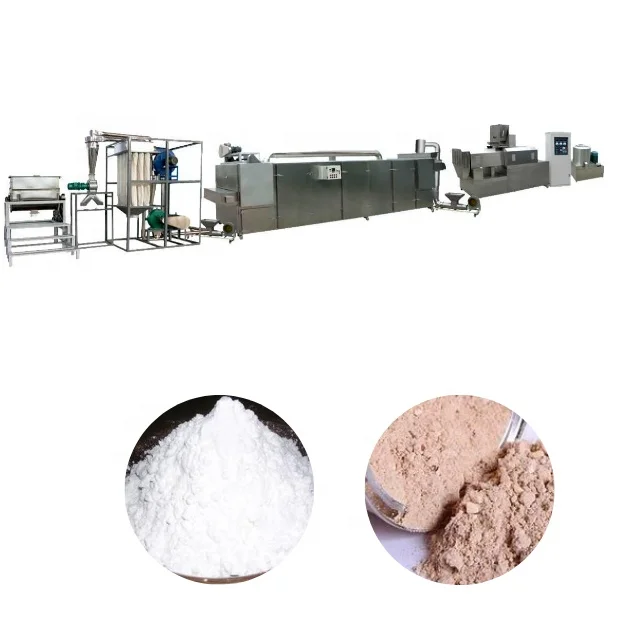
Matched Throughput Stations — every cooler, grinder and extruder in the line is sized to the same hourly target so starch output holds steady without upstream or downstream bottlenecks.
Technical Specifications
| Parameter | Value |
|---|---|
| Product Type | Modified Starch Extrusion Processing Line |
| Extruder Type | Twin-screw |
| Control System | PLC and MCC |
| Rated Power | 45–200 kW (basis to be confirmed per line configuration) |
| Output Capacity | 100–1500 kg/h (basis not stated in source — confirm raw material, moisture content, and target starch type) |
| Voltage & Frequency | 220–440 V, tri-phase (basis to be confirmed for 50 Hz / 60 Hz availability) |
| Net Weight | 1000–5000 kg (basis to be confirmed against specific line configuration) |
| Screw Configuration | Matched to raw material and target product |
| Raw Materials Supported | Corn starch, wheat flour, rice flour, soybean flour, potato starch, additive materials |
| Line Stations | Mixer → Twin-screw extruder → Cooling conveyor → Pulse grinder → Packing (available via partner supplier) |
| Cooling Conveyor | Low-power fan with wind-knife blowing mouth, ambient-temperature air drying |
| Pulse Grinder | Auger feeder with speed control, rotor/stator, classifier, cyclone discharge, dust collector |
| Assembly State | Complete line with supporting equipment |
| Standards | CE certified, ISO certified |
Application Suitability
| Application | Material or Output |
|---|---|
| Food additive starch manufacturing | Corn starch, potato starch, wheat flour with functional modification |
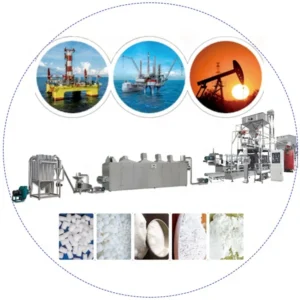
| Oil drilling industry starch processing | Modified starch blends for fluid-loss control additives |
| Paper making industry starch | Cationic and oxidised starch from corn and wheat sources |
| Nutritional grain-based powder processing | Rice flour, corn flour, soybean flour blends for instant porridge and infant formula base |
| Industrial adhesive and binder starch | Pregelatinised starch from tapioca and corn for corrugated board and textile sizing |
Why "Rated Capacity" Means Nothing Without Raw Material Context
A modified starch processing line full equipment range only delivers its nameplate output when the screw profile, barrel zones and downstream cooling match the buyer’s actual starch source and moisture level.
I watched a food additive producer lose an entire shift because their corn starch batch ran higher in protein than the trial material. The gelatinisation degree never reached spec, and output dropped noticeably. The extruder was rated for a certain throughput, but that rating assumed a standard corn starch profile at a defined moisture content. [NEED_CITE: starch gelatinisation temperature variation by protein content and moisture level]. When buyers specify a modified starch processing line full equipment range based on a brochure number alone, the gap between catalog performance and workshop reality shows up on the first production day.
Station Sequencing From Batch Infeed to Final Powder
The modified starch processing line full equipment range begins at the mixer, where raw starch and additive materials are blended to a uniform moisture target before entering the twin-screw extruder. The extruder applies controlled shear and heat across its barrel zones, driving gelatinisation and molecular modification in a single continuous pass. Screw configuration is selected around the specific starch source — corn, wheat, rice, potato or soybean — because each raw material responds differently to shear and residence time.
Matching Cooler and Grinder to Extruder Discharge
Once the extrudate leaves the die, the cooling conveyor uses ambient-temperature wind-knife air to bring the strand down to a safe handling temperature without case-hardening the surface. This step protects starch colour and prevents moisture trapping that would later cause clumping in the grinder. The pulse grinder then reduces the cooled strand to a fine powder through a speed-controlled auger feeder, rotor-stator impact and an integrated classifier. Cyclone discharge with a rotary valve keeps powder flow steady, while filter-pocket dust collection holds fines inside the circuit rather than letting them escape into the workshop. [NEED_CITE: dust collection standards for starch powder processing environments].
Reading the Specs That Actually Matter
Twin-screw extrusion gives operators independent control over shear intensity and residence time, which directly governs the degree of starch modification — whether the target is pregelatinisation, cross-linking or partial dextrinisation. Barrel temperature zones work with screw element spacing to manage moisture flash-off; too aggressive a profile scorches the starch, too gentle a profile leaves uncooked cores that fail viscosity tests downstream. The PLC and MCC control system records temperature and screw-speed set points for each production run, making batch-to-batch repeatability a matter of reloading a saved recipe rather than relying on operator memory. Voltage availability across 220–440 V tri-phase means the same line can be wired for 50 Hz or 60 Hz markets, but the motor winding and heater ratings must be confirmed before the control cabinet is built. Net weight across the 1000–5000 kg range shifts depending on whether the packing station and auxiliary conveyors are included, so foundation loading should be calculated after the final station list is locked.
The Cost of Skipping the Station-Match Calculation
When the cooling conveyor is undersized relative to extruder output, starch strands enter the grinder still warm and tacky, clogging the classifier screen and forcing unplanned stops. Operators then slow the extruder to let the cooler catch up, and the line runs below its intended throughput for every remaining hour of the shift. [NEED_CITE: thermal management in starch extrusion downstream equipment]. An undersized dust collector lets fine powder accumulate on motor housings and control panels, raising maintenance frequency and creating an ignition-risk layer in a combustible-dust environment. Mismatched throughput between stations is rarely visible in a single-machine quote — it only appears once the whole line is running under load.
Why Buyers Source the Full Range Here
Every station — mixer, extruder, cooler, grinder, and optional packing interface — comes from one supplier, so throughput calculations are cross-checked before the line ships rather than discovered during commissioning. Screw configuration and die design are specified to the buyer’s actual starch source and target modification level, not copied from a generic build. The in-house testing workshop runs customer-supplied raw material before dispatch, catching protein or moisture deviations while adjustments still cost hours instead of weeks. PLC and MCC panels are built with the target market’s voltage and frequency in mind, eliminating on-site rewiring delays. Pre-sales layout drawings show utility drops and station spacing, so foundation work and cable routing proceed without waiting for machine arrival.
Documentation & Verification
- Line layout drawing confirming station spacing and utility drops for your modified starch configuration
- Screw and die configuration record matched to your starch source and target gelatinisation degree
- Electrical schematic listing motor ratings, heater loads and confirmed voltage-frequency combination
- Factory test record on your raw material batch showing throughput and product quality data
- CE declaration of conformity covering the complete assembled line
- Operation and maintenance manual with station-by-station lubrication and inspection intervals
Installation, Commissioning & Support
- Foundation plan showing load points for twin-screw extruder and pulse grinder based on confirmed line weight
- Dedicated circuit sizing for 45–200 kW total load with separate breaker for cooling conveyor fan motors
- Station modules shipped in bolted assemblies for re-alignment on your workshop floor
- First-run parameter logging through PLC to establish baseline temperature and screw-speed recipe
- Operator training covering auger feeder speed adjustment and classifier screen change on the pulse grinder
- Wear parts list specifying screw elements, die plates and grinder rotor clearance intervals
What to Include With Your Inquiry
Send the specific starch source and any additive ratios you plan to run, along with the target modification type — pregelatinised, oxidised, cross-linked or other. Confirm your local voltage and frequency, the control-panel language preference, and whether your workshop ceiling height can accommodate the cyclone and dust collector stack. If you already have upstream batching or downstream packing equipment, share the interface dimensions so the line layout accounts for existing conveyors and hoppers.
Frequently Asked Questions
Q: How is the 100–1500 kg/h capacity range determined for this line?
A: The range reflects different raw materials and moisture levels across starch sources. Corn starch at standard moisture may reach the upper band, while potato starch or high-protein wheat flour typically yields lower throughput. Exact capacity is confirmed during the trial run on your specific material before shipment.
Q: Which stations are included and how is throughput matched?
A: The line covers mixer, twin-screw extruder, cooling conveyor and pulse grinder as standard, with packing available through a partner supplier. Each station’s rated handling rate is calculated against the extruder’s confirmed output so that no single unit bottlenecks the others.
Q: What voltage and frequency configurations are available?
A: The line supports 220–440 V tri-phase supply. Frequency — 50 Hz or 60 Hz — must be confirmed before the motor and heater specifications are locked in, because winding and resistance values differ between the two standards.
Q: How is the screw and die configuration selected for different starch sources?
A: Screw element spacing, kneading block angle and die aperture are chosen based on the gelatinisation temperature, amylose content and particle size of the raw starch. A trial run on your material validates the configuration before the line leaves the workshop.
Q: What supporting equipment completes the line from a single supplier?
A: Mixing and batching systems, conveying equipment and the cooling conveyor are supplied directly. The pulse grinder and dust collector are integrated into the line scope. Packing machines are available through a verified partner supplier and can be included in the same shipment.