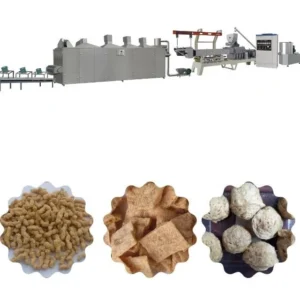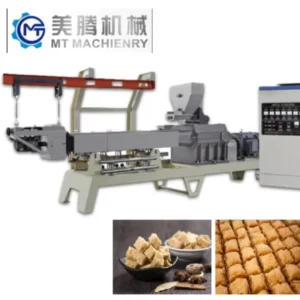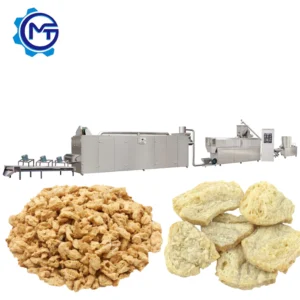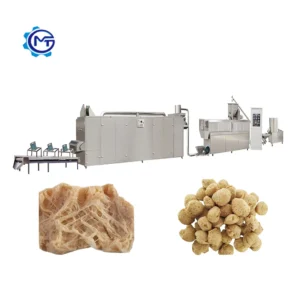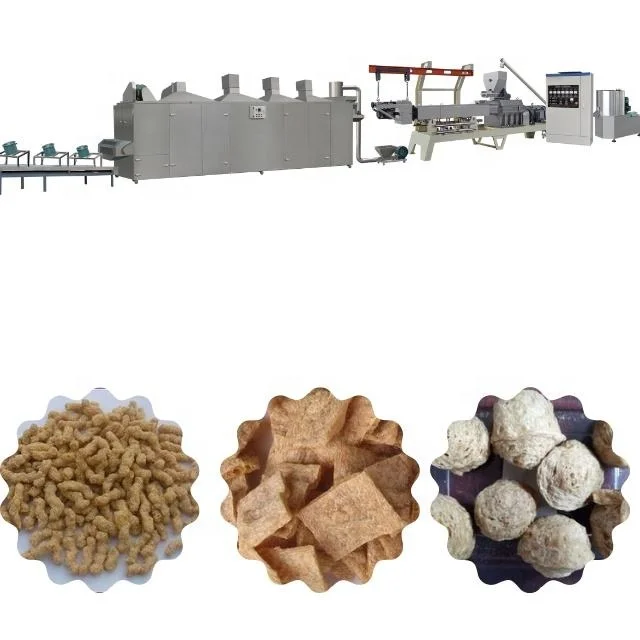
Throughput matched at every station — mixers, extruders, dryers, and coolers are specified together so no single unit chokes the Textured Soy Protein Production Line output.
Technical Specifications
| Parameter | Value |
|---|---|
| Product Type | Textured Soy Protein Production Line |
| Extruder Models Available | MT65 / MT70 / MT85 |
| Screw Type | Twin-screw (Double Screw Extruder) |
| MT65 Installed Power | 85 kW |
| MT65 Real Power | 65 kW |
| MT65 Output | 150-200 kg/h (basis not stated in source — confirm raw material formulation and moisture content) |
| MT65 Dimension | 18000 × 1300 × 2300 mm |
| MT70 Installed Power | 120 kW |
| MT70 Real Power | 90 kW |
| MT70 Output | 200-300 kg/h (basis not stated in source — confirm raw material formulation and moisture content) |
| MT70 Dimension | 20000 × 1500 × 2400 mm |
| MT85 Installed Power | 195 kW |
| MT85 Real Power | 165 kW |
| MT85 Output | 600-800 kg/h (basis not stated in source — confirm raw material formulation and moisture content) |
| MT85 Dimension | 24000 × 3500 × 4300 mm |
| Powder Mixer Tank Volume | 150 kg |
| Powder Mixer Mixing Time | 10 min per batch |
| Powder Mixer Rotary Speed | 385 rpm |
| Powder Mixer Power | 4 kW |
| High-temperature Roaster Effective Belt Length | 3.5 m |
| High-temperature Roaster Far Infrared Heater Power | 3.9 kW × 24 |
| High-temperature Roaster Gas Consumption | 6.8 m³/h |
| High-temperature Roaster Dimension | 4500 × 1500 × 1600 mm |
| Line Stations | Mixing → Conveying → Extrusion → Conveying → Drying → Cooling → Packing |
| Construction Material | Stainless steel (food-grade contact parts) |
| Control System | Available with PLC or MCC control |
| Voltage and Frequency | Configurable to site requirements |
| Warranty | 1 year complete warranty, life-time maintenance service |
Application Suitability
| Application | Material or Output |
|---|---|
| Textured vegetable protein (TVP) for meat substitutes | Low-temperature soybean meal |
| Plant-based meat for sausages and ham alternatives | Soy protein isolate or concentrate blends |
| Vegetarian chunks for canned and fast food | Peanut meal formulations |
| Textured protein ingredient for quick-frozen foods | Soybean and cereal protein mixtures |
| Fortified protein additives for snack production | Blended plant protein with starch carriers |
Why Extruder Capacity Alone Misleads Buyers on a Textured Soy Protein Production Line
A rated output number means nothing if the dryer cannot keep up.
When sourcing a textured soy protein production line full equipment range, buyers often focus entirely on the extruder. The MT70 might show 200-300 kg/h on paper, but if the downstream roaster is sized for a lower throughput, product piles up wet and unprocessable. I saw this happen on a Southeast Asian project where the client specified their extruder first, then tried to add a dryer later — the moisture removal fell short, and fiber structure collapsed before packing. [NEED_CITE: throughput balancing principles in extrusion line design] Every station in this catalogue carries its own capacity rating so you can verify the match before committing to a layout.
Every Station Specified, Every Throughput Visible
This catalogue lays out the complete equipment sequence for a Textured Soy Protein Production Line — from the powder mixer through the twin-screw extruder, roaster, and cooling unit. Each station lists its own throughput range, motor power, and physical footprint. Buyers surveying equipment before specifying a full line can see exactly where material flows and where constraints might emerge. No station is left ambiguous.
Matching Mixer Cycles to Extruder Feed Rates
The powder mixer runs a 150 kg batch in a 10-minute cycle at 385 rpm. If the twin-screw extruder is set to consume material faster than the mixer can deliver consistent batches, operators end up feeding the extruder with incompletely blended material. The result is uneven fiber structure across a production run. The 4 kW mixer motor drives a rotary speed calibrated for soy and peanut meal viscosity. Matching these cycle times matters more than chasing the highest extruder speed number on a spec sheet. [NEED_CITE: batch mixing uniformity standards for protein extrusion]
Reading the Extruder Specs for Protein Applications
The three extruder models — MT65, MT70, MT85 — span distinct output bands and power envelopes. The MT65 draws 85 kW installed with 65 kW real power consumption, while the MT85 pulls 195 kW installed with 165 kW real. These are twin-screw configurations, meaning material experiences higher shear and longer residence time compared to single-screw designs. That matters for soy and peanut meal because the protein molecules need mechanical energy to align into fibrous structures. The screw configuration and die design should be specified to the buyer’s actual raw material formulation rather than copied from a generic build. Barrel temperature profiles across zones determine gelatinisation depth, and even small deviations in moisture content at the feed point shift the expansion and density of the final TVP chunks.
The Cost of Skipping Voltage Confirmation Before Production
Exporting a textured soy protein production line full equipment range without locking down voltage, frequency, and control language creates delays that no factory test can fix. A 380V machine arriving at a site wired for 440V will not simply run slower — the motor windings overheat and the PLC may fail to initialize. [NEED_CITE: industrial voltage mismatch consequences on extruder motors] I have seen commissioning stalled for weeks while step-down transformers were sourced locally, and operator panels displaying in the wrong language forced facilities to bring in translators for basic troubleshooting. Electrical schematics and voltage confirmation must be finalized before the machines enter production, not after they arrive at the dock.
Why Procurement from One Supplier Reduces Line Integration Risk
Every station in this textured soy protein production line comes from a single source, meaning throughput calculations are performed across the entire sequence rather than assembled from disconnected vendor quotes. Screw and die configuration is matched to your raw material and target product specification, not pulled from a standard template. The in-house testing workshop allows trial runs on your actual soybean meal or peanut meal formulation before any equipment ships. Documentation including the screw configuration record, trial run report, and factory test record travel with each delivery. Stainless steel construction covers all food-contact zones across mixers, extruders, dryers, and coolers for hygiene compliance. Pre-sales consultation through commissioning and ongoing maintenance are handled by the same engineering team that built the line.
Documentation & Verification
- Line layout and capacity calculation matched to your soy protein formulation and target output
- Screw and die configuration record specific to your raw material moisture and particle size
- Electrical schematic with voltage and frequency confirmation before production starts
- Trial run report on your soybean meal or peanut meal before shipment
- CE declaration of conformity and ISO certificate included with dispatch
- Factory test record with throughput verification at each station
Installation, Commissioning & Support
- Foundation planning accounts for MT85 footprint of 24000 × 3500 × 4300 mm and dynamic loads from twin-screw vibration
- Dedicated power circuits sized for MT70 real power draw of 90 kW with startup surge allowance
- Extruder arrives with screw and barrel pre-assembled; dryer belt tensioned on site
- First-run commissioning includes temperature profile calibration across all barrel zones
- Operator training covers mixer batch timing, extruder feed rate, and dryer belt speed coordination
- Spare screw elements, die plates, and dryer belts documented in wear parts list at delivery
Preparing Your Inquiry for a Textured Soy Protein Production Line
Share your raw material details including protein content, moisture percentage, and particle size distribution. Specify your target daily output and the physical form of the final TVP product — chunks, flakes, or granules. Include your site voltage, frequency, and preferred control language so electrical schematics are correct from the start. If you have existing upstream or downstream equipment, provide model and capacity details so integration points are planned early.
Frequently Asked Questions
Q: How is output capacity verified for my specific soybean meal formulation and moisture content?
A: Capacity figures listed for the MT65, MT70, and MT85 are reference ranges. Actual throughput depends on your raw material formulation, moisture content, and target product density. We run a trial in our testing workshop using your material sample to confirm real output and fiber structure before finalizing the line specification.
Q: Can each station be purchased individually or only as a complete line?
A: Individual stations — mixer, extruder, roaster, cooling machine — are available separately. However, throughput matching across stations is only guaranteed when the full line is configured together. We provide capacity calculations for each scenario so you can evaluate integration with existing equipment.
Q: What voltage, frequency, and control language options are available for each machine?
A: Voltage and frequency are configurable to your site electrical standard. Control system options include PLC or MCC, with operator interface language set to your preference. These parameters are confirmed via electrical schematic review before production begins.
Q: How do I match extruder throughput with dryer and cooler capacity to avoid bottlenecks?
A: Each station in the catalogue carries its own throughput rating. We calculate the material flow balance across all stations based on your target output and raw material characteristics. The roaster belt speed and effective belt length are matched to the extruder output so product moisture reaches target levels before cooling.