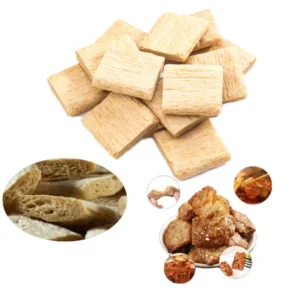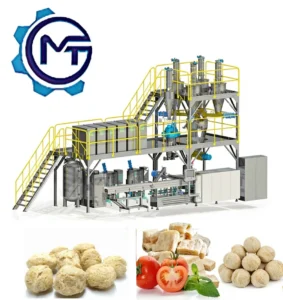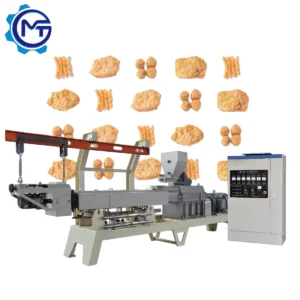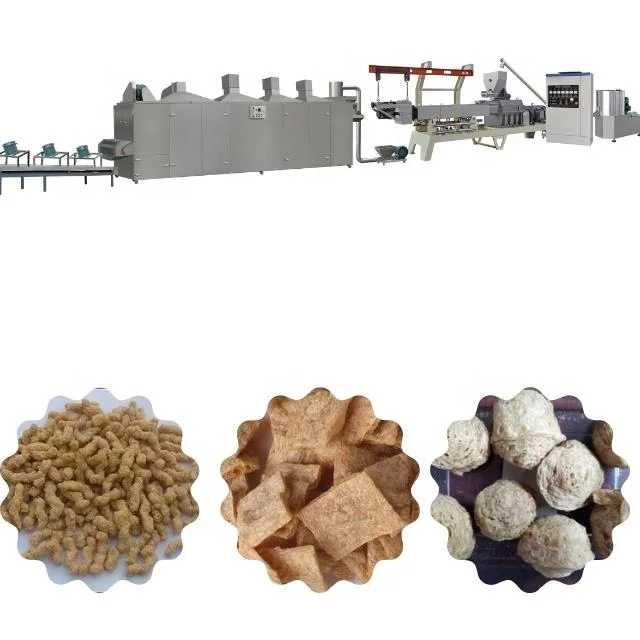
Complete Line Coverage — Every station from powder mixing through twin-screw extrusion, drying, cooling and packing is matched by design rather than assembled from separate vendors, preventing throughput mismatches that bottleneck plant-based meat output.
Technical Specifications
| Parameter | Value |
|---|---|
| Product Type | Twin-Screw Extrusion Line for Texturized Vegetable Protein (Plant-Based Meat) |
| Model Options | MT65 / MT70 / MT85 |
| Screw Type | Twin-screw |
| Installed Power | 85 kW (MT65) / 120 kW (MT70) / 195 kW (MT85) |
| Actual Power Consumption | 65 kW (MT65) / 90 kW (MT70) / 165 kW (MT85) |
| Output Capacity | 150–200 kg/h (MT65, basis not stated in source — confirm raw material formulation & moisture) / 200–300 kg/h (MT70, basis not stated in source) / 600–800 kg/h (MT85, basis not stated in source) |
| Overall Dimensions (L×W×H) | 18000×1300×2300 mm (MT65) / 20000×1500×2400 mm (MT70) / 24000×3500×4300 mm (MT85) |
| Mixer Output | 300–600 kg/h, 4 kW, 150 kg tank volume |
| Dryer Type | High-temperature roaster, far infrared + gas heating, 3.5 m effective belt length |
| Cooling Machine Output | 200–300 kg/h |
| Contact Material | Food-grade stainless steel |
| Control System | Available with PLC or MCC control (confirm before order) |
| Voltage & Frequency | Configurable to destination facility (confirm before commissioning) |
| Certification | CE |
| Warranty | 1 year complete; lifetime maintenance service |
Application Suitability
| Application | Material or Output |
|---|---|
| Texturized vegetable protein (TVP) production | Low-temperature soybean meal, defatted soy flour |
| Plant-based meat and vegetarian meat | Soybean meal and peanut meal blends converted into fibrous meat-like structures |
| Soybean tissue protein for ingredient use | Soy protein isolate and concentrate blends for ham, sausage and canned food formulations |
| Quick-frozen and fast-food protein components | Extruded fibrous protein chunks and strips for frozen meal assembly |
| Fortified protein food lines | Blends incorporating pea protein, wheat gluten or other plant proteins (recipe-dependent configuration) |
What "Nominal Capacity" Hides on a Plant Based Meat Processing Line
A line rated at a headline output will not hold that number on your actual protein blend unless screw geometry, die design, dryer belt length and cooler capacity are specified together against your recipe.
I once saw a buyer sign for a TVP line based on a quoted hourly figure, only to discover on commissioning that their pea-protein-heavy blend required different shear and moisture than the standard soybean meal the line was configured for. Four days of on-site adjustment followed before fiber alignment and density stabilized within their market specification [NEED_CITE: material-specific extrusion behavior for alternative protein blends]. When a plant based meat processing line is quoted on a single nominal number with no raw-material basis stated, the real risk is not the extruder itself — it is the downstream dryer or cooler that cannot keep pace, forcing the entire line to run below its nameplate rate.
How Twin-Screw Extrusion Builds Fibrous Protein Structure
The core mechanism of this plant based meat processing line relies on high temperature, high pressure and high shear inside the twin-screw barrel to open spherical protein molecules, stretch them into chains and reorganize them into a fibrous, meat-like matrix. Low-temperature soybean meal or peanut meal is ground, stirred and tempered before entering the extruder, where moisture and barrel temperature profile determine the degree of texturization. Screw configuration and die geometry are matched to the specific protein blend so that fiber length and bite density meet the target product specification.
Matching Every Station to Prevent Throughput Mismatches
A frequent failure point in TVP production is a dryer or cooler specified for a different output class than the extruder. The high-temperature roaster on this line uses far infrared and gas heating across a 3.5-meter effective belt length, sized to handle the moisture load exiting the die. The cooling station follows at a matched rate so that residual heat does not cause condensation inside packing [NEED_CITE: dryer sizing relative to extruder moisture output in TVP applications]. When any station in a plant based meat processing line is under-specced, operators are forced to slow the extruder to match the bottleneck, and the quoted capacity becomes theoretical.
Reading the Specification Sheet: Power, Dimensions and Process Control
Installed power across the three model tiers ranges from 85 kW to 195 kW, with actual consumption approximately 20–30 kW lower during steady-state operation — a difference driven by motor load factor during extrusion of high-protein blends. The line footprint stretches from 18 meters for the MT65 to 24 meters for the MT85, meaning workshop length and ceiling height must be confirmed before layout finalization. Twin-screw extrusion of plant protein demands precise moisture addition at the preconditioning stage; too little moisture under-extrudes and produces crumbly output, while excess moisture reduces shear and collapses fiber formation. The food-grade stainless steel contact surfaces resist the corrosive salts and organic acids present in soybean and peanut meals during prolonged runs.
The Hidden Cost of Generic Screw and Die Configurations
When screw elements and die plates are copied from a generic build rather than specified to the buyer’s actual protein blend, the first symptom is inconsistent fiber alignment — some chunks tear apart cleanly while others crumble or remain dense and rubbery. This variability is not solved by adjusting barrel temperature alone; the compression ratio and element stagger angle must match the rheology of the specific meal [NEED_CITE: screw element configuration impact on TVP fiber quality]. Operators spend days chasing stability, raw material waste accumulates, and the buyer’s downstream customers reject batches that fall outside texture specification.
Why Procurement Here Differs from Assembling Separate Stations
Each line is designed as a complete system where mixer volume, extruder throughput, dryer belt length and cooler capacity are calculated against one another, eliminating the station-level mismatch that plagues multi-vendor assemblies. Screw configuration and die design are specified to the buyer’s raw material and target fiber texture rather than pulled from a standard catalog. An in-house testing workshop runs trial production on the customer’s actual protein blend before shipment, so recipe adjustments happen at the factory, not on the buyer’s floor during commissioning. Pre-sales consultation extends through engineer-led layout design, on-site installation and operator training, with ongoing maintenance support backed by a one-year complete warranty. Documentation includes line layout drawings, capacity calculations and trial run reports tied to the buyer’s specific formulation.
Documentation & Verification
- Line layout and capacity calculation matched to your protein blend and target fiber density
- Screw and die configuration record specifying element geometry for your recipe
- Trial run report on your raw material produced in the testing workshop before shipment
- Electrical schematic and voltage confirmation document for your destination facility
- CE declaration of conformity covering the complete extrusion line
- Operation and maintenance manual with wear parts list for screws, dies and seals
Installation, Commissioning & Support
- Foundation and floor space confirmed against the 18–24 m line footprint and station clearances
- Dedicated electrical circuit sized for 85–195 kW installed load depending on model selection
- Assembled line stations delivered in sections with on-site mechanical and electrical joining
- First-run parameter setting including barrel temperature profile, screw speed and moisture addition rate
- Operator training on recipe changeover, die cleaning and screw element inspection intervals
- Wear parts inventory including replacement screw elements, die plates and barrel liners
Preparing Your Inquiry
To configure the right plant based meat processing line for your facility, share your protein blend composition — including soybean meal, pea protein or wheat gluten ratios — along with your target output in kg per hour. Confirm your workshop length, ceiling height and local voltage and frequency so that the electrical package and line layout match your building. If you require a trial run on your raw material before shipment, state this early so that testing workshop scheduling aligns with your project timeline.
Frequently Asked Questions
Q: How is the output capacity verified, and what raw material formulation is it based on?
A: The listed capacity ranges are model-tier references without a fixed raw-material basis stated in the source documentation. Actual output is verified through a trial run in our testing workshop using your specific protein blend, moisture level and target fiber density. We provide a capacity calculation sheet tied to your recipe before production begins.
Q: Can the screw configuration and die design be customized to our protein blend?
A: Yes. Screw element geometry, compression ratio and die plate aperture are specified to your exact formulation — whether soybean meal, peanut meal or a blend incorporating pea protein. A configuration record is generated for your line, and trial runs validate fiber alignment and density before the machine leaves our workshop.
Q: How do you ensure dryer and cooler capacity matches the extruder output?
A: Each station is calculated as part of the complete line rather than selected independently. The high-temperature roaster with its 3.5-meter belt and far infrared plus gas heating is sized to the moisture load from extrusion, and the cooling machine is matched to prevent downstream bottlenecks that would force extruder slowdown.
Q: Is a trial run on our raw material performed before shipment?
A: We run production trials on your actual protein blend in the in-house testing workshop. You may witness the trial in person or receive a detailed report including output rate, fiber texture, moisture content and product photographs. Any recipe or hardware adjustments are made before the line ships.
Q: What voltage, frequency and control language options are confirmed before production?
A: We confirm your facility’s voltage, frequency and preferred control language during the specification phase, before production begins. The electrical schematic and PLC or MCC configuration are documented and matched to your destination standards to avoid commissioning delays on arrival.