Screw Configuration Matched to Your Grain — Sectional 38CrMoAL screw modules are arranged to the buyer’s specific maize formulation and target flake density, not copied from a generic build.
Technical Specifications
| Parameter | Value |
|---|---|
| Product Type | Corn Flakes Production Line |
| Extruder Models Available | MT65 / MT70 / MT85 |
| Screw Type | Twin-screw, co-rotating, sectional modules |
| Screw Material | 38CrMoAL alloy, nitriding process |
| Motor | SIEMENS (China) |
| Inverter | Delta |
| Feeding System | Food-grade stainless steel twin-screw feeder, speed-adjusted |
| Gearbox | Automatic lubrication function |
| Cutting System | Knife fixed in die head seat, rotary cutting by V-belt drive |
| Control System | MCC control box (extruder, dryer, sugar spraying system) |
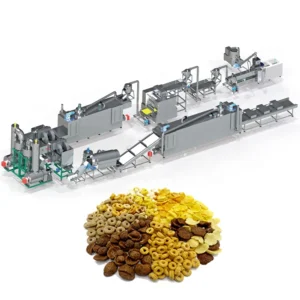
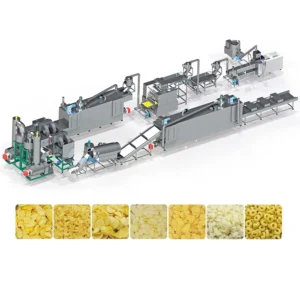
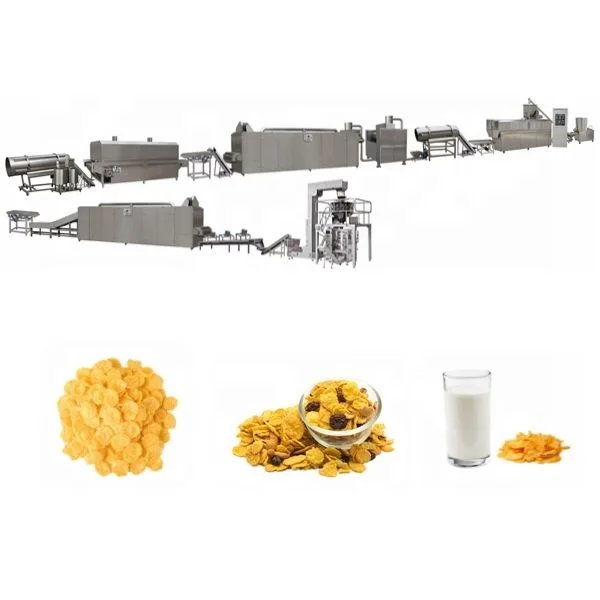
| Line Stations | Mixer → Screw Conveyor → Double Screw Extruder → Corn Flakes Press Machine → High-temperature Oven → Sugar Spraying System → Cooling Conveyor → Sifter → Packing Machine |
| Mixer Power | 4 kW |
| Mixer Tank Size | φ600 × 500 mm |
| Corn Flakes Press Machine Power | 16.12 kW |
| Corn Flakes Press Machine Roller | 510 × 310 × 1050 mm |
| Corn Flakes Press Machine Features | Adjustable roller distance for flake thickness; integrated cooling system |
| High-temperature Oven Size | 4.5 × 1.4 × 1.8 m |
| High-temperature Oven Power | 3.75 kW |
| High-temperature Oven Heat Source | Gas-fired, dual-side baking system |
| Sugar Spraying System Total Power | 28.75 kW |
| Sugar Spraying System Roller Size | Ø600 × 2700 mm |
| Dryer Type | Multilayer mesh dryer (electric or steam options) |
| Dryer Temperature Range | 0–200 °C |
| Dryer Configurations | 3-layer 5m / 5-layer 5m / 5-layer 7m / 5-layer 8m / 7-layer 8m / 5-layer 11m |
| MT65 Installed Power | 70 kW |
| MT65 Real Power | 40 kW |
| MT65 Output | 100–150 kg/h (basis not stated in source) |
| MT65 Dimension | 20000 × 1200 × 2200 mm |
| MT70 Installed Power | 100 kW |
| MT70 Real Power | 70 kW |
| MT70 Output | 200–240 kg/h (basis not stated in source) |
| MT70 Dimension | 25000 × 1500 × 2200 mm |
| MT85 Installed Power | 200 kW |
| MT85 Real Power | 150 kW |
| MT85 Output | 300–400 kg/h (basis not stated in source) |
| MT85 Dimension | 30000 × 3500 × 4300 mm |
| Contact Material | Food-grade stainless steel throughout product-contact zones |
| Certification | CE, ISO |
Application Suitability
| Application | Material or Output |
|---|---|
| Traditional corn flakes production | Maize grits and whole corn |
| Multigrain breakfast cereals | Rice, wheat, oat, and rye blends |
| Sugar-coated cereal variants | Corn flakes with sugar syrup coating |
| Salt-flavored savory cereals | Grain base with salt and spice seasoning |
| Fortified nutrition cereals | Grain blends with added vitamin and mineral premix |
Why Nominal Extruder Output Means Nothing Without Matching Every Downstream Station
A breakfast cereal corn flakes machine full equipment range is only as fast as its slowest station.
When a buyer quotes a line based solely on what the extruder claims to produce per hour, the dryer, flake press, or sugar spraying drum often turns out to be the real constraint. The result is an expensive extruder idling while downstream equipment catches up, or worse, product piling up between stations and degrading in quality. I have watched operators throttle back a perfectly capable twin-screw just to keep the oven from flooding with wet pellets. [NEED_CITE: throughput balancing across extrusion line stations]
Station-by-Station Equipment Breakdown
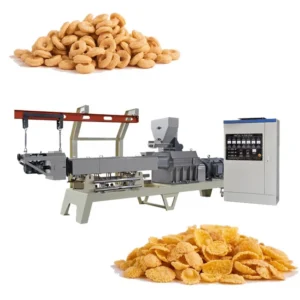
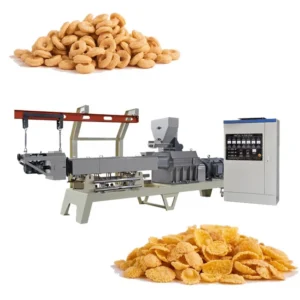
The breakfast cereal corn flakes machine full equipment range covers every stage from raw flour mixing through final packing. The mixer feeds a screw conveyor that delivers a consistent material flow into the twin-screw extruder, where sectional screw modules handle transport, mixing, cooking, and forming in a single pass. From the extruder die, cooked pellets move to the corn flakes press machine, where an adjustable roller gap determines final flake thickness, and an integrated cooling system prevents sticking.
Drying and Coating Sized to the Extruder
The multilayer mesh dryer is available in six configurations — from a compact 3-layer 5-meter unit to a 5-layer 11-meter system — each mapped to a specific extruder tier so residence time and moisture removal stay in balance. After drying, the sugar spraying system uses a Ø600 × 2700 mm coating roller to apply syrup evenly before the cooling conveyor sets the coating. Every station in this breakfast cereal corn flakes machine full equipment range is specified so that no single piece of equipment creates a bottleneck. [NEED_CITE: drying residence time requirements for breakfast cereal moisture targets]
Reading the Specs That Actually Matter
The twin-screw design with 38CrMoAL nitrided screw modules allows the screw profile to be rearranged as the buyer’s grain formulation changes — a forward-conveying section can be swapped for a mixing or de-gassing element without replacing the entire shaft. The corn flakes press machine features a 510 × 310 × 1050 mm roller set with adjustable gap, which directly controls whether the final flake shatters in the bowl or holds its shape in milk. Gas-fired dual-side baking in the high-temperature oven provides uniform heat distribution, critical when flake thickness varies across the belt width. The MCC control box ties together the extruder, dryer, and sugar spraying system into a single panel, reducing the chance of speed mismatch between operators at different stations.
The Cost of Undersizing the Sugar Spraying Drum
A common mistake is specifying the extruder and dryer correctly but leaving the coating drum undersized. When the sugar spraying system cannot keep pace, coated flakes sit too long in the drum, clumping together and blocking discharge chutes. The line stops, operators dig out hardened sugar buildup, and the shift output drops. This is not a problem with the recipe — it is a problem with station capacity planning that was never done. [NEED_CITE: sugar coating drum sizing relative to extruder throughput]
Why Source the Full Range From One Builder
Every station from the 4 kW mixer to the packing machine is designed under one roof, so throughput calculations are not guesses stitched together from different vendor data sheets. The screw configuration and die design are specified to the buyer’s actual raw material and target flake density before production begins. An in-house testing workshop runs trial batches on customer-supplied grain before shipment, so product development does not start from zero on the factory floor. Twin-screw expertise spans corn flakes, puffed cereals, and multigrain formats within the same equipment platform. Pre-sales engineering covers line layout, utility planning, and station-by-station capacity matching before any metal is cut.
Documentation & Verification
- Line layout and capacity calculation showing throughput matched across every station
- Screw and die configuration record specified to your grain formulation and target flake density
- Electrical schematic with voltage, frequency, and control language confirmed before production
- Trial run report on your raw material from the in-house testing workshop before shipment
- CE declaration of conformity and ISO certificate included with shipping documents
- Operation and maintenance manual with wear parts list for screws, dies, and press rollers
Installation, Commissioning & Support
- Foundation and floor space planning based on line dimensions up to 30,000 × 3500 × 4300 mm for the MT85 configuration
- Electrical load calculation covering installed power from 70 kW to 200 kW depending on extruder tier selected
- MCC control box commissioning with parameter setting for extruder speed, dryer temperature, and sugar spray timing in sequence
- Operator training covering screw module changes, roller gap adjustment on the press machine, and gas oven temperature zones
- Wear parts inventory including spare 38CrMoAL screw elements, die plates, and press roller bearings packed with the shipment
- Routine maintenance schedule for gearbox automatic lubrication, mesh belt tension, and coating drum nozzle cleaning
What to Prepare Before Requesting a Quote
To build an accurate line proposal, share your primary grain type and whether you plan to run multigrain blends, along with your target daily output and available workshop floor space. Confirm your local voltage and frequency so the MCC panel and motor drives are built to match, and specify whether your operators need the control interface in a particular language. If you already have upstream milling or downstream packing equipment, provide the make and model so the new stations can be matched to your existing flow.
Frequently Asked Questions
Q: How is throughput matched between the extruder, dryer, and sugar spraying system?
A: Each dryer configuration — from 3-layer 5m to 5-layer 11m — is paired with a specific extruder model based on moisture removal rate and residence time. The sugar spraying system roller diameter and drum length are then sized so coating speed does not fall behind drying output. The result is a line where no station forces the others to idle.
Q: What dryer heat source options are available?
A: The multilayer mesh dryer is available with electric heating elements or steam heat exchangers, and the high-temperature oven uses a gas-fired dual-side baking system. The choice depends on your plant’s existing utility infrastructure and local energy costs. Dryer temperature range covers 0–200 °C across all configurations.
Q: Can I order individual stations to upgrade my existing line?
A: Yes. The corn flakes press machine, sugar spraying system, and multilayer dryer can each be supplied separately and integrated into an existing line. Throughput compatibility is calculated based on your current extruder output so the new station does not create a bottleneck upstream or downstream.
Q: What utility requirements should I plan for across all stations?
A: Total installed power ranges from 70 kW for the MT65 line to 200 kW for the MT85 line. The gas-fired oven requires a dedicated gas supply line, and the sugar spraying system draws 28.75 kW. Compressed air is needed for pneumatic valves on the MCC panel. A complete utility load sheet is provided with the line proposal.