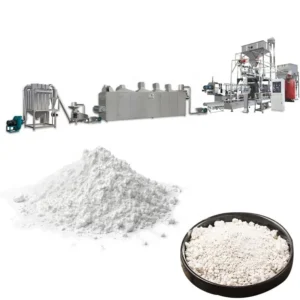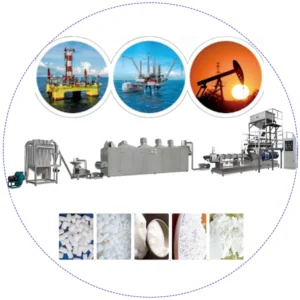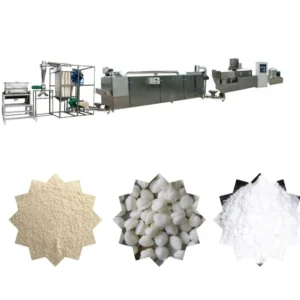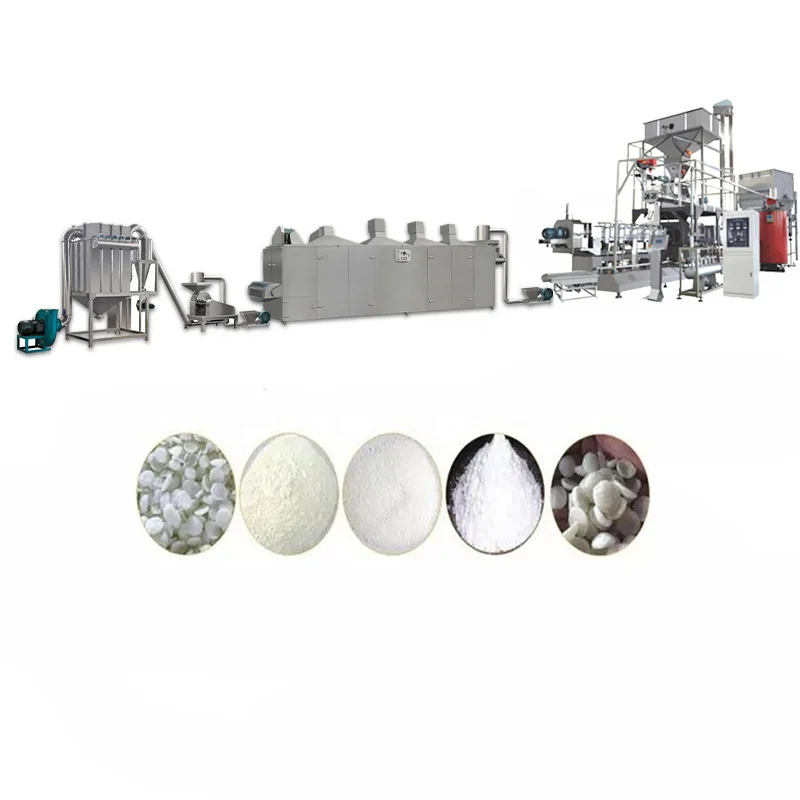
Screw Configuration Matched to Raw Material — We build the twin-screw setup and temperature profile around your starch source, whether corn, tapioca, or potato, rather than shipping a generic barrel arrangement.
Technical Specifications
| Parameter | Value |
|---|---|
| Product Type | Modified Starch Processing Line |
| Line Stations | Materials preparation → Material blending → Mixing → Extruding → Drying → Grinding → Packing |
| Extruder Type | Twin Screw |
| Extruder Control | Frequency speed controlling system with high automatic and stable performance |
| Extruder Lubrication | Automatic lubricating and cooling |
| Dryer Heating Source Options | Electric / Steam / Gas (configured to local utility availability) |
| Grinding Machine Discharge | Bottom butterfly valve discharge |
| Grinding Machine Contact Material | Stainless steel 304 on food-contact parts |
| Grinding Particle Fineness | Less than 10 mm (basis to be confirmed by raw material and moisture) |
| Control System | High automation with PLC/MCC integration available |
| Assembly State | Complete line from material grinding to final packing |
| Standards | CE |
Model-Specific Ratings
| Model | Installed Power | Real Consumption | Output Capacity |
|---|---|---|---|
| MT85 | 90 kW | 63 kW | 100–200 kg/hr (basis not stated in source — confirm raw material, moisture and gelatinisation degree) |
| MT100 | 180 kW | 120 kW | 500–600 kg/hr (basis not stated in source — confirm raw material, moisture and gelatinisation degree) |
| MT110 | 200 kW | 150 kW | 500–600 kg/hr (basis not stated in source — confirm raw material, moisture and gelatinisation degree) |
| MT135 | 240 kW | 165 kW | 1000–1500 kg/hr (basis not stated in source — confirm raw material, moisture and gelatinisation degree) |
Maximum extruding capacity claim of up to 2 ton per hour is stated for corn starch only; actual throughput depends on model selection, screw configuration, and moisture content.
Application Suitability
| Application | Material or Output |
|---|---|
| Pre-gelatinised starch for food processing | Corn, tapioca or potato starch — thickeners and binders |
| Textile industry sizing agents | Modified starch with controlled viscosity for warp sizing |
| Oil drilling mud additives | Denatured starch with specified rheology and gel strength |
| Paper industry coating and bonding | Starch grades targeting surface strength and printability |
| Construction adhesives and mortars | Pre-gelatinised starch for cement and gypsum formulations |
| Fortified and infant nutrition powders | Thermal-stable starch with consistent freeze-thaw behaviour |
Why the Raw Material Question Comes Before the Quotation
A capacity figure means nothing without the starch source and moisture level attached to it.
I spent two weeks on a site in South Asia because the line was quoted on corn starch throughput while the customer ran cassava starch. The gelatinisation temperature, shear sensitivity, and final α-degree were all off. The screw combination and barrel temperature zones had to be rebuilt from scratch while the customer’s dryer sat idle. That kind of mismatch turns a commissioning visit into a re-engineering project [NEED_CITE: gelatinisation behaviour differences between corn and tapioca starch under twin-screw extrusion]. Every modified starch processing line equipment order should start with a lab sample and a target specification sheet, not a catalogue number.
Barrel Zones and Temperature Control for Gelatinisation
Twin-screw extrusion of pre-gelatinised starch relies on a carefully staged barrel temperature profile. Feed zones keep moisture from flashing off too early, while downstream zones push the starch through its gelatinisation window. The modified starch processing line equipment uses frequency-controlled screw speed to balance residence time against shear input, which directly shapes the α-degree and cold-water viscosity of the finished powder.
Screw Element Arrangement Across Starch Sources
Corn starch, tapioca starch, and potato starch each demand a different screw element sequence. Kneading block angles and spacing determine how much mechanical energy converts into gelatinisation versus how much simply generates waste heat. Changing the screw configuration record between campaigns lets one line produce both high-swelling pre-gelatinised grades and lower-viscosity denatured grades without swapping barrels [NEED_CITE: screw element geometry effect on starch gelatinisation degree in twin-screw extruders].
Reading the Power Table Against Real Output
The MT85 at 63 kW real consumption suits pilot and small-batch production, while the MT135 at 165 kW real consumption targets continuous industrial volumes. Installed power figures run higher than actual draw because the frequency drive only pulls what the material resistance demands. Matching the dryer heating source — electric, steam, or gas — to local utility costs matters just as much as the extruder motor rating when you calculate running expense over a year of shifts.
What Happens When Extruder and Dryer Are Mismatched
An extruder pushing output that the downstream dryer cannot handle means starch leaves the dryer with residual moisture above specification. That residual moisture triggers clumping during storage and ruins the cold-water solubility that your food or textile customer specified. The same problem works in reverse: an oversized dryer wastes fuel and over-dries the material, driving the grinding station to work harder on brittle granules that produce excess fines.
Why Buyers Choose This Source
- Every line station from batching through packing is supplied under one contract, so throughput is balanced at the design stage rather than corrected during commissioning.
- Screw and die configuration is documented against your raw material and target gelatinisation degree before the extruder leaves the factory.
- The in-house testing workshop runs your actual starch sample before shipment, producing a trial run report that locks in the screw combination and barrel temperature settings.
- Twin-screw expertise spans food-grade, textile-grade, and industrial-grade modified starch, so the same engineering team handles formulation shifts without outsourcing process know-how.
- Pre-sales consultation covers electrical schematic review and voltage confirmation against the installation site, preventing rewiring delays on arrival.
Documentation & Verification
- Line layout and capacity calculation matched to your starch source and target α-degree
- Screw and die configuration record tied to your formulation before shipment
- Electrical schematic with voltage and frequency confirmed to your installation site
- Trial run report on your raw material performed in the testing workshop
- Operation and maintenance manual covering every station from mixing to packing
Installation, Commissioning & Support
- Foundation and floor space planned around the full MT85–MT135 line footprint including dryer length
- Dedicated power circuit sized to the selected model’s installed power, from 90 kW to 240 kW
- Barrel segments and screw elements arrive assembled; site work covers station-to-station conveyor alignment
- First-run parameter setting includes barrel temperature profile and frequency speed calibration on your starch
- Operator training covers screw element changeover procedure for switching between starch grades
- Wear parts list provided for screws, barrel liners, and grinding screen meshes with recommended replacement intervals
What to Include in Your Inquiry
Send the raw material type and origin — corn, tapioca, or potato starch — along with your target gelatinisation degree and daily output requirement. Confirm the local voltage, frequency, and preferred control language. If you have an existing dryer or packing station that the new line must connect to, share the interface dimensions and throughput rating so the layout can be matched from the start.
Frequently Asked Questions
Q: How is output capacity verified on my specific starch source and moisture level?
A: We run your raw material through our in-house testing workshop before shipment. The trial documents the screw combination, barrel temperature profile, and actual throughput achieved at your target gelatinisation degree, giving you a verified capacity figure rather than a generic catalogue estimate.
Q: Which screw and die configuration is chosen for my target modified starch grade?
A: The screw element sequence — kneading block angles, spacing, and barrel zone count — is selected based on your starch source and the α-degree your end customer requires. A configuration record is produced and shared with you before the extruder ships.
Q: What voltage, frequency, and control language will the line be shipped with?
A: The electrical schematic is confirmed with you during the specification stage. Voltage, frequency, PLC/MCC programming language, and HMI display language are all locked in before production so the line powers up correctly on arrival without rewiring.
Q: How is throughput balanced between extruder, dryer, and grinder to avoid line bottlenecks?
A: Each station is sized during the layout stage based on the extruder output at your confirmed raw material and moisture. Dryer belt length, heating capacity, and grinding station feed rate are all calculated to match, preventing upstream or downstream constraints.