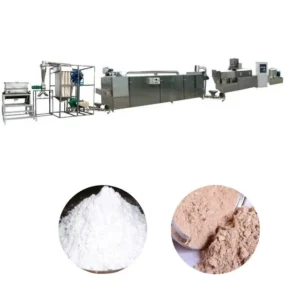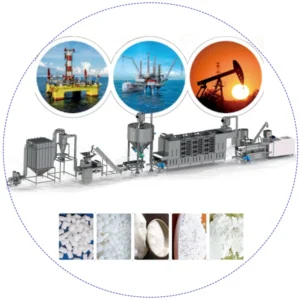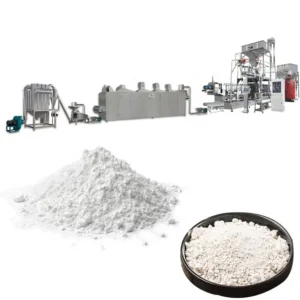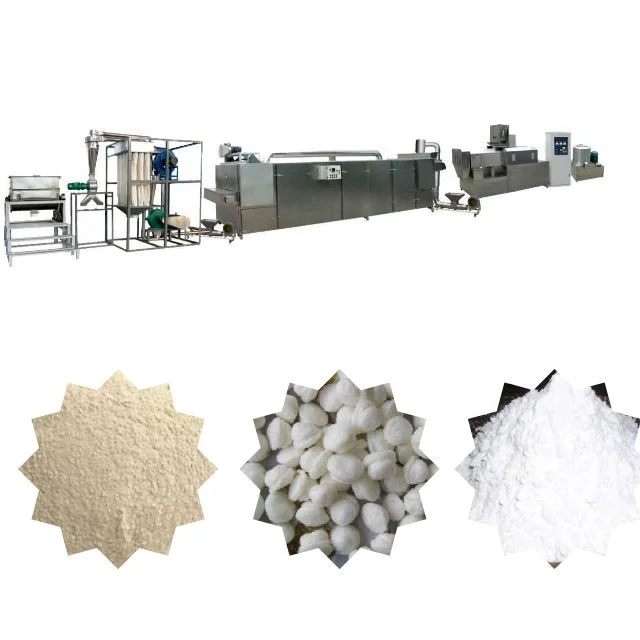
Throughput Matched Across Every Station — this modified starch processing line pairs each extruder with a dryer, grinder, and mixer sized to the same raw material basis, preventing the bottleneck that plagues multi-vendor builds.
Technical Specifications
| Parameter | Value |
|---|---|
| Product Type | Modified Starch Production Line |
| Extruder Models Available | MT70 / MT85 / MT75 |
| Screw Type | Twin-screw |
| Installed Power | 160 kW (MT70) / 190 kW (MT85) / 210 kW (MT75) |
| Power Consumption | 120 kW (MT70) / 140 kW (MT85) / 150 kW (MT75) |
| Output Capacity | 150–200 kg/h (MT70) / 300–400 kg/h (MT85) / 300–500 kg/h (MT75) (basis not stated in source — confirm raw material and moisture) |
| Overall Dimensions (L×W×H) | 41000×1500×2200 mm (MT70) / 43000×1500×3200 mm (MT85) / 45000×1500×3500 mm (MT75) |
| Screw Material | 38CrMoAl |
| Barrel Temperature Control | Integrated cooling system with heating rings |
| Heating Power | 14 kW (7×2 kW rings) |
| Feeding Power | 0.75 kW |
| Cutting Power | 0.75 kW |
| Voltage & Frequency | 380 V / 50 Hz / Three Phase (configurable) |
| Control System | PLC and MCC control |
| Mixer Contact Material | 201 SS or 304 SS (food-grade) |
| Dryer Type | 5-layer baking oven |
| Dryer Fuel Options | Gas / diesel / electricity / steam |
| Dryer Speed Control | Inverter controlled |
| Grinder Type | Pulse grinder with cyclone discharge and dust collector |
| Standards | CE, ISO |
Application Suitability
| Application | Material or Output |
|---|---|
| Pre-gelatinised starch for food industry | Wheat flour or corn starch base |
| Modified starch for feed binding | Corn starch with controlled gelatinisation |
| Expanded corn starch for industrial use | Corn starch at controlled moisture content |
| Pregelatinised starch for pharmaceutical carriers | Wheat flour or specialty starch blends |
| Functional starch for paper and textile sizing | Modified corn or cassava starch |
What "300 kg/h Output" Leaves Out About Starch Gelatinisation
A rated capacity figure means nothing unless it states the exact raw material, moisture level, and gelatinisation degree the line was tested on.
I have walked onto sites where a line built for standard corn starch could not hold anywhere near its nameplate capacity once the operator switched to cassava or potato starch — the gelatinisation temperature gap throws off the entire thermal balance. The barrel cooling system then struggles to maintain the profile, expansion drops, and the downstream dryer is suddenly handling product with residual moisture it was never sized for [NEED_CITE: gelatinisation temperature variance across starch sources]. That is why every modified starch processing line equipment for sale should ship with a trial run report based on your actual feedstock, not a generic benchmark.
Screw Configuration Dictates Your Starch Modification Window
The twin-screw design across the MT70, MT85, and MT75 models allows the screw element sequence to be rearranged for different modification targets — a high-shear arrangement for dextrinisation, a gentler profile for cross-linking reactions. The 38CrMoAl screw material withstands the abrasion common in starch processing, where mineral contaminants in flour can accelerate wear on lesser alloys. Barrel sections with integrated cooling channels let operators dial in precise temperature zones rather than relying solely on friction heat, which is critical when working with modified starch processing line equipment for sale that must hold tight gelatinisation windows.
Dryer and Grinder Sizing Must Track Actual Extruder Output
The 5-layer baking oven with inverter speed control is matched to each extruder model’s throughput range, so residence time in the dryer stays consistent whether you are running the MT70 or the MT75. Multi-fuel capability — gas, diesel, electricity, or steam — means the thermal input can be tuned to local utility costs and availability. Downstream, the pulse grinder with cyclone discharge and integrated dust collector produces uniform particle size while containing the fine starch dust that would otherwise create a housekeeping hazard [NEED_CITE: combustible dust standards for starch processing facilities].
Reading the Specs That Actually Matter on a Starch Line
The installed power versus power consumption gap — for example 160 kW installed versus 120 kW consumed on the MT70 — reflects motor reserve capacity, which matters when a denser starch blend momentarily increases torque demand. The 7×2 kW heating ring arrangement gives seven independently controlled barrel zones, allowing a temperature gradient that mirrors the progressive gelatinisation stages as starch moves through the barrel. The inverter-controlled dryer speed means belt velocity can be adjusted without stopping the line, compensating for ambient humidity shifts that affect drying rate. Mixer options in 201 SS or 304 SS address different sanitation standards; facilities producing pharma-grade pregelatinised starch typically require the higher corrosion resistance of 304 SS throughout contact surfaces [NEED_CITE: food contact material regulations by market].
The Real Cost of Mismatched Line Stations
When a buyer sources an extruder from one vendor and a dryer from another, the dryer is almost always undersized because it was quoted on paper capacity rather than actual moisture load. The line then runs at a fraction of its potential while operators constantly adjust drying time, burning product or passing through wet starch that fails downstream specification [NEED_CITE: moisture content specifications for modified starch products]. Grinder throughput is another frequent mismatch — a pulse grinder that cannot clear the extruder’s real output creates a material backlog, forcing the entire line to slow. These problems surface weeks after installation, when the buyer has already paid most of the invoice.
Why Procurement Here Differs
Every station on this modified starch processing line equipment for sale is specified under one manufacturer, so the mixer batch size, extruder throughput, dryer residence time, and grinder capacity are calculated together before the quotation is issued. The screw configuration and die design are matched to your raw material — corn starch, wheat flour, or cassava — rather than copied from a standard build. An in-house testing workshop runs your actual feedstock before shipment, producing a trial run report that documents real achievable capacity. The PLC and MCC control system is confirmed against your site voltage and frequency before production begins, avoiding the commissioning delays that arise from unverified electrical assumptions. Pre-sales engineering through on-site installation and operator training keeps one technical team accountable for the full line.
Documentation & Verification
- Line layout drawing showing throughput calculation across mixer, extruder, dryer, and grinder stations
- Screw configuration and die design record matched to your specific starch raw material
- Trial run report from in-house testing workshop on your supplied feedstock before dispatch
- Electrical schematic with voltage and frequency confirmed to your local supply standard
- CE declaration of conformity and ISO certificate with factory test record
- Operation and maintenance manual with wear parts list and replacement intervals
Installation, Commissioning & Support
- Overall line footprint up to 45000×1500×3500 mm requires clear floor space with access for 5-layer dryer positioning
- Three-phase power supply matched to confirmed voltage and frequency, with dedicated circuit for extruder main motor
- Complete line arrives factory-assembled and tested; site assembly covers station alignment and utility connections
- First production run sets barrel temperature profile and dryer speed parameters specific to your starch type
- Operator training covers screw element changeover and pulse grinder screen adjustment for particle size control
- Wear parts stock plan covers 38CrMoAl screw elements, heating rings, and die plates with first-replacement schedule
Preparing Your Inquiry
To specify the right configuration, provide your exact starch raw material (corn, wheat, cassava, or blend), the target modification type, and your daily production volume. Include your workshop dimensions and ceiling height to confirm the line layout fits. State your local voltage and frequency — configurations beyond 380 V 50 Hz are available — and whether you need the control interface in a specific language. If you have existing upstream batching or downstream packing equipment, note the interface points so the line integrates without gaps.
Frequently Asked Questions
Q: How is output capacity verified, and what does the stated kg/h figure actually mean?
A: The capacity figures listed for each model are reference values that depend on your specific starch raw material, moisture content, and target modification type. A trial run in the testing workshop on your actual feedstock produces a verified output figure documented in the trial report. This report becomes part of the shipment documentation so you know exactly what to expect at installation.
Q: Can the line voltage and frequency be configured for markets outside mainland China?
A: Yes. Voltage and frequency are confirmed during the specification stage before production begins. The electrical schematic is then built to match your local power supply standard, whether that is 415 V 60 Hz, 220 V 60 Hz, or another configuration. This confirmation step prevents the commissioning delays that occur when electrical assumptions go unverified.
Q: How are screw configuration and die design matched to different starch types?
A: The twin-screw element sequence is arranged based on your raw material and target starch modification — high-shear zones for dextrinisation, gentler profiles for cross-linking. Die geometry is selected to control expansion and density. Both are recorded in the screw and die configuration document that ships with the line.
Q: Is a trial run on my raw material possible before the line ships?
A: Yes. The in-house testing workshop conducts a production run using your supplied starch material, documenting actual throughput, barrel temperature profile, and product quality parameters. The trial run report covers all findings and is included in your documentation package before dispatch.
Q: What wear parts should I plan for, and when is the first replacement typically due?
A: Primary wear parts include 38CrMoAl screw elements, die plates, and heating rings. A wear parts list with recommended first-replacement intervals ships with the line, based on your starch type and projected running hours. Keeping these on site avoids unplanned downtime when the first wear signs appear.