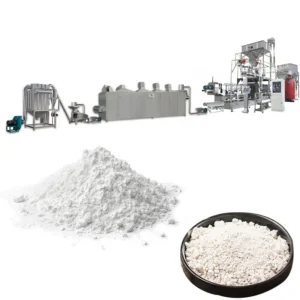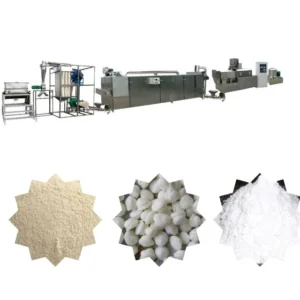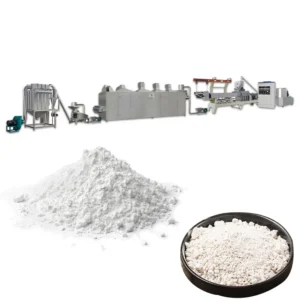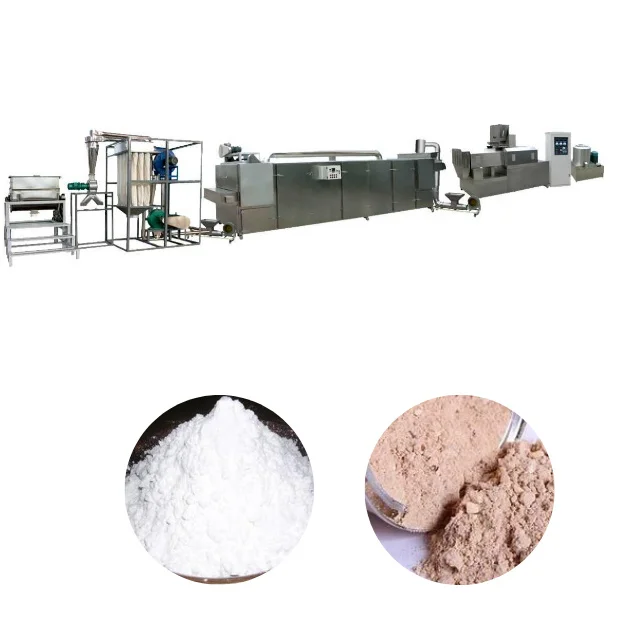
Matched Throughput Across Stations — Every mixing, extrusion, drying, and grinding unit in this modified starch production line is sized to the same capacity band, preventing mid-line bottlenecks that stall output.
Technical Specifications
| Parameter | Value |
|---|---|
| Model | MT85 / MT100 / MT110 / MT135 |
| Product Type | Modified Starch Production Line / Pregelatinized Starch Processing Line |
| Extruder Type | Twin-screw |
| Installed Power (MT85) | 90 kW |
| Installed Power (MT100) | 180 kW |
| Installed Power (MT110) | 200 kW |
| Installed Power (MT135) | 240 kW |
| Real Consumption (MT85) | 63 kW |
| Real Consumption (MT100) | 120 kW |
| Real Consumption (MT110) | 150 kW |
| Real Consumption (MT135) | 165 kW |
| Output Capacity (MT85) | 100–200 kg/h (basis not stated in source — confirm raw material type, moisture content, target gelatinisation degree) |
| Output Capacity (MT100) | 500–600 kg/h (basis not stated in source — confirm raw material type, moisture content, target gelatinisation degree) |
| Output Capacity (MT110) | 500–600 kg/h (basis not stated in source — confirm raw material type, moisture content, target gelatinisation degree) |
| Output Capacity (MT135) | 1000–1500 kg/h (basis not stated in source — confirm raw material type, moisture content, target gelatinisation degree) |
| Line Stations | Materials preparation → Material blending → Mixing → Extruding → Drying → Grinding → Packing |
| Dryer Heating Source | Electric / Steam / Gas (configured to site conditions) |
| Grinding Contact Material | Stainless steel 304 (food-contact parts) |
| Grinding Discharge | Bottom butterfly valve |
| Grinding Particle Fineness | Less than 10 mm |
| Control System | Frequency speed controlling system |
| Barrel & Screw Design | Changeable configuration for modified or denatured starch variants |
| Lubrication | Automatic lubricating and cooling system |
| Warranty | 1 year |
| Standards | CE, ISO |
Application Suitability
| Application | Material or Output |
|---|---|
| Textile sizing and warp yarn treatment | Pregelatinized corn starch with controlled thermal viscosity |
| Paper surface coating and corrugating adhesive | Modified tapioca starch with film-forming properties |
| Oil drilling fluid viscosity control | Denatured potato or corn starch with high water-binding capacity |
| Construction gypsum board and mortar additive | Pregelatinized starch providing freeze-thaw stability |
| Food ingredient blending for bakery and sauce | Modified starch with specific gelatinisation degree and cold-water solubility |
What "Nominal Capacity" Ignores About Starch Gelatinisation
Real output depends on your raw material’s protein content, moisture level, and target gelatinisation degree — not the nameplate.
A twin screw extruder for modified starch might be rated at a given throughput on standard corn starch at controlled moisture. Swap to a wheat starch with higher protein, or a tapioca starch with different gelatinisation kinetics, and the same screw speed, barrel temperature profile, and die geometry may deliver a different product density or fall short of expected throughput. I once saw a line configured on standard test starch that needed a full parameter rewrite when the customer’s actual feedstock arrived with higher protein content than anticipated. That kind of mismatch delays commissioning by weeks [NEED_CITE: variability of starch gelatinisation behaviour across raw material sources].
How Screw Configuration Shapes Pregelatinised Starch Properties
The twin-screw extruder at the heart of this pregelatinized starch processing machine relies on a barrel and screw arrangement that can be changed to suit different starch sources. Corn, tapioca, and potato starches each have distinct granule sizes and gelatinisation temperatures. Matching the screw element sequence — kneading blocks, conveying sections, reverse elements — to the raw material determines shear intensity and residence time inside the barrel, which directly controls the degree of starch modification achieved in a single pass.
Throughput Matching Between Extrusion and Downstream Stations
A common failure in modified starch production line equipment is sizing the extruder correctly but undersizing the dryer or grinder. When the extruder pushes output at full rate but the dryer cannot remove moisture fast enough, material backs up and the line stalls. On these MT-series lines, mixing, extruding, drying, and grinding stations are selected within the same capacity band so that material flows continuously from one stage to the next without accumulation or idle time [NEED_CITE: importance of line-wide throughput matching in continuous processing].
Reading the Power and Capacity Figures Correctly
Installed power and real consumption tell different stories. The MT135 draws 240 kW on paper but runs around 165 kW under typical load, because motors do not operate at peak draw continuously. The frequency speed controlling system adjusts motor speed to actual demand, so energy use tracks with the material load in the barrel rather than staying at maximum. Barrel and screw wear also affects power draw over time; as clearances increase, the extruder works harder to maintain the same shear level, which is why the automatic lubricating and cooling system matters for long-term consistency. Grinding fineness below 10 mm through the stainless steel 304 contact surfaces ensures the final powder meets the particle size expectations of downstream users in textile or paper applications.
The Hidden Cost of Skipping Raw Material Confirmation
When a line ships without a trial run on the buyer’s actual starch, the first weeks of production become an expensive experiment. Screw speed, barrel temperature zones, and moisture addition all need adjustment once real feedstock behaves differently from the test material. Operators unfamiliar with the process may push the extruder beyond safe parameters trying to hit output targets, accelerating wear on screws and dies. Correcting these issues on-site costs more in downtime and replacement parts than a pre-shipment trial run ever would [NEED_CITE: commissioning delays caused by unverified raw material behaviour].
Why Procurement Through This Channel Works
Every station from material blending through packing is supplied under one responsible source, meaning throughput calculations and layout drawings are coordinated before fabrication rather than reconciled after delivery. The in-house testing workshop runs your actual raw material through the configured extruder before the line ships, so screw and die settings are documented in a trial report rather than guessed on your factory floor. Dryer heating is specified to your available utility — electric, steam, or gas — avoiding last-minute conversions. Electrical schematics and voltage confirmation are locked in before production starts, matching your market’s frequency and plug standards. CE and ISO documentation accompanies every shipment for customs and compliance purposes.
Documentation & Verification
- Line layout drawing showing station throughput matching across the full MT85–MT135 range
- Screw and die configuration record tied to your starch type and target gelatinisation property
- Trial run report on customer-supplied raw material before dispatch
- Electrical schematic with confirmed voltage and frequency for destination market
- Wear parts list covering screws, dies, and barrel sections with replacement intervals
- Operation and maintenance manual for all line stations
Installation, Commissioning & Support
- Power supply circuit sized to the confirmed real consumption figure, up to 165 kW for the MT135 line
- Foundation and floor plan aligned with the full station sequence from mixing through packing
- Dryer utility connection matched to the configured heating source — electric, steam, or gas
- First-run parameter setting based on the pre-shipment trial report data
- Operator training covering screw configuration changes for different starch variants
- Spare screw and die elements stocked for the initial replacement cycle
Preparing Your Inquiry
To configure the right modified starch production line equipment for your operation, share the type of native starch you will process, the target modification properties, and the output range you need per hour. Confirm your site’s available power supply voltage and frequency, and let us know which dryer heating source your facility supports. If you have a specific particle fineness requirement for the ground final product, include that in your specification so the grinding station can be matched accordingly.
Frequently Asked Questions
Q: How is line capacity verified on my specific starch raw material?
A: Before shipment, your raw material runs through the configured twin-screw extruder in the in-house testing workshop. The trial covers screw speed, barrel temperature profile, moisture addition, and die geometry against your target gelatinisation degree. Results are documented in a report so settings are known before installation, not discovered during commissioning.
Q: How are the extruder, dryer, and grinder matched to avoid bottlenecks?
A: Each station is selected within the same MT-series capacity band. The dryer’s residence time and heating capacity are calculated against the extruder’s moisture output, and the grinder is sized to handle the dried material flow rate. This prevents accumulation between stations and keeps the line running continuously.
Q: Can the dryer heating source be configured to my site utility?
A: Yes. The dryer is available with electric, steam, or gas heating. Your site conditions determine which option is specified during the line configuration stage, so the correct heat exchangers, burners, or electrical elements are installed before the dryer leaves the factory.
Q: What electrical details are confirmed before production begins?
A: Voltage, frequency, control language, and plug standards are confirmed against your destination market requirements. An electrical schematic is provided for approval before manufacturing starts, ensuring the frequency speed controlling system and all motor ratings match your facility’s power supply.
Q: What does the pre-shipment trial run cover?
A: The trial uses your supplied raw material and tests the barrel and screw configuration, temperature zones, and moisture levels to produce modified starch matching your specification. The resulting report records all parameters so your team can replicate the settings immediately after installation.