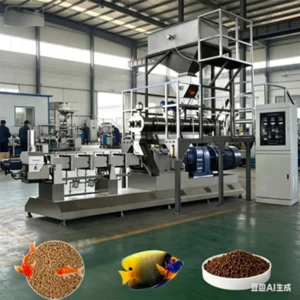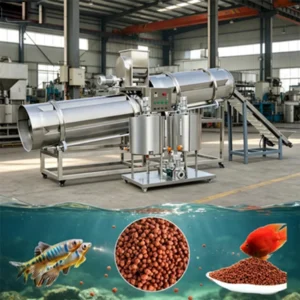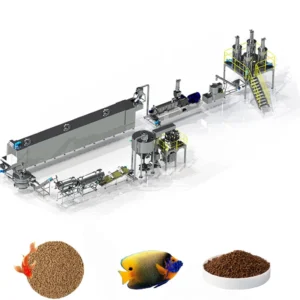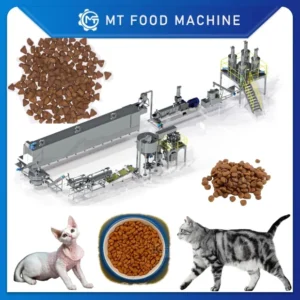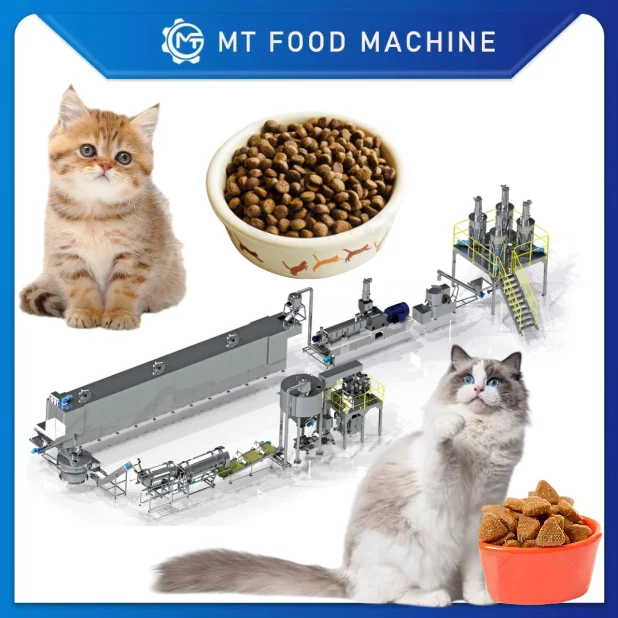
Station-by-station throughput matching — the MT135 line balances extruder output with dryer, flavouring, and packing capacity so no single unit chokes the entire pet food processing line manufacturer workflow.
Technical Specifications
| Parameter | Value |
|---|---|
| Model | MT135 |
| Product Type | Pet Food Processing Line |
| Output Capacity | 2.5–3.0 t/h (basis not stated in source — confirm raw material, moisture content, and product format) |
| Alternative Output Rating | 550 kg/h (basis not stated in source — confirm raw material and product specification) |
| Screw Type | Twin-screw |
| Control System | PLC Controlled |
| Application Range | Cat, dog, fish, bird, and cattle feed |
| Line Stations | Batching, extrusion, drying, flavouring, coating, cooling, packing |
| Assembly State | Complete production line |
| Voltage & Frequency | Configurable to target market (confirm before order) |
| HMI Language Options | Configurable (confirm before order) |
| Standards | CE, ISO |
Application Suitability
| Application | Material or Output |
|---|---|
| Dry kibble for dogs and cats | Corn, poultry meal, meat slurry, vitamin premix |
| Floating and sinking aquatic feed | Fish meal, soy, starch binders for catfish, tilapia, shrimp |
| Bird feed pellets | Grains, seed blends, calcium supplements |
| Cattle feed extruded pellets | Forage meal, grain concentrates, protein supplements |
| Multi-species contract production | Quick die and screw changeovers between product runs |
Why Nominal Capacity Rarely Survives Contact with Your Raw Material
A pet food processing line manufacturer may quote a headline throughput, yet the actual output depends on what you feed into the hopper. Real capacity is only proven on your specific formulation.
I once watched a twin-screw line stall at barely half its nameplate rate because the buyer switched from a corn-heavy test blend to a high-fresh-meat recipe after the order was placed. The screw profile that handled dry grits could not move a sticky, protein-rich mash. Extruder barrels ran hot, die pressure spiked, and kibble came out dense and misshapen. The dryer then had to work twice as long to hit target moisture, backing the whole line up [NEED_CITE: twin-screw extrusion behaviour under high-moisture protein loads]. When every station on the MT135 is quoted, we start with your recipe, not a generic catalogue figure.
Surveying the Full Machine Catalogue
The MT135 platform covers every station a pet food processing line manufacturer needs to assemble a complete kibble or aquatic feed line. Buyers evaluating equipment options can review extruder models, dryer lengths, flavouring drum diameters, and packing head counts in a single catalogue rather than stitching together separate vendor quotes. Each unit is documented with its own footprint and utility draw, making plant layout decisions faster.
How Throughput Matching Prevents Hidden Bottlenecks
An extruder pushing 3 t/h means little if the downstream dryer only handles 1.5 t/h of evaporative load. The MT135 line configuration pairs each supporting station to the extruder’s verified output on the buyer’s raw material. Dryer belt length, airflow volume, flavouring drum residence time, and cooler capacity are all scaled together [NEED_CITE: thermal and mechanical balancing in extruded feed lines]. This avoids the situation where one under-sized unit silently caps the entire line.
Reading the Specs That Actually Matter
Twin-screw architecture gives the MT135 a wider operating window than single-screw extruders when processing high-fat or high-moisture recipes common in premium kibble. The screw configuration and die geometry are selected against the buyer’s ingredient list, controlling expansion ratio and final kibble density. PLC control maintains barrel temperature zones and screw speed within tight bands, holding batch-to-batch consistency even when ambient humidity shifts between seasons. Output ratings of 2.5–3.0 t/h or 550 kg/h must always be validated against your specific raw material moisture and formulation before they are treated as guaranteed throughput.
The Cost of Skipping Raw-Material Trials
Sending a line to site without running the buyer’s actual recipe in the factory workshop is a common shortcut that surfaces problems only after installation. Screw combinations tuned for generic corn flour cannot compensate for a recipe loaded with fresh chicken slurry. I have seen commissioning stretch into a full week of on-site rework because the trial material did not match production reality. Density drift, sinking kibble in aquatic feed, and uneven coating adhesion all trace back to this gap [NEED_CITE: importance of pre-shipment extrusion trials on customer formulations]. Running your ingredients through the MT135 before crating eliminates most of these field corrections.
Why Source This Line Here
The MT135 is configured as a single-supplier line, so throughput calculations span every station rather than stopping at the extruder door. Screw and die sets are documented against the buyer’s ingredient list, giving you a written configuration record instead of a generic build. An in-house testing workshop lets you send raw materials for trial runs before the line ships. PLC and MCC schematics are confirmed for your local voltage, frequency, and HMI language before production starts. Wear parts lists ship with the first order, so replacement screws and dies are identifiable from day one.
Documentation & Verification
- Line layout drawing showing station-by-station footprint and utility tie-in points
- Capacity calculation sheet based on your recipe moisture and ingredient ratios
- Screw and die configuration record matched to your raw material trial
- Electrical schematic with confirmed voltage, frequency, and PLC language
- Factory trial run report on your actual ingredients before crating
- CE declaration of conformity and ISO certificate for customs and compliance
Installation, Commissioning & Support
- Foundation plan indicating load points and floor-flatness tolerance for the MT135 frame
- Dedicated electrical circuit sized to the confirmed rated power and local voltage
- Modular station delivery allowing phased unloading in low-clearance workshops
- First-run parameter logging on your recipe to establish baseline PLC setpoints
- Operator training covering screw changeover, die cleaning, and HMI navigation
- Wear parts list with part numbers for screws, dies, and dryer belt segments
What to Include in Your Inquiry
Send your ingredient list with typical moisture percentages, target kibble size range, and daily output goal so the pet food processing line manufacturer can size each station accurately. Specify your local voltage and frequency, preferred HMI language, and any existing upstream mixers or downstream packing machines that must interface with the MT135. If a raw-material trial is needed before commitment, ship a representative sample batch to the testing workshop.
Frequently Asked Questions
Q: How is the 2.5–3.0 t/h output capacity verified for my recipe?
A: Capacity depends on raw material moisture, fat content, and kibble density target. We run your actual formulation through the MT135 in our testing workshop, measure steady-state throughput at the extruder and each downstream station, and document the result in a trial report before the line is built.
Q: What voltage and PLC language options are available?
A: The MT135 control system is configured to your site’s voltage and frequency before production. HMI language is selected during the specification confirmation stage, so operators see menus and alarms in their working language on day one of commissioning.
Q: How do you prevent the dryer or cooler from bottlenecking the extruder?
A: Each supporting station is sized against the extruder’s verified output on your recipe. Dryer belt length, airflow, and cooler residence time are calculated from the moisture removal load, not from a generic line template, keeping throughput balanced end to end.
Q: Can I see the screw and die configuration before committing?
A: Yes. After your raw material trial, we provide a written screw profile and die geometry record. This document shows the exact element arrangement and aperture size selected for your formulation, so you know the mechanical setup before the purchase order is placed.