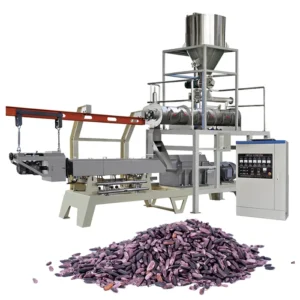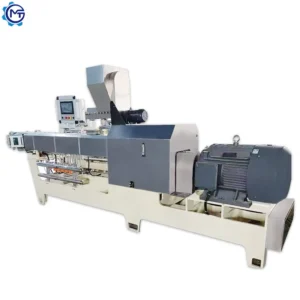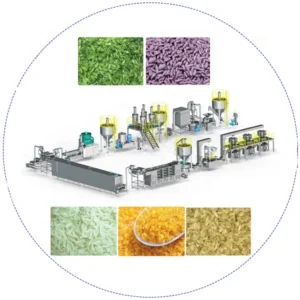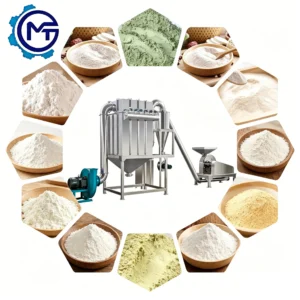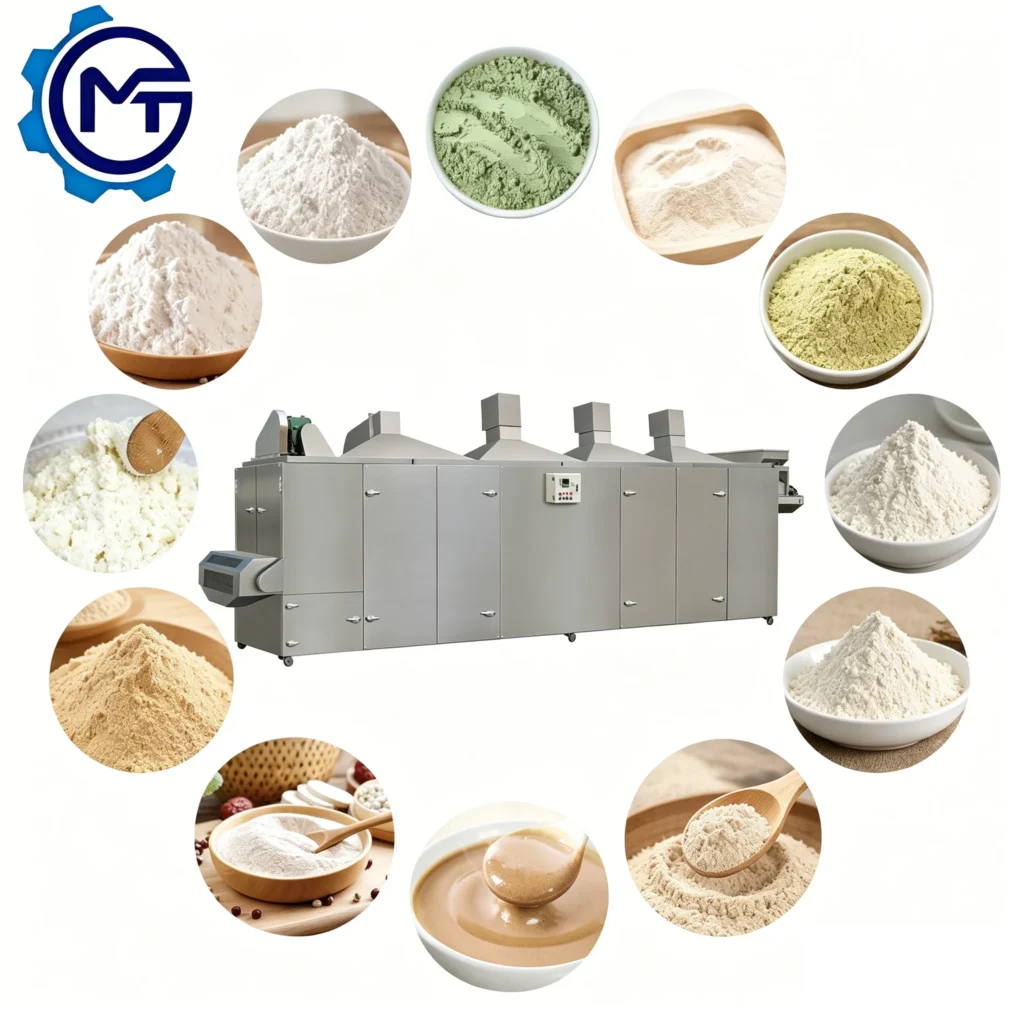
Full Line Equipment Matching — throughput balanced from batching through packing so no single station bottlenecks the nutritional powder processing line.
Technical Specifications
| Parameter | Value |
|---|---|
| Product Type | Nutritional Powder Processing Line |
| Output Capacity | 200–500 kg/h (basis to be confirmed — dependent on raw material, moisture content, and formulation) |
| Construction Material | Food-Grade 304 Stainless Steel (product-contact surfaces) |
| Control System | Touch Control Panel with Digital System |
| Heat Source Options | Electric / Gas / Steam |
| Automation Level | Full Automatic |
| Key Line Stations | Baking Ovens, Mixers, Conveying, Cooling, Packing (full configuration to be confirmed against project scope) |
| Warranty | 1 Year |
| After-Sales Service | Overseas Engineer Support |
Application Suitability
| Application | Material or Output |
|---|---|
| Baby food and infant nutrition powder | Rice, corn, beans, and blended grain formulations |
| Fortified porridge and instant cereal | Multi-grain mixes with added micronutrients |
| Nutritional supplement powder bases | Legume and cereal blends requiring controlled gelatinisation |
| Dietary and weaning food production | Pre-cooked starch and protein matrices for reconstitution |
Why "200 kg/h" Means Nothing Without Your Raw Material
The capacity figure on a nutritional powder processing line full equipment range is only meaningful when tied to the buyer’s actual formulation and moisture profile.
I have stood in workshops where a line rated at a certain throughput on standard rice flour dropped to nearly half that rate the moment the operator introduced soy flour and trace mineral premix. The gelatinisation temperature shifted, the barrel heat profile was no longer valid, and material began sticking inside the baking chamber. Buyers who source individual machines from separate vendors often discover this mismatch only after the equipment is bolted to the floor. The nutritional powder processing line full equipment range shown here addresses that gap by presenting every station — mixing, baking, conveying, cooling, packing — so capacity assumptions can be checked against each other before an order is placed. [NEED_CITE: starch gelatinisation temperature variation across common grain and legume blends]
How Each Station Fits in the Sequence
Every machine listed in this nutritional powder processing line full equipment range occupies a defined position in the production sequence. The mixer homogenises raw grains and micronutrient additives before the material enters the baking stage, where controlled heat converts raw starch into a digestible, shelf-stable intermediate. Downstream conveying then moves the baked product to cooling stations that reduce moisture to a level safe for milling and packing. Viewing all stations in one survey lets buyers see where a mismatch in throughput or utility demand might create a choke point.
Matching Heat Source to Existing Factory Infrastructure
Baking ovens in this line are configurable for electric, gas, or steam heating. The choice is rarely about preference — it depends on what utility infrastructure already exists in the buyer’s facility. A plant running a central steam boiler will find steam-heated ovens cheaper to operate per hour, while a smaller operation without boiler capacity may opt for electric elements to avoid the capital cost of a separate steam generator. Confirming heat source compatibility before the line is built prevents costly utility retrofits after delivery. [NEED_CITE: industrial steam versus electric heating cost comparison for food processing]
Reading the Specifications Against Your Formulation
Food-grade 304 stainless steel on all product-contact surfaces is a baseline hygiene requirement, but its practical value depends on cleaning frequency. Nutritional powders containing fat-rich ingredients like soy or ground nuts leave residue that demands wash-down between batches; 304 stainless steel tolerates repeated hot-water and caustic cleaning cycles without surface degradation. The touch control panel with digital system centralises temperature set-points and conveyor speed for each station, which matters when a line switches between a rice-based infant formula and a multi-bean porridge mix — each recipe needs its own thermal profile, and the digital system stores these as selectable programs rather than requiring manual dial adjustments every changeover. Full automatic operation across mixing, baking, and downstream stations reduces the number of manual interventions between the raw material inlet and the packing outlet, keeping batch-to-batch variation within acceptable limits for regulated nutritional products.
The Hidden Cost of Unmatched Stations
When a buyer purchases a mixer from one supplier, a baking oven from another, and a packing station from a third, nobody is responsible for ensuring the material flow rate is consistent across all three. The mixer may produce faster than the oven can bake, forcing operators to let mixed material sit and absorb ambient moisture — altering the very formulation the recipe was designed around. Or the oven output may exceed the packing station capacity, causing baked product to cool unevenly on conveyors and pick up moisture from the air, which shortens shelf life. These are not equipment failures; they are system design failures that only appear after installation. [NEED_CITE: material flow balancing in multi-vendor food processing lines]
Why Buyers Survey the Full Range Here
Every station from mixing to packing is listed within one equipment catalogue, so throughput can be compared station-by-station before a line is configured. Screw and die records — where applicable to pre-processing stages — are specified to the buyer’s raw material rather than carried over from a generic template. An in-house testing workshop allows trial runs on the customer’s actual grain blend or legume mix before the line ships, catching gelatinisation and density issues at the factory rather than on the buyer’s floor. Electrical schematics and voltage confirmations are completed before production begins, so control panels arrive configured for the target market’s power grid and language. Documentation — from layout drawings to CE declarations — is issued as a single package covering the entire line rather than assembled piecemeal from multiple vendors.
Documentation & Verification
- Line layout and capacity calculation showing throughput balance across every station from mixer to packer
- Machine specification sheet with voltage, frequency, and control language confirmed for the destination market
- Screw and die configuration record matched to the buyer’s grain, legume, or blended raw material
- CE declaration of conformity and ISO certificate covering the complete processing line
- Factory test record documenting trial run results on the customer’s actual formulation before dispatch
Installation, Commissioning & Support
- Floor plan review confirming oven footprint and mixer placement within the available workshop dimensions
- Dedicated electrical circuit sizing based on total connected load of baking ovens and conveying motors
- Modular station delivery allowing sequential installation from mixing through packing as floor space is prepared
- First-run parameter setting on the touch control panel using the buyer’s specific nutritional powder recipe
- Operator training covering recipe selection, temperature adjustment, and cleaning procedures on 304 stainless steel surfaces
- Wear parts list with recommended spare inventory for heating elements, conveyor belts, and mixer blades
What to Include in Your Inquiry
Buyers evaluating a nutritional powder processing line should share the specific raw materials — whether rice, corn, bean blends, or fortified mixes — along with the target moisture content of the finished powder. Providing the local voltage and frequency standard, plus the preferred heat source based on existing factory utilities, allows the line to be quoted with the correct electrical and thermal configuration from the outset.
Frequently Asked Questions
Q: What supporting stations are available and how do they fit into a complete nutritional powder line?
A: The range includes mixers for raw material homogenisation, baking ovens for starch gelatinisation, conveyors for inter-station transfer, cooling systems to stabilise moisture before milling, and packing stations. Each station is sized so its throughput matches the others, preventing bottlenecks that arise when equipment is sourced from separate vendors.
Q: How is output capacity determined and what assumptions does it depend on?
A: The listed capacity range depends on the specific raw material blend, incoming moisture level, and the degree of gelatinisation required by the product specification. Buyers should request a capacity calculation based on their own formulation rather than relying on a generic throughput figure.
Q: Which heat source option suits different factory environments?
A: Electric heating works well for smaller operations without existing steam infrastructure. Gas firing is common where natural gas or LPG is readily available and cost-competitive. Steam heating integrates with facilities that already operate a central boiler, reducing per-unit energy cost at higher volumes.
Q: What food-grade materials and surface finishes are used on product-contact parts?
A: All surfaces that contact the nutritional powder are constructed from 304 stainless steel, which withstands repeated hot-water and caustic cleaning cycles. This grade is specified to meet hygiene requirements for infant food and fortified powder production environments.
Q: How are individual machines selected and matched to avoid throughput bottlenecks?
A: Each station is reviewed against the others during the layout design phase so that mixer output, oven dwell time, conveyor speed, and packing rate are balanced. A trial run on the buyer’s raw material in the testing workshop confirms the balance before the line is shipped.