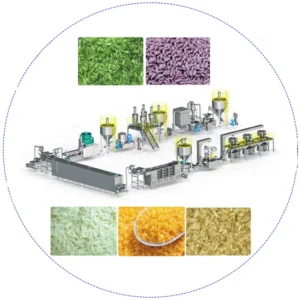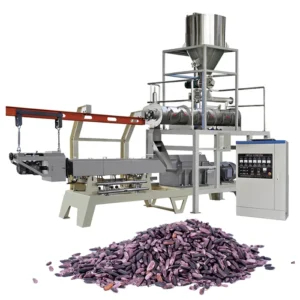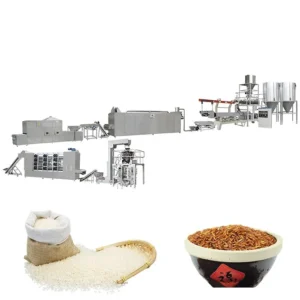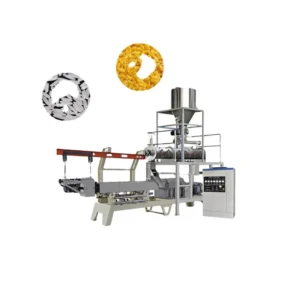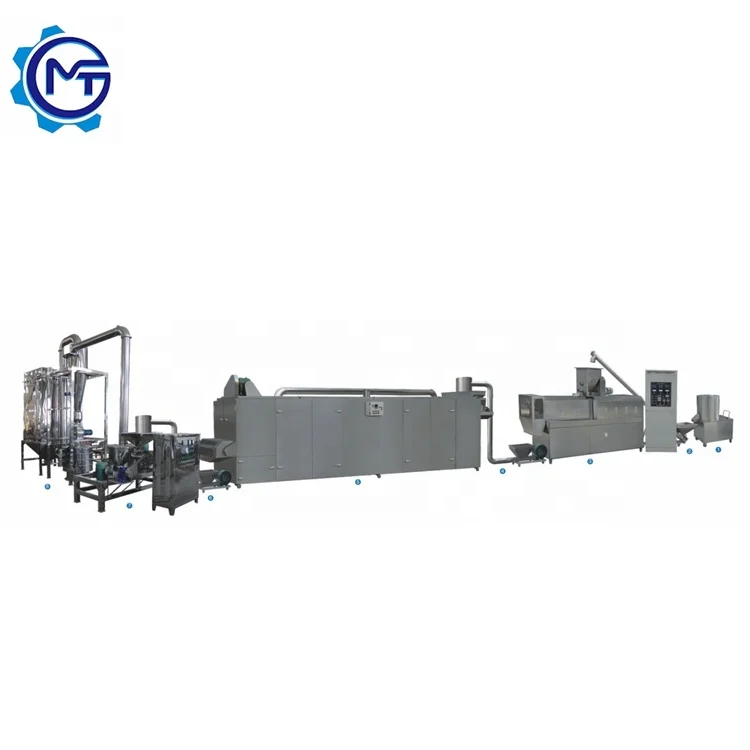
Integrated Turnkey Station Matching — Every station from mixing to packing is sized against the same throughput target so the extruder never starves the dryer or overwhelms the mill on your actual nutritional powder blend.
Technical Specifications
| Parameter | Value |
|---|---|
| Product Type | Nutritional Powder Processing Line |
| Model Options | MT65 / MT70 / MT85 |
| Screw Type | Twin-screw |
| Installed Power | MT65: 66 kW; MT70: 100 kW; MT85: 130 kW |
| Real Power Consumption | MT65: 50 kW; MT70: 67 kW; MT85: 80 kW |
| Output Capacity | MT65: 100–150 kg/h (basis not stated in source — confirm raw material blend and moisture); MT70: 200–240 kg/h (basis not stated in source); MT85: 400–500 kg/h (basis not stated in source) |
| Voltage & Frequency | Three-phase 380 V / 50 Hz, single-phase 220 V / 50 Hz (customizable to local voltage) |
| Control System | PLC and MCC |
| Machine Material | Stainless steel with food-grade contact materials |
| Line Stations | Mixing system → Extrusion system → Drying system → Milling system → Packing system |
| Assembly State | Complete line |
| Standards | CE (since 2014), ISO certified |
Application Suitability
| Application | Material or Output |
|---|---|
| Instant infant baby food production | Cereal flours (corn, wheat, rice, oat, soy) with milk powder |
| Fortified Blended Food (FBF) and CSB | Corn-soy blends with vitamin and mineral premix |
| Samaposha and nutritional supplements | Multi-grain blends with natural flavors (fruit, vanilla) |
| Institutional and humanitarian food programmes | High-protein cereal-based instant powder |
What "Rated Output" Ignores on a Nutritional Powder Processing Line Full Equipment Range
The rated capacity means nothing if the dryer or mill cannot keep pace with the extruder on your specific grain blend.
I spent a week in Bogotá pulling a nutritional powder line back from the edge because the supplier had quoted a nominal hourly output based on pure rice flour, while the customer was running a high-fiber oat-and-soy mixture that demanded a completely different screw profile and longer barrel residence time. The extruder choked, the downstream dryer sat idle, and the mill received inconsistent feed that produced clumpy powder outside the particle-size specification. When evaluating a nutritional powder processing line full equipment range, the capacity number only matters if it has been verified against the exact raw material blend and moisture content you will actually run. [NEED_CITE: impact of raw material composition on twin-screw extrusion throughput]
How Each Station Connects Across the Line
A nutritional powder processing line full equipment range starts at the batching and mixing station, where cereal flours, milk powder, and micronutrient premix are blended to a uniform moisture level before entering the extruder barrel. The twin-screw configuration provides the shear and residence time necessary for complete starch gelatinisation across diverse grain blends, from pure corn flour to high-fiber multi-cereal mixtures.
From the extruder, the cooked mass moves directly into the drying system, where residual moisture is reduced to a level safe for milling. The dried extrudate then enters the milling station, which grinds it to the target particle size for instant reconstitution. The final packing station fills and seals the powder into bags or sachets, completing a continuous flow that keeps every station operating at matched throughput.
Why Screw and Die Specification Must Follow the Raw Material
Every grain flour behaves differently under heat and shear inside the extruder barrel. Corn starch gelatinises at a lower temperature than oat starch, and soy protein introduces fat and fiber that change how the material flows through the screw channels. The die plate geometry controls expansion ratio, which in turn determines the density of the extrudate entering the dryer. [NEED_CITE: starch gelatinisation temperature differences across cereal types]
When a nutritional powder processing line full equipment range ships with a generic screw build copied from a standard configuration, the extrudate may exit too dense for the dryer to handle in a single pass, or too fragile and dusty for the mill to process cleanly. Matching screw pitch, kneading block arrangement, and die aperture to the buyer’s actual flour blend is not optional detail work — it is the step that decides whether the line runs at its rated output or stalls on the first day.
Reading the Power and Dimension Figures
The installed power values — 66 kW for the MT65, 100 kW for the MT70, and 130 kW for the MT85 — represent peak motor and heating capacity across all stations. Real running power sits lower at 50 kW, 67 kW, and 80 kW respectively, which is the figure to use when sizing transformers and calculating utility costs. Line footprint grows substantially from the MT65 at 19,000 × 1,200 × 2,200 mm to the MT85 at 30,000 × 3,500 × 4,300 mm, meaning workshop layout and ceiling clearance must be confirmed before the machine ships.
Voltage is set at three-phase 380 V / 50 Hz with single-phase 220 V / 50 Hz for auxiliary circuits, but local grids in Latin America, Southeast Asia, and parts of Africa often run at different frequencies or tolerances. Confirming the exact supply with the local utility before production begins prevents a situation where the MCC panel arrives with contactors rated for a voltage the site cannot deliver.
The Hidden Cost of Mismatched Station Capacity
When a dryer is undersized relative to the extruder output, the extrudate enters the milling stage with moisture still too high, producing a gummy powder that clogs screens and forces frequent shutdowns for cleaning. An undersized mill creates a different problem — the extruder and dryer run at full pace while the mill falls behind, and partially ground material accumulates in intermediate hoppers. [NEED_CITE: common causes of unplanned downtime in cereal powder production lines]
I have watched operators bypass safety interlocks just to keep material moving through a bottleneck station, introducing contamination risk and voiding the CE conformity declaration for the entire line. These failures are not mechanical defects; they are specification errors that could have been caught by a line layout document showing matched throughput at every station before the purchase order was signed.
Why Sourcing Every Station from One Supplier Matters
The line layout and capacity calculation is produced once against a single throughput target, so the mixer output, extruder feed rate, dryer evaporation capacity, and mill throughput all align from the start. Screw configuration and die design are specified to the buyer’s declared raw material blend rather than pulled from a generic library.
An in-house testing workshop allows a trial run on the customer’s actual flour mixture before the line ships, revealing density, expansion, and moisture issues while adjustments still cost hours instead of weeks. PLC and MCC control integration across every station means one operator interface manages the full sequence from batching to packing. CE and ISO certification covers the assembled line as a system, not just individual machines, simplifying import documentation and regulatory acceptance in the destination market.
Documentation & Verification
- Line layout and capacity calculation confirming throughput matching across mixing, extrusion, drying, milling, and packing
- Screw and die configuration record matched to buyer’s declared cereal blend and moisture content
- Electrical schematic with voltage and frequency confirmed against buyer’s local supply
- Trial run report on customer raw material produced in the testing workshop before shipment
- CE declaration of conformity and ISO certificate covering the complete assembled line
- Operation and maintenance manual with wear parts list for screws, dies, and dryer screens
Installation, Commissioning & Support
- Floor plan review against MT85 footprint of 30,000 × 3,500 × 4,300 mm to confirm ceiling clearance and utility routing
- Dedicated circuit sized for real running power up to 80 kW on the MT85 model with correct voltage and frequency
- Full line arrives in sectional modules requiring on-site assembly, alignment, and utility connection
- First-run parameter setting on buyer’s raw material blend with screw speed, barrel temperature, and dryer residence time adjustment
- Operator training covering PLC interface, MCC panel operation, and emergency stop procedures across all stations
- Wear parts inventory including replacement screw elements, die plates, and dryer screens for scheduled maintenance intervals
What to Prepare Before Requesting a Quotation
To size the line correctly, the supplier needs the exact raw material blend including the percentage of each cereal flour, milk powder, and any added fiber or fat content. Target daily or shift output, workshop floor dimensions with ceiling height, and local voltage and frequency must be confirmed so the electrical package matches the site supply.
Buyers should also specify the desired powder particle size, packaging format, and whether any existing upstream or downstream equipment needs to integrate with the new line. Declaring these details early prevents specification mismatches that only surface during commissioning.
Frequently Asked Questions
Q: How is output capacity verified across every station to prevent bottlenecks?
A: Each station — mixer, extruder, dryer, mill, and packer — is sized against a single throughput target during line layout design. The capacity calculation document confirms that no station limits another. A trial run on the buyer’s actual raw material in the testing workshop validates these figures before the line ships.
Q: What voltage and frequency options are available for different export markets?
A: The standard configuration is three-phase 380 V / 50 Hz with single-phase 220 V / 50 Hz for controls. Voltage and frequency can be customized to match local grid specifications. The electrical schematic is confirmed against the buyer’s declared supply before production begins.
Q: Which raw material blends have been tested in the workshop?
A: The testing workshop runs trial batches on the buyer’s own cereal blend, whether it is pure corn flour, a multi-grain mixture with oat and soy, or a fortified blend with milk powder and micronutrients. The trial run report documents extrudate density, moisture after drying, and powder particle size achieved.
Q: Can individual stations be upgraded or added after initial installation?
A: The PLC and MCC control architecture supports adding or replacing individual stations such as a higher-capacity dryer or an additional flavouring drum. Integration requires updating the line layout and capacity calculation to ensure the new station matches the existing throughput target across the full line.